Hennepin County DA Mary Moriarty Plea Deal: Serial Rapist Case Draws Federal Intervention
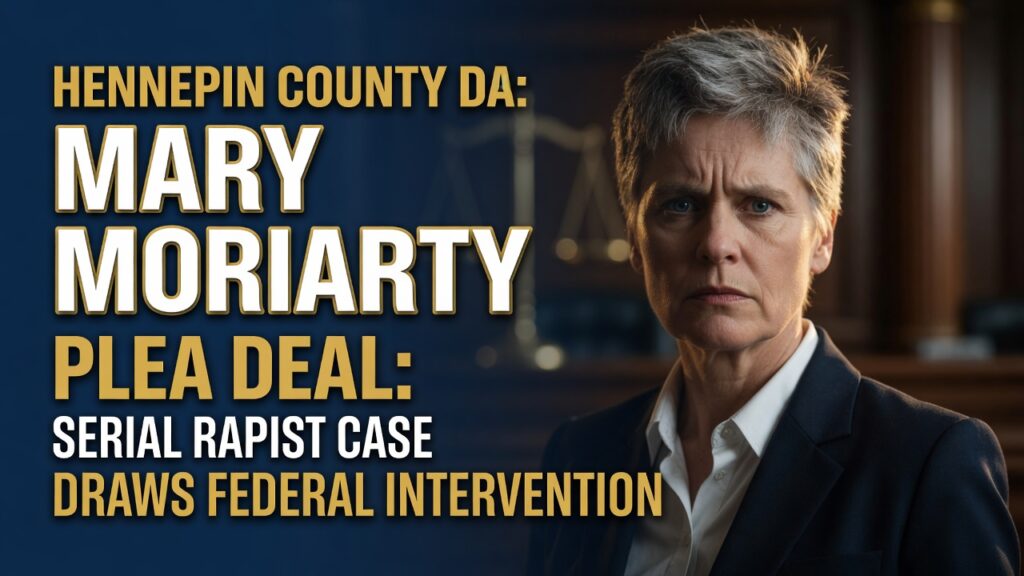
A convicted sex offender was handed probation after raping multiple women — then the feds had to take over. As the case of Abdimahat Bille Mohamed sends shockwaves across Minnesota, millions of Americans are asking: who is actually protecting the public, and who will be held accountable when the system fails?
A woman texted her sister from a hotel room: “I think I’m getting kidnapped.” No one came in time. By the time police pieced together what had happened, Abdimahat Bille Mohamed had already held her captive for nearly a week, raped her twice, and choked her into compliance. He did it less than four months after walking out of a Hennepin County courtroom on probation — having served zero days in prison for prior rape convictions.
This is not a hypothetical failure of progressive criminal justice policy. It is a documented, court-record-confirmed sequence of events that unfolded in Minnesota in 2025, and it raises urgent questions about the judgment of the officials voters trust to keep them safe.
Support Independent Local Journalism
TheTownHall.News is a non-profit reader-supported journalism. Just $5 helps us hire local reporters, investigate important issues, and hold public officials accountable across Alameda County. If you believe our community deserves strong, independent journalism, please consider donating $5 today to support our work.What Did the Hennepin County Plea Deal Actually Look Like?
The facts of this case are worth examining carefully, because the details are more alarming than most headlines have conveyed. Abdimahat Bille Mohamed, 28, was charged in 2024 with multiple counts of first-degree Criminal Sexual Conduct — the most serious rape charge under Minnesota law — for assaulting a 15-year-old girl in 2017 and an adult woman in 2024. The Hennepin County Attorney’s Office, led by Mary Moriarty, had even filed notice that it intended to seek an upward departure from standard sentencing guidelines, signaling the severity with which it initially viewed the crimes.
Then came the reversal. In May 2025, both cases were resolved through a combined plea to two counts of fifth-degree Criminal Sexual Conduct — the lowest felony sexual conduct charge available under Minnesota law. Under state sentencing guidelines, that charge carries a stayed (non-executed) sentence for first-time felony offenders. Mohamed was credited with 364 days of time already served and released on five years of probation.
A man with DNA evidence linking him to the rape of a 15-year-old girl walked out of court without serving a single additional day in prison. Under the original charges, sentencing guidelines called for a presumptive commitment of 144 months — twelve years — for a single first-degree CSC conviction with no prior criminal history.
“The sentencing guidelines suggest a presumptive 144-month prison commitment for a single 1st degree CSC conviction — instead, he walked free on probation.”
Was a Third Assault Deliberately Left Off the Table?
It gets worse. An FBI affidavit filed as part of federal charges reveals that Moriarty’s office did not simply negotiate the two known cases down to lesser charges. According to the affidavit, as part of the May 2025 plea agreement, the Hennepin County Attorney’s Office explicitly agreed not to charge a third sexual assault — a May 2018 kidnapping and rape in which Mohamed and an accomplice forced a woman into a car, drove her to a Minneapolis alley, and assaulted her at gunpoint.

The affidavit states directly: “As part of the plea agreement, the Hennepin County Attorney’s Office agreed that the 2018 under investigation would not be charged.” When Alpha News pressed Moriarty’s office for an explanation, it received no response. Her subsequent public statement addressed neither the 2018 case nor the decision to suppress it within the plea deal.
Three separate rape cases. Two reduced to the lowest felony charge. One buried entirely in a negotiated agreement. If this is what “securing a conviction” looks like, what does failure look like?
What Happened After Mohamed Was Released?
Prosecutors, judges, and corrections officials all assured the system was working. It was not. Mohamed was required, as a condition of probation, to stay off the internet without approval. He was back on Snapchat within months.
In September 2025, he used the platform to contact a woman in Mankato, drove to pick her up under the pretense of getting food, and told her — once she was locked in his car — “you are not going home.” He drove her 70 miles to a hotel in Bloomington, where he held her for nearly a week, raped her twice, choked her, and confiscated her phone when she tried to reach her sister for help. She eventually escaped by jumping from his moving vehicle.
5 confirmed victims. At least 8 years of predatory conduct. Zero days served in prison before the federal government finally intervened.
Support Independent Local Journalism
TheTownHall.News is a non-profit reader-supported journalism. Just $5 helps us hire local reporters, investigate important issues, and hold public officials accountable across Alameda County. If you believe our community deserves strong, independent journalism, please consider donating $5 today to support our work.That statistic demands one unavoidable question: at what point does a system stop being a failure and start being a choice?
What Do Supporters of This Policy Actually Believe?
This is a fair question worth engaging directly. Moriarty and her defenders have argued that the weakened plea was a prosecutorial necessity, not a political preference. Her office stated that the loss of “critical witnesses” substantially undermined the strength of the case, and that fifth-degree CSC convictions still secured a felony record and sex offender registration for Mohamed. She has also accused the Trump Administration’s DOJ of cynically politicizing a sexual assault case to inflame anti-immigrant sentiment and harm Minnesota’s Somali community.
These are not frivolous points. Witness loss is a real obstacle in sexual assault prosecutions. Sex offender registration does carry consequences. And the intersection of immigration enforcement with criminal prosecution has genuine constitutional dimensions worth scrutinizing.
But the counterargument does not survive contact with the FBI affidavit. Prosecutors did not simply lose witnesses — they proactively agreed, in writing, to shield a third assault victim’s case from prosecution as a bargaining chip. DNA evidence, one of the most reliable forms of forensic proof available, linked Mohamed to multiple victims. The argument that the state’s hands were tied collapses when its own lawyers were tying them.
The question isn’t whether the system faces real challenges in prosecuting sexual violence — it does. The question is whether those challenges justify releasing a man with DNA-confirmed multiple rape cases onto the streets with zero prison time.
Is This the Accountability Moment Minnesota Has Been Waiting For?
Federal prosecutors charged Mohamed in December 2025 with two counts of kidnapping carrying a mandatory minimum of 20 years and a maximum of life in federal prison. Attorney General Pamela Bondi stated plainly: “If Minnesota will not protect its own people, the Department of Justice will do it for them.” The FBI also opened a national tip line — 1-800-CALL-FBI — to identify potential additional victims.
Mary Moriarty announced in August 2025, before the Bloomington kidnapping became public, that she would not seek re-election in 2026. Whether that decision reflects political calculation, personal exhaustion, or genuine self-assessment, the consequences of her tenure will outlast her time in office.
The Center of the American Experiment, a Minnesota policy organization, described the Mohamed case as a “systemic failure” involving the county attorney, public defenders, multiple district court judges, and the corrections system — a collective breakdown that left a violent serial predator free to commit crimes that were, in retrospect, entirely predictable.
The voters of Hennepin County — and every jurisdiction watching this case — face a fundamental question about what they are willing to accept from their elected prosecutors.
Key Questions This Story Raises:
- Why did Hennepin County’s plea agreement explicitly protect a third rape case from prosecution, and who authorized that decision?
- What accountability mechanisms exist when a prosecutor’s charging decisions directly precede a preventable violent crime?
- Should federal intervention in state-level sexual assault cases become standard practice when local jurisdictions demonstrably fail to incapacitate violent repeat offenders?
The real question this case leaves every voter with is not whether the system failed — it is whether anyone in a position of authority will face real consequences for that failure, or whether the next victim will simply be the price we pay for looking the other way.
What do you think — is it too late to demand accountability from the officials who made these decisions? Share this article and weigh in.
Still have questions? Subscribe for daily coverage of the stories that affect your community. Think others need to hear this? Share the article with someone who should know. Want to make your voice count? Contact your local county attorney’s office or reach your Minnesota state representatives at mnleg.state.mn.us and demand transparency in plea negotiations involving violent offenders.