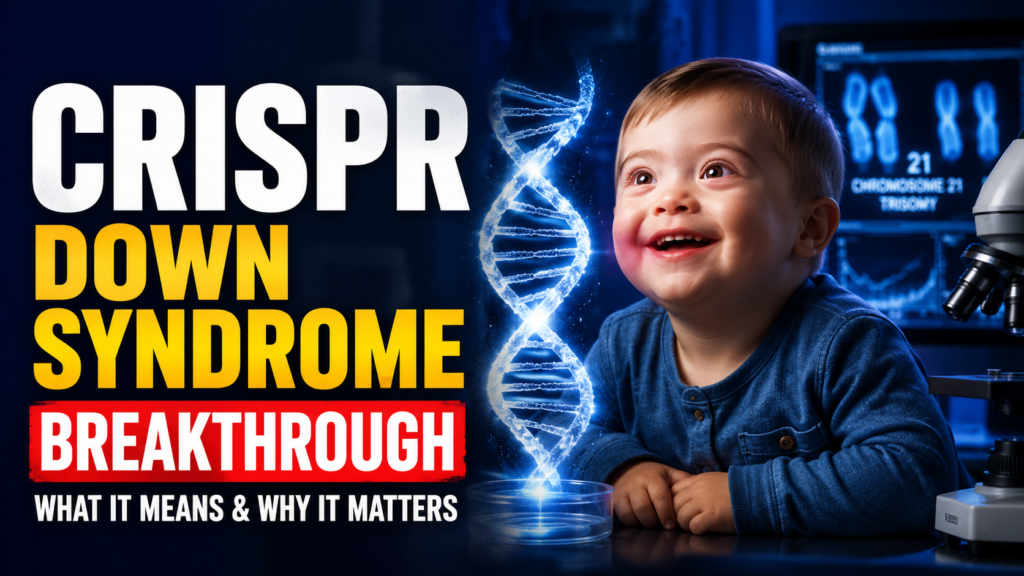
CRISPR Down Syndrome Breakthrough: What It Means and Why It Matters
Japanese scientists have successfully deleted the extra chromosome that causes Down syndrome — in lab cells. The harder question is what happens next.
Science moved faster than the conversation this week. Researchers at Mie University in Japan announced they had used CRISPR-Cas9 gene editing to remove the extra copy of chromosome 21 responsible for Down syndrome — not in a patient, not in an embryo, but in laboratory-grown human cells. The result was published in PNAS Nexus in February 2025 and has since traveled across every major news wire. The science is real. The ethics debate that should accompany it has barely begun.
This matters right now because gene-editing technology is no longer a theoretical concern. It is funded, it is published, and it is advancing toward clinical trials. The question citizens, parents, and lawmakers need to ask is not whether CRISPR works — it demonstrably does — but who decides what it is used for, on whom, and under what oversight.
Support Independent Local Journalism
TheTownHall.News is a non-profit reader-supported journalism. Just $5 helps us hire local reporters, investigate important issues, and hold public officials accountable across Alameda County. If you believe our community deserves strong, independent journalism, please consider donating $5 today to support our work.What Did the Japanese Researchers Actually Prove?
The answer is both impressive and limited, and that gap deserves attention. The Mie University team, led by Dr. Ryotaro Hashizume, used a technique called allele-specific editing to target and delete only the extra copy of chromosome 21 while leaving the normal pair untouched. They tested the approach on induced pluripotent stem cells and skin fibroblasts derived from individuals with Down syndrome.
The results were notable. After editing, treated cells showed more normal gene expression patterns — genes involved in nervous system development became more active, while those associated with inflammation were dialed down. The cells also grew faster and behaved more typically than untreated counterparts. The team achieved chromosome elimination rates between 13% and 37.5%, depending on the conditions used.
This is the first time scientists have directly targeted the chromosomal root cause of Down syndrome — not its symptoms, not its secondary effects, but the extra chromosome itself.
What the research did not prove is equally important. It has not been tested in living patients. It has not been shown to be safe. And some CRISPR cuts in the study affected healthy chromosomes — a known risk called off-target editing that researchers acknowledge must be resolved before any clinical application is considered.

Is This a Medical Milestone or the Opening of a Much Darker Door?
That tension is the honest heart of this story. Viewed purely as a scientific achievement, this research is extraordinary. Down syndrome affects approximately 1 in 700 newborns in the United States [CDC data], making trisomy 21 the most common chromosomal disorder in the country. Millions of families live with it. Effective treatments that address its root cause rather than its symptoms would represent a genuine medical advance.
But the same technology that could one day reduce cognitive disability through targeted cell therapy could also be pointed in directions that carry far heavier moral freight. In Iceland, Down syndrome has been nearly eliminated — not through medicine, but through prenatal screening followed by abortion in nearly 100% of confirmed cases. That precedent is not ancient history. It is ongoing, and it has been widely reported and debated in European human rights circles.
“The question isn’t whether we can remove a chromosome. The question is whether a society that can do so will ever stop asking which chromosomes come next.”
CRISPR does not inherently lead to eugenics. But the absence of a serious public and regulatory conversation about where gene editing ends creates the conditions under which eugenics — under softer language — becomes normalized incrementally.
Who Is Really in Charge of This Research?
37.5%. That is the highest chromosome elimination rate the Mie University team achieved in controlled laboratory conditions. The question no one in the science press is asking loudly enough: what happens to that number once pharmaceutical investment, competitive pressure, and regulatory shortcuts enter the picture?
Currently, no international treaty governs germline gene editing — edits that would be heritable, passed to future generations — with binding enforcement. The closest attempt, a 2019 call for a global moratorium from the World Health Organization, produced a framework document, not a law. The United States has a patchwork of FDA regulations and NIH guidelines, but no comprehensive statute governing the use of CRISPR in human cellular research aimed at clinical translation.
Support Independent Local Journalism
TheTownHall.News is a non-profit reader-supported journalism. Just $5 helps us hire local reporters, investigate important issues, and hold public officials accountable across Alameda County. If you believe our community deserves strong, independent journalism, please consider donating $5 today to support our work.If Congress has not passed a law governing CRISPR in humans by the time this technique is ready for trials, who exactly will be doing the governing?
This is not an abstract concern. He Jiankui, the Chinese scientist who edited the genomes of human embryos in 2018, operated outside his country’s ethical guidelines and produced the world’s first gene-edited babies before anyone could stop him. He was sentenced to prison. The babies are growing up.
What Do Supporters of This Research Actually Believe?
This is a fair question, and it deserves a fair answer. Proponents of CRISPR-based Down syndrome research make several serious arguments. First, they argue that the goal is therapeutic, not eliminationist — the aim is to develop cell-based treatments for people already living with Down syndrome, not to screen embryos or alter future pregnancies. Stem-cell therapies using corrected cells could, in theory, repair neural tissue without requiring any changes to reproduction or prenatal testing.
Second, they note that families living with Down syndrome deserve the same access to emerging medical research as families affected by any other genetic condition. Withholding scientific inquiry on ethical grounds that may never materialize is its own form of harm.
Third, researchers emphasize that clinical application is years — possibly decades — away. The current success rates, the off-target editing risks, and the delivery challenges for neural tissue all represent substantial unsolved problems.
These arguments are legitimate. The response is not to stop the science, but to build the governance architecture now, while the technology is still in laboratory cells and not in patients.
Are Parents and Citizens Being Left Out of This Conversation?
They largely are, and that is a failure of institutions, not individuals. The Mie University study was published in February 2025. It circulated widely in science media in the summer of 2025. It has received almost no meaningful attention in policy circles, legislative hearings, or parental rights forums — the spaces where decisions with generational consequences are typically debated.
Parental rights advocates who have spent years defending informed consent in medical and educational settings should be at the forefront of this conversation. The same principle that says a parent has the right to know what is being taught to their child, or what vaccine schedule their pediatrician recommends, applies here: parents of children with Down syndrome — and parents of future children — deserve a seat at the table before clinical frameworks are built around them.
If this technology moves from lab cell to clinical trial without a public debate, the people most affected will have had the least say.
What do you think — is it too late to start asking these questions before the science outruns the safeguards? Share this article and tell us where you stand.
Key Questions
- If CRISPR-based Down syndrome therapy reaches clinical trials, what regulatory body has the authority — and the mandate — to approve or reject it?
- At what point does treating a genetic condition become selecting against a type of person, and who draws that line?
- Are the families of people with Down syndrome being included in the research and ethics conversations that will shape this technology’s future?
The Science Is Moving. Is Our Judgment Keeping Up?
The Mie University breakthrough is real, significant, and worth following closely. It is not, yet, a cure. It is not, yet, a threat. But it is a signal — the clearest one to date — that humanity is approaching a set of decisions about genetic difference, disability, and human value that will not wait for a convenient legislative session.
The researchers themselves have been careful. Dr. Hashizume has emphasized that precision, safety, and long-term study are prerequisites for any clinical use. The science, in other words, is proceeding with more caution than the public conversation around it.
The real question isn’t whether this technology will eventually reach people — it’s whether the frameworks to govern it responsibly will be built before or after it does.
Still have questions about where gene-editing policy stands? Subscribe to The Town Hall for daily coverage of the issues that actually affect your life. Think others need to hear this? Share the article and start the conversation. Want to make your voice count? Contact your congressional representative and ask what position they take on federal CRISPR oversight legislation.