Did an Ohio Mayor ‘s War on a School Book Cross the Line or Wake Parents Up?
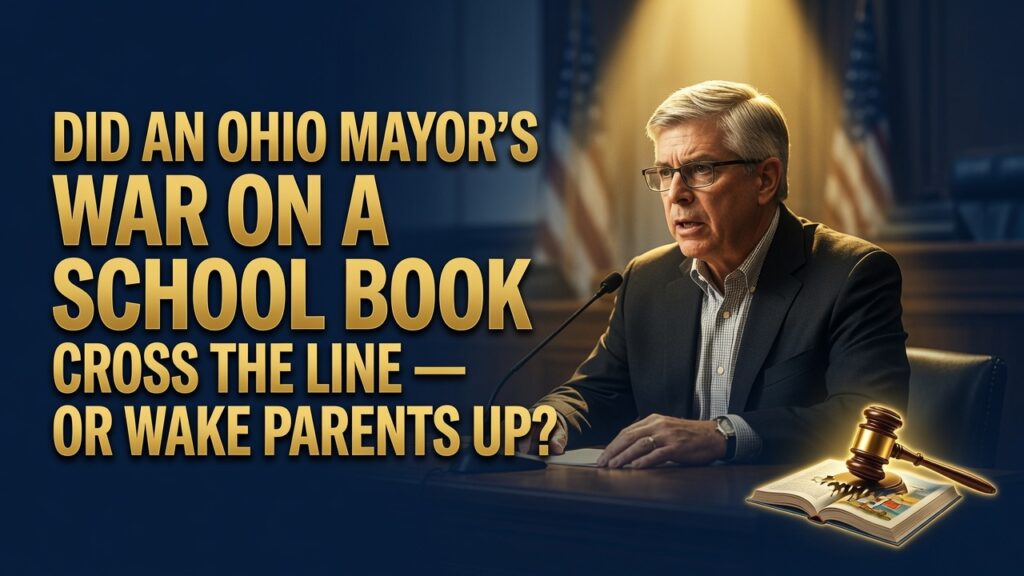
A legitimate parental grievance collided with a mayoral ultimatum that didn’t survive legal scrutiny — and what was left exposed a real question schools still need to answer.
Parents have every right to know what their children are reading in class. What happens when the official defending that right goes too far — and hands the other side an easy win?
That question sits at the center of a September 2021 school board meeting in Hudson, Ohio, that briefly made national headlines, then quietly faded from the news cycle. It keeps resurfacing on social media, stripped of context, repackaged as breaking outrage. The full story is more complicated than any viral clip suggests — and more instructive.
Support Independent Local Journalism
TheTownHall.News is a non-profit reader-supported journalism. Just $5 helps us hire local reporters, investigate important issues, and hold public officials accountable across Alameda County. If you believe our community deserves strong, independent journalism, please consider donating $5 today to support our work.What Was Actually in the Book?
The book at the center of the controversy was a paperback journal titled 642 Things to Write About, which had been used as supplemental material in a senior writing course for more than five years. It was not a standard textbook. Published by Chronicle Books and compiled by the San Francisco Writers’ Grotto, the journal is marketed as a creative writing tool containing 642 prompts designed to stimulate the imagination and break writer’s block. WKYCChronicle Books
Among the prompts that caught parents’ attention: “Write a sex scene you wouldn’t show your mom. Rewrite the sex scene from above into one that you let your mom read. Describe your favorite part of a man’s body using only verbs.” Parent Monica Haven read several of these aloud at the board meeting. Her message to the board was direct: “I hope each and every one of you is as uncomfortable as I am after reading that.” News 5 Cleveland
The discomfort was warranted. The material was adult-oriented, and parents had not been specifically informed it was in the book. That much of the complaint is defensible on its face.
Parents had a right to know this material existed in their children’s classroom. The question is whether what came next helped or hurt that cause.

What Did the Mayor Actually Do?
Hudson Mayor Craig Shubert attended the board meeting and told members: “It has come to my attention that your educators are distributing essentially what is child pornography in the classroom. I’ve spoken to a judge this evening and she’s already confirmed that. So I’m going to give you a simple choice: either choose to resign from this board of education or you will be charged.” Complex
The ultimatum drew immediate national attention. It also began unraveling almost immediately.
A joint statement from the Hudson Police Department and the Summit County Prosecutor’s Office confirmed the mayor had misrepresented his conversation with a judge. The prosecutor’s office was unambiguous on the legal question: “Under Ohio law, a prompt about a fictional writing is not child pornography.” Comic SandsWKYC
“The reckless conduct by Hudson’s Mayor resulted in threats, fear, and hate-filled words from around the country. The people behind those threats were uneducated about the matter and accepted the word of Mayor Shubert because of his elected position, not because of any fact.”
— Summit County Prosecutor Sherri Bevan Walsh
That is not the language of a mild disagreement. It is a prosecutorial finding that the mayor’s intervention caused direct harm to public servants while misusing the weight of elected office.
What Do Supporters of the Mayor’s Position Actually Believe?
This is the fair question to engage. Many parents and conservative commentators argued that Shubert was doing what elected officials almost never do: showing up, speaking plainly, and refusing to treat parental objections as nuisances to be managed. In a political environment where school boards have frequently dismissed community concerns about curriculum content, the instinct to escalate is understandable.
Support Independent Local Journalism
TheTownHall.News is a non-profit reader-supported journalism. Just $5 helps us hire local reporters, investigate important issues, and hold public officials accountable across Alameda County. If you believe our community deserves strong, independent journalism, please consider donating $5 today to support our work.The supporters have a point about the underlying issue. A book with adult writing prompts — including explicit sexual content — had been sitting in a high school class for five years without meaningful scrutiny. Principal Brian Wilch acknowledged as much during the meeting: “We did not exercise due diligence when we reviewed this resource. And as a result, we overlooked several writing prompts among the 642 that are not appropriate for our high school audience.” That admission matters. News 5 Cleveland
But the question of whether the book contained inappropriate material is separate from the question of whether those responsible committed child pornography. The mayor conflated the two, and the legal system — including a Republican county prosecutor — said clearly that he was wrong. The prosecutor’s investigation found the allegations were false and resulted in numerous threats against board members, faculty, and administrators. The parents who had a legitimate complaint found themselves associated with a mayor who had fabricated a legal endorsement of his position. WKYC
Crying “child pornography” when the law says otherwise doesn’t protect children. It discredits the people who are genuinely trying to.
Did the School Do Anything Wrong?
Yes — and that part of the story deserves more attention than it receives in the viral retellings.
The district says it was first made aware of the writing prompts on September 10. Since then the board collected the books from students and discontinued their use. The school moved quickly once the issue surfaced — but five years passed before it did. That is a curriculum review failure, not a criminal conspiracy. The principal said so himself. WKYC
The course required a signed waiver from parents acknowledging that a college-level environment might include mature themes. That waiver is relevant context. It does not excuse the specific prompts — a waiver for “mature themes in a college environment” is not informed consent for sexually explicit writing exercises. But it complicates the narrative that parents were kept entirely in the dark. WKYC
642 things. Five years. Nobody noticed. That is the accountability question schools should answer — not through resignations under political pressure, but through a serious review of how supplemental materials get approved and what oversight exists once they are in classrooms.
Is This Story Still Relevant?
Curriculum transparency fights have not gone away. Since 2021, dozens of states have passed or considered legislation expanding parental notification requirements, restricting certain classroom materials, and creating formal review mechanisms for supplemental content. The Hudson case is one of the earlier examples of a local conflict going national — and it set a template, for better and worse.
The template it set for parents: show up, speak up, and don’t assume the school is handling it. That part holds.
The template it set for elected officials: weaponize parental anger, make unverifiable legal claims, and let the outrage do the political work. The prosecutor’s final assessment was stark: the episode appeared to be a staged political stunt timed to affect an upcoming election, with the mayor continuing to promote false theories even after being told he was wrong. WKYC
The community of Hudson paid a real price for that. Board members received threatening messages. Faculty were harassed. The legitimate conversation about curriculum standards got buried under a legal claim that had no foundation.
If a public official invokes criminal law to settle a political score, who actually holds him accountable?
Key Questions
- If the book had been in the curriculum for five years without triggering a review process, what does that say about how schools approve supplemental materials — and who is responsible for fixing it?
- When a mayor makes false legal claims at a public meeting that lead to threats against educators, what recourse does the community have beyond a recall petition?
- Does the parental rights movement gain or lose credibility when its most visible advocates overstep the facts — and does it matter?
The Hudson story is not about a heroic mayor taking on a rogue school board. It is not about a school board deliberately exposing children to pornography. It is about a real oversight failure in a curriculum review process, a legitimate parental complaint that deserved a serious response, and a political intervention that made everything worse and then called itself accountability.
The parents of Hudson were right to be concerned. They deserved better from their mayor.
The real question is not whether someone should be held responsible for what ended up in that classroom. Someone should. The question is whether manufactured outrage — legal claims that don’t hold up, threats to public servants, national media storms built on misrepresentation — is what accountability is actually supposed to look like.
Think this story raises questions your community needs to hear? Share it and weigh in — what should the standard be for how schools review classroom materials? Subscribe to The Town Hall for coverage that gives you the full picture.