H-1B Visa Fraud and Texas Housing Crisis: What Homeowners Need to Know in 2026
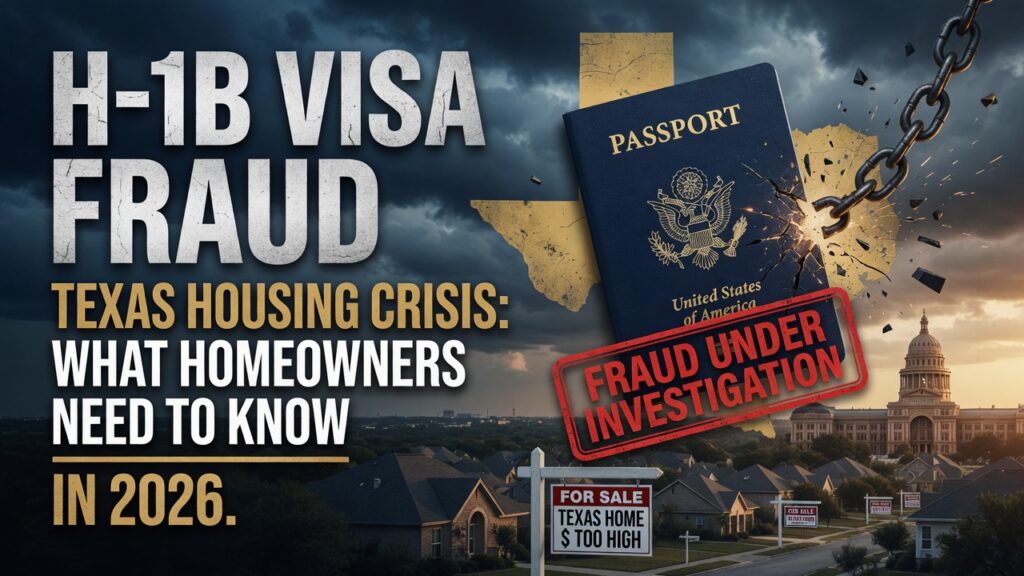
A luxury housing boom built on immigration-driven demand is unwinding across Dallas suburbs — and the questions about who is responsible, and who will absorb the losses, are only getting louder.
Nobody was supposed to notice until it was too late.
For nearly a decade, the outer suburbs of Dallas — Frisco, Prosper, Celina — experienced one of the most concentrated housing booms in American history. Builders rushed to meet the demand. Schools were planned. Roads were funded. Entire communities were designed around assumptions baked into one government program: the H-1B visa. Now those assumptions are cracking, home prices in the affected counties are falling at nearly double the regional average, and Texas taxpayers, homebuilders, and local governments are being left to sort through the consequences of a system that rewarded volume over oversight.
Support Independent Local Journalism
TheTownHall.News is a non-profit reader-supported journalism. Just $5 helps us hire local reporters, investigate important issues, and hold public officials accountable across Alameda County. If you believe our community deserves strong, independent journalism, please consider donating $5 today to support our work.What Actually Happened in North Texas?
The numbers are striking. South Asian buyers — the overwhelming majority on H-1B visas, with Indian nationals accounting for roughly three-quarters of all approvals in fiscal year 2023 [Pew Research Center] — became the dominant force in luxury new-home purchases across Collin and Denton counties. At Tradition Homes, a family-owned builder in the region, South Asian buyers once represented approximately 70% of sales. Entire subdivisions were designed with puja rooms — traditional Hindu prayer spaces — and secondary “spice kitchens” as standard features. The area earned its own nickname: “Dallaspuram.” The Dallas area received nearly 32,000 new H-1B approvals over the four-year period ending September 2024 [federal USCIS data], topping Silicon Valley, Seattle, and San Francisco. That pipeline was treated as permanent. It was not.
South Asian buyers once made up 70% of luxury home sales in some North Texas subdivisions. Today that figure has fallen below 30% — and 125 homes are sitting unsold at one builder alone.
Who Is Really Behind the Fraud?
The fraud piece of this story is real — and it runs deeper than many realize. Texas Attorney General Ken Paxton launched a sweeping investigation in January 2026 and has since expanded it to nearly 30 North Texas businesses suspected of H-1B visa abuse. The scheme is specific: companies registered single-family homes as office addresses, listed worksites at empty or unfinished buildings, and set up sham websites advertising nonexistent products — all to fraudulently sponsor H-1B visas. These are not edge cases. Paxton’s office has issued Civil Investigative Demands to entities including Tekpro IT LLC, 1st Ranking Technologies, Qubitz Tech Systems, and several others.
Federal prosecutors had already moved before the state. In June 2025, two North Texas men were indicted on H-1B and green card fraud charges involving shell companies, in a case USCIS described as part of a “large-scale immigration fraud scheme.” The fraud documented by investigators is primarily employer-side — sham companies gaming the sponsorship system — rather than individual homebuyers falsifying mortgage documents. That distinction matters for accuracy. But it does not reduce the systemic damage. When the visa pipeline was built on fabricated employers, the workers it brought in and the real estate market that depended on them were resting on a foundation that was never sound.

“When you get fewer people receiving H-1B visas, you get an immediate negative surprise — because you have housing that has already been built for those people sitting on the market.” — Eli Beracha, Florida International University, Journal of Real Estate Research [2025]
Is This What Happens When Government Stops Asking Questions?
The broader policy environment accelerated the collapse. In September 2025, President Trump signed a proclamation raising the H-1B petition fee to $100,000 — up from a prior range of roughly $700 to $1,500. The administration simultaneously directed the Department of Housing and Urban Development to bar non-permanent residents, including H-1B visa holders, from accessing FHA-insured mortgages, effective May 25, 2025. The share of FHA loan volume issued to non-permanent residents fell from 6% in April 2025 to less than 1% by June [John Burns Research and Consulting]. A February 2026 federal rule replaced the random H-1B lottery with a salary-weighted selection system. Texas Governor Greg Abbott ordered an immediate freeze on new H-1B petitions by state agencies and public universities. Each of these decisions, taken individually, was defensible. Taken together, they simultaneously acknowledged how dependent a major regional economy had become on a temporary visa program — while pulling that program’s oxygen.
The H-1B application fee went from roughly $1,500 to $100,000 overnight. The question now is who absorbs the shock — the workers who planned their lives around it, or the communities that built around them?
What Do the Numbers Actually Tell Us?
Home prices in Collin County’s northern suburbs — the epicenter of the boom — fell nearly 9% year-over-year as of February 2026, according to Redfin data. That is more than double the 4% drop recorded across the broader Dallas-Fort Worth metro. Tech sector job losses, with AI consistently cited as the primary driver, surpassed 123,000 nationally by early summer 2026. Builders who tailored entire product lines to South Asian preferences — puja rooms, spice kitchens, Vastu-compliant floor plans — are now sitting on unsold inventory with no clear buyer pool. Local governments that planned school construction and road expansion around projected population growth face the prospect of that growth reversing. The fiscal implications for Collin and Denton counties have not yet been fully quantified, but the direction is unambiguous.
9% year-over-year price decline in Collin County. The question every North Texas homeowner needs to ask: who was stress-testing these assumptions before the market was built around them?
What Do Supporters of This Program Actually Believe?
Supporters of the H-1B program argue — with significant evidence — that high-skilled immigration is essential to American competitiveness in technology, engineering, and medicine. They point out that the overwhelming majority of H-1B holders are legitimate, credentialed professionals who pay taxes, purchase homes, and contribute to local economies. The housing boom in North Texas, they note, was a genuine economic success story: Collin County’s Indian population grew from roughly 70,000 to over 116,000 in five years [census data], generating enormous tax revenue, school enrollment, and commercial activity. The fraud, they argue, was committed by employers gaming a sponsorship system — not by workers who built lives, businesses, and communities in good faith.
Support Independent Local Journalism
TheTownHall.News is a non-profit reader-supported journalism. Just $5 helps us hire local reporters, investigate important issues, and hold public officials accountable across Alameda County. If you believe our community deserves strong, independent journalism, please consider donating $5 today to support our work.That argument has merit, and it deserves to be taken seriously. But it sidesteps the accountability question. A program that generated 32,000 approvals in the Dallas metro alone over four years, while enforcement infrastructure remained thin enough for nearly 30 ghost-office operations to go undetected, is a program that was not being run responsibly. Personal responsibility has to extend to institutions. The question is not whether skilled immigrants deserve opportunity — they do. The question is whether the federal government exercised the oversight that both taxpayers and program participants were entitled to expect.
Is Anyone Being Held Accountable?
Some accountability is arriving, belatedly. Paxton’s investigation is ongoing. Federal indictments have been handed down. The $100,000 petition fee, whatever its other effects, effectively ends the ghost-office model by pricing out the staffing intermediaries who made it possible. But accountability for the communities, builders, and local governments left holding the consequences remains abstract. There is no mechanism to compensate a school district that overbuilt capacity on the assumption of population growth that evaporated. There is no framework for homeowners — many of them visa holders themselves — who purchased in good faith at peak prices and now face a market that has moved sharply against them.
If the federal government created conditions for this boom, and then reversed those conditions without transition planning, who is responsible for the fallout? That question deserves a direct answer.
The Cost of Looking Away
The 2008 financial crisis taught a specific and painful lesson about what happens when an entire sector of the economy is built on assumptions that regulators declined to examine. The North Texas situation is not 2008 — housing analysts and market data do not support that comparison, and it is important to say so plainly. There is no evidence of a systemic wave of fraudulent mortgage origination, no derivatives exposure amplifying the risk, no threat of broader financial contagion at the scale of the last crisis. What it is, instead, is a more localized version of the same core failure: allowing a concentrated economic dependency to develop without ever asking what would happen if the underlying conditions changed.
The answer to that question is now visible in the northern suburbs of Dallas, in the backlog of 125 unsold homes at a single builder, in the 9% price decline in Collin County, in the schools and roads planned around a pipeline that turned out to be subject to executive action, judicial challenge, and enforcement reversal at any time. That is the consequence of government programs being treated as permanent infrastructure rather than temporary policy. And the cost of that category error, as usual, is being paid by the people who were never part of the decision.
Key Questions
- If federal enforcement agencies knew ghost-office H-1B fraud was widespread in North Texas, why did investigation take until 2026 to reach scale?
- What obligation — legal or moral — does the federal government have to communities and builders who structured their economic planning around visa programs it later reversed?
- If this pattern holds in other H-1B-dependent metro areas — New York, New Jersey, California, Washington, Virginia — who is running the stress tests?
What do you think — was this a predictable failure that no one wanted to name, or an unavoidable correction? Share this article and tell us where you stand. Still have questions? Subscribe for daily coverage. Want to make your voice count? Contact your congressional representative and ask what oversight measures are in place for H-1B employer sponsorships.