Could Amivantamab Be the Most Important Cancer Drug in a Generation?
A single injection dissolved whole tumors in patients who had already exhausted every other option. The results are in, the experts are calling them “unprecedented” — and the race to approve this drug is now on.
When a cancer treatment makes whole tumors disappear in patients given no other hope, it demands attention. That is exactly what happened in a major international clinical trial of amivantamab, a bispecific antibody developed by Johnson & Johnson — and the scientific community is not using the word “unprecedented” lightly.
The OrigAMI-4 trial, conducted across 55 hospitals in 11 countries, enrolled 102 patients with head and neck squamous cell carcinoma whose disease had already resisted both immunotherapy and platinum-based chemotherapy. These were people at the end of the conventional road. What happened next is rewriting what oncologists believed was possible.
Support Independent Local Journalism
TheTownHall.News is a non-profit reader-supported journalism. Just $5 helps us hire local reporters, investigate important issues, and hold public officials accountable across Alameda County. If you believe our community deserves strong, independent journalism, please consider donating $5 today to support our work.What Did the Trial Actually Find?
The numbers are striking on their own. Tumors shrank in 43 of the 102 patients treated with subcutaneous amivantamab — a 42 percent overall response rate in a population where existing salvage therapies typically produce responses in only 21 to 24 percent of cases. But the figure drawing the most attention is this: in 15 of those patients, the tumors disappeared completely.
15 patients. Complete tumor elimination. In people whose cancer had already beaten chemotherapy and immunotherapy.
Professor Kevin Harrington of the Institute of Cancer Research in London, who led the trial team at the Royal Marsden NHS Foundation Trust, described the results plainly: “These are unprecedentedly strong responses in patients whose disease has become resistant to both chemotherapy and immunotherapy.” The responses were also rapid — visible within weeks of the first injection — and durable, with the median duration of response not yet reached at nearly a year of follow-up.
For context, head and neck squamous cell carcinoma is the sixth most common cancer worldwide, affecting approximately 12,800 people in the United Kingdom each year alone. In the United States, the American Cancer Society estimates over 66,000 new cases of oral cavity and pharyngeal cancers annually. Patients whose cancer returns after standard treatment face a grim prognosis. Amivantamab is changing that calculus.

How Does a Drug Like This Actually Work?
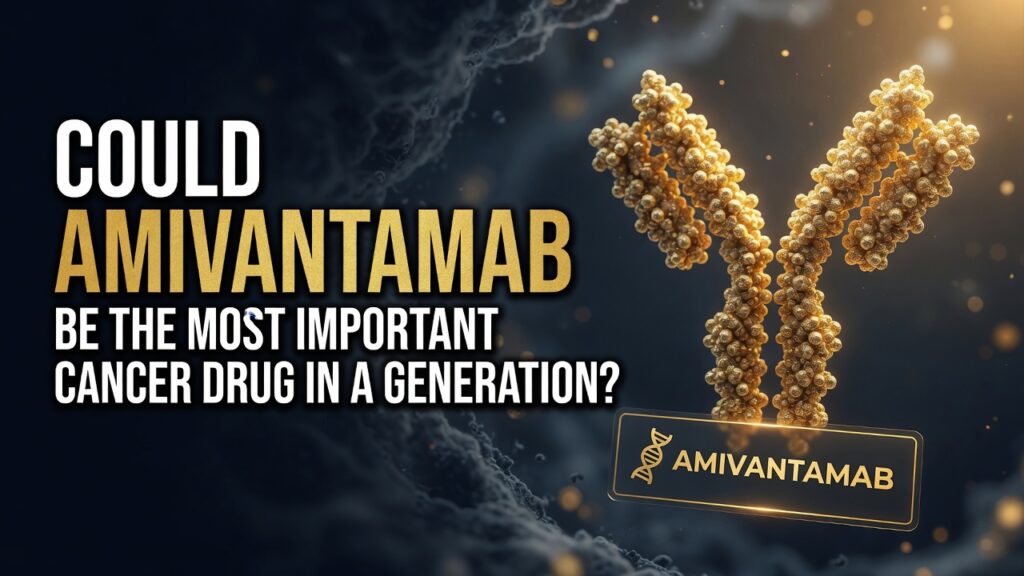
Amivantamab is not a conventional chemotherapy agent. It is a bispecific antibody, meaning it is engineered to lock onto two separate targets simultaneously — EGFR (epidermal growth factor receptor) and MET, two proteins that drive tumor growth and allow cancer cells to evade destruction. By blocking both pathways at once while also engaging the body’s own immune cells, the drug attacks tumors through multiple mechanisms at the same time.
“These are unprecedentedly strong responses in patients whose disease has become resistant to both chemotherapy and immunotherapy.” — Professor Kevin Harrington, Institute of Cancer Research, London
This dual-targeting approach is what makes amivantamab structurally different from older therapies that block only one pathway, allowing tumors to adapt and resist through the other. The drug, marketed as Rybrevant Faspro in its subcutaneous form, is administered as an injection rather than an intravenous infusion — a meaningful quality-of-life difference for patients already enduring physically demanding treatment regimens.
The subcutaneous formulation was also notable for its safety profile. Administration-related reactions occurred in only 13 percent of patients, and all were mild to moderate. Just six patients — six percent of the trial cohort — discontinued treatment due to side effects.
What Happens Next for Patients Who Need This Now?
The FDA is already moving. Earlier this year, the agency granted amivantamab Breakthrough Therapy Designation for HPV-unrelated advanced head and neck cancer — a designation reserved for drugs that show substantial improvement over available therapies for serious conditions. Johnson & Johnson has submitted a supplemental Biologics License Application seeking formal approval for this indication.
42%. That is the response rate amivantamab achieved in patients who had no remaining standard treatment options. The question is: how many patients are running out of time while the approval process runs its course?
Support Independent Local Journalism
TheTownHall.News is a non-profit reader-supported journalism. Just $5 helps us hire local reporters, investigate important issues, and hold public officials accountable across Alameda County. If you believe our community deserves strong, independent journalism, please consider donating $5 today to support our work.The pivotal data were presented at the 2026 American Society of Clinical Oncology Annual Meeting in Chicago on May 31 and simultaneously published in the Journal of Clinical Oncology — the field’s most authoritative peer-reviewed journal. That dual release signals the scientific community’s confidence in these findings. A Phase 3 trial, OrigAMI-5, is already enrolling, evaluating amivantamab in combination with pembrolizumab and carboplatin as a first-line treatment — meaning the drug could eventually reach patients earlier in their disease course, before other therapies have failed.
Is the Medical Establishment Moving Fast Enough?
The FDA’s Breakthrough Therapy Designation accelerates the review process, but patients with recurrent or metastatic head and neck cancer do not measure time in regulatory quarters. For those individuals, the gap between a confirmed scientific result and an accessible prescription can be the difference between life and death.
The drug is already approved for multiple lung cancer indications. In December 2025, the FDA approved the subcutaneous formulation of amivantamab for all previously approved EGFR-mutated non-small cell lung cancer indications. Just this week, the agency approved a once-monthly dosing schedule for subcutaneous amivantamab combined with lazertinib for first-line lung cancer treatment — simplifying an already promising regimen. The clinical infrastructure for this drug is expanding rapidly.
What advocates and patients are watching closely is whether the head and neck cancer approval follows the same pace, or whether bureaucratic timelines extend the wait for a population already facing the worst odds.
What Do Supporters of the Current Approval Timeline Actually Believe?
Defenders of the FDA’s standard review process make a legitimate point: speed without rigor creates its own dangers. The OrigAMI-4 results, while remarkable, come from a Phase 1b/2 study — an earlier-stage trial designed to evaluate safety and early efficacy, not the large-scale Phase 3 randomized trial that typically anchors a full approval. The ongoing OrigAMI-5 Phase 3 trial will provide the controlled, head-to-head comparison data that regulators need to confidently quantify benefit versus risk across a broader patient population.
Proponents of the current process also note that Breakthrough Therapy Designation is itself an acceleration tool — it opens the door to rolling review and frequent FDA guidance, compressing the timeline significantly compared to standard review. The supplemental BLA has already been submitted, meaning the formal clock is running.
These are fair arguments. But they exist within a system that has historically under-served patients with rare or aggressive cancers who cannot afford to wait. The OrigAMI-5 trial’s primary completion is estimated for years away. The tension between scientific caution and human urgency is real, and it does not resolve itself.
A Drug That Is Already Changing Outcomes
Carl Walsh, a 56-year-old patient who was diagnosed with tongue cancer in May 2024, enrolled in the OrigAMI-4 trial at the Royal Marsden in July 2025 after chemotherapy and immunotherapy both failed. His case represents exactly the population this drug is designed to serve — patients who have run the gauntlet of standard care and found no answer on the other side.
The amivantamab portfolio is now active in more than 60 clinical trials spanning multiple cancer types, including colorectal cancer, where a Phase 3 trial is currently recruiting patients in a head-to-head comparison against cetuximab. The science is moving. The question is whether the systems designed to evaluate and deliver it are moving fast enough to keep pace with the patients counting on them.
If a drug can make whole tumors disappear in patients given no other options, what does it say about our health system if it takes years to reach them?
Key Questions
- When will the FDA formally approve amivantamab for head and neck cancer — and what can patients do in the meantime to access it through trials or expanded access?
- Will the Phase 3 OrigAMI-5 results confirm the complete response rates seen in OrigAMI-4, or are these outcomes specific to the earlier trial population?
- As amivantamab expands into colorectal and other cancer types, which patient populations stand to benefit next — and how quickly will those approvals follow?
The real question is not whether amivantamab works — the evidence at hand is among the most compelling the oncology world has seen in years. The question is whether the patients who need it most will be alive to receive it by the time every bureaucratic box is checked. That is a question worth asking loudly.
Think others need to hear about this breakthrough? Share the article and start the conversation. Still have questions? Subscribe for daily coverage of the stories that matter. Want to make your voice heard on research funding and drug approval timelines? Contact your congressional representative and ask where they stand on expedited approval for breakthrough cancer therapies.