Is the Gaza Aid Crisis Finally Breaking the World’s Silence — or Too Late?
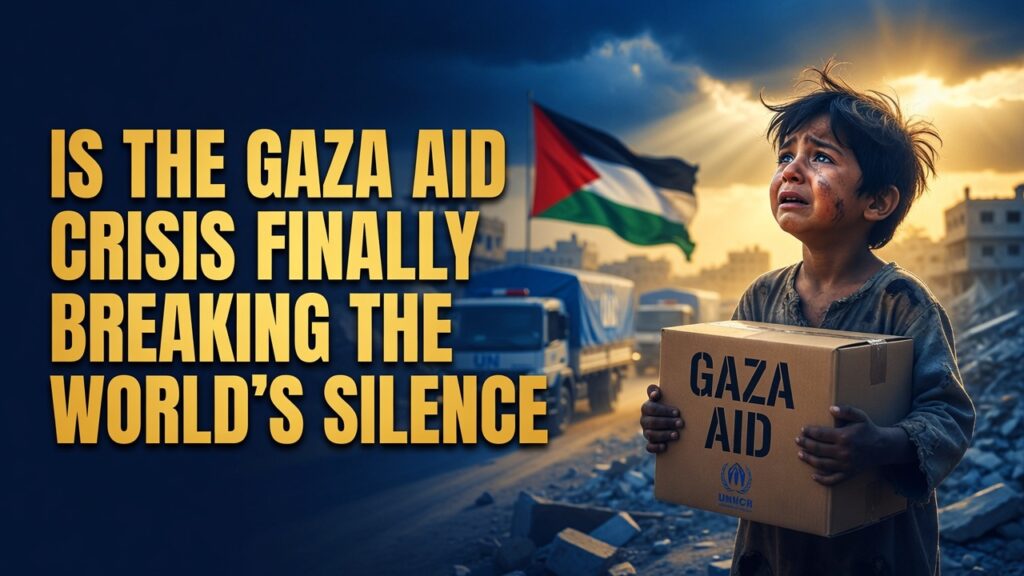
Nearly a million people still need emergency shelter. The ceasefire is fraying. And the UN’s emergency fund is only 13 percent funded. At what point does silence become a choice?
The numbers do not lie — but the people responsible for acting on them often do. As of June 2026, the humanitarian situation in Gaza remains, by every credible metric, one of the worst ongoing crises on the planet. A ceasefire brokered in October 2025 was supposed to change that. It hasn’t — not nearly enough.
The question is no longer whether the crisis is real. The question is whether the institutions and governments claiming to care about it are doing anything proportionate to its scale.
Support Independent Local Journalism
TheTownHall.News is a non-profit reader-supported journalism. Just $5 helps us hire local reporters, investigate important issues, and hold public officials accountable across Alameda County. If you believe our community deserves strong, independent journalism, please consider donating $5 today to support our work.What Do the Numbers Actually Tell Us?
The scale of what has unfolded in Gaza since October 7, 2023 is staggering in the most literal sense. According to UNRWA’s Situation Report #220, more than 72,599 Palestinians had been killed in the Gaza Strip by late April 2026, with over 172,411 injured. UNRWA itself has recorded 391 of its own colleagues killed — aid workers, not combatants — since the war began [UN agency data].
Those are not statistics. They are people. And every week that passes without meaningful accountability is a week the number grows.
Thirty percent of all those killed have been children, according to a June 2026 UN Commission of Inquiry report. The commission found that Israel has continued to deliberately target Palestinian children — describing the pattern as constituting genocide, war crimes, and crimes against humanity. Even after the October 2025 ceasefire, the commission noted, children continue to be killed with what it described as “continued disregard” for the protections owed to them under international law [UN Independent International Commission of Inquiry on the Occupied Palestinian Territory].
72,599. That is the confirmed Palestinian death toll as of late April 2026 — and the question no government in the West has convincingly answered is: what number would finally be enough to trigger binding action?

Is the Ceasefire Working — or Just Providing Cover?
A ceasefire is supposed to stop the killing. The one brokered in October 2025 was presented as a turning point. In January 2026, U.S. Special Envoy Steve Witkoff announced that the agreement was moving into Phase Two — focused on Hamas disarmament, governance arrangements, and the gradual withdrawal of Israeli forces, which still control more than half of Gaza’s territory.
What has actually happened since is something closer to managed deterioration.
The ceasefire exists on paper. On the ground, conflict monitors warn that Israeli bombardment has accelerated since a separate U.S.-Israel ceasefire in the Iran conflict was reached last month. Raids in the occupied West Bank are intensifying. A UN envoy, addressing the Security Council in May 2026, warned that the deteriorating status quo risks becoming “permanent” — a divided Gaza, with Hamas retaining military control over two million civilians and no disarmament in sight.
“The risk is that the deteriorating status quo becomes permanent: a divided Gaza, Hamas holding military and administrative control over two million people.” — Nickolay Mladenov, UN Board of Peace High Representative, May 2026
The international stabilization force envisioned by the October 2025 framework has not yet been formed. Contributing nations have not been confirmed. The governance transition remains stalled. What was supposed to be an off-ramp has become, for most Gazans, more of the same.
Who Is Really Paying for This Policy?
The UN’s 2026 Flash Appeal was designed to address the most urgent needs across Gaza and the West Bank. It seeks more than $4 billion to support nearly three million people. As of the latest reporting, it is approximately 13 percent funded [UN data, May 2026].
Support Independent Local Journalism
TheTownHall.News is a non-profit reader-supported journalism. Just $5 helps us hire local reporters, investigate important issues, and hold public officials accountable across Alameda County. If you believe our community deserves strong, independent journalism, please consider donating $5 today to support our work.Thirteen percent.
This is not a resource problem. The nations capable of filling that gap in a single budget line — the United States, the European Union, Gulf states — have collectively pledged billions to defense arrangements in the same period. The money exists. The political will does not.
If the international community can mobilize resources for every other crisis faster than it can fund the most documented humanitarian emergency of the decade, that is not a logistics failure. That is a values failure.
On the ground, organizations like World Central Kitchen report they are delivering hundreds of thousands of hot meals daily — one of the largest food relief operations anywhere in the world. But WCK’s response director has said clearly that financial sustainability is now as serious a challenge as operational access. The organization is funded overwhelmingly by private donations, not governments. That is who is actually paying for this policy: private citizens, not the states that created the conditions for it.
What Do Supporters of the Current Approach Actually Believe?
Those who defend the current pace of international response make arguments worth engaging seriously. They point out that the October 2025 framework did achieve a real ceasefire — however imperfect — after more than two years of full-scale conflict. They note that aid volumes into Gaza have increased since the ceasefire compared to the months preceding it. They argue that demanding immediate, unconditional access ignores the legitimate security concerns of a nation that suffered a major terrorist attack on its own soil in October 2023. And they maintain that the governance transition requires careful sequencing — that rushing disarmament or political restructuring could destabilize what fragile calm exists.
These are not irrational positions. A permanent ceasefire with governance structures is more valuable than a temporary pause that collapses into worse conflict. Sequencing matters.
But the response to those arguments must be equally direct: sequencing is being used as a delay mechanism. Israeli forces still control more than half of Gaza. Settlement expansion in the West Bank is accelerating, with plans for over 2,200 new housing units advanced in recent months alone. The UN’s emergency fund is 87 percent unfunded. And the commission of inquiry has found that even after the ceasefire, children are still being killed with apparent systematic intent.
At what point does “careful sequencing” become a phrase that means “indefinite inaction”?
Are the Children of Gaza Being Failed by Every Institution Designed to Protect Them?
The June 2026 UN Commission of Inquiry report is not a political document. It is the product of a body established by the UN Human Rights Council, examining alleged violations of international law with reference to evidence. Its findings — genocide, war crimes, crimes against humanity — carry specific legal meaning under international law.
The report found that Israel’s targeting of neonatal and maternity care centers directly endangered Palestinians’ reproductive future. It documented how the aid blockade of 2025 caused starvation-related deaths and a collapse in immunization rates. It found that 238 children were killed in the occupied West Bank alone between October 2023 and April 2026 — in addition to the 30 percent of Gaza’s total death toll accounted for by minors.
Is this the accountability moment the international legal system was built for — and if so, why are the institutions that were supposed to act still deliberating?
Meanwhile, nearly a million people across Gaza still lack adequate shelter. UNRWA teams are responding to outbreaks of scabies and waterborne diseases in overcrowded displacement sites. There is a severe shortage of pesticides, anti-lice shampoos, and basic hygiene materials.
These are not the conditions of a post-ceasefire recovery. They are the conditions of an ongoing emergency being managed at the minimum level the world has decided is acceptable.
Key Questions This Story Demands Answers To:
- Why is the UN’s $4 billion emergency appeal only 13 percent funded, and which specific governments have failed to contribute?
- What are the legal consequences — if any — for a state found by a UN commission to have committed genocide against children, and who enforces them?
- When does the international stabilization force envisioned by the October 2025 framework actually deploy, and what happens to Gaza’s civilians if it doesn’t?
The real question at the center of this crisis is not whether the suffering in Gaza is real — the documentation is overwhelming. The real question is whether the governments and institutions that have spent two and a half years expressing concern are willing to move from statements to consequences. The answer to that question will define not just what happens in Gaza, but what international law and humanitarian norms are actually worth in the 21st century.
Think others need to hear this? Share the article and add your voice. Still have questions? Subscribe for daily coverage of the stories that demand accountability. Want to make your voice count? Contact your elected representative and ask them directly: why is the UN’s Gaza appeal only 13 percent funded?