Iraq Sends Tanks Into the Green Zone: 47 Arrested in Anti-Corruption Sweep Targeting Pro-Iran Network
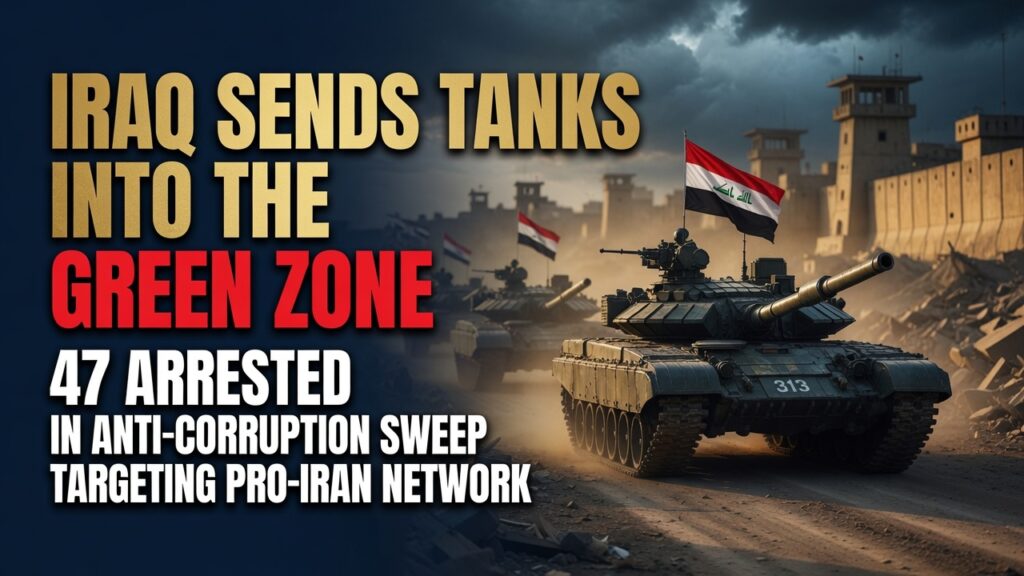
Iraqi elite forces raided Baghdad’s most fortified district before sunrise Sunday, arresting at least 47 officials including sitting members of parliament. The story being told is about corruption. The story underneath is about who controls Iraq.
On the morning of June 28, 2026, Baghdad woke up to the sound of armored vehicles rolling through the Green Zone — the heavily fortified two-square-mile enclave on the west bank of the Tigris River that houses the U.S. Embassy, foreign diplomatic missions, parliament, and the residences of Iraq’s most powerful politicians. Black Humvees belonging to the elite Counter Terrorism Service (CTS) fanned out through the streets before dawn. Checkpoints sealed the main gates. Gunfire rang out.
By the time the sun rose over Baghdad, Iraq’s most powerful district had been locked down by its own government — and dozens of the country’s most connected officials were in handcuffs.
Support Independent Local Journalism
TheTownHall.News is a non-profit reader-supported journalism. Just $5 helps us hire local reporters, investigate important issues, and hold public officials accountable across Alameda County. If you believe our community deserves strong, independent journalism, please consider donating $5 today to support our work.Iraq’s state news agency INA confirmed that 47 suspects were arrested on corruption charges, including sitting members of parliament whose parliamentary immunity had been formally lifted prior to the operation. The Commission of Integrity — Iraq’s anti-graft body — stated that authorities were executing judicial arrest warrants against officials accused of misappropriating public funds.
But those who follow Iraq closely know that in Baghdad, nothing is ever just about corruption.
What Did the Confessions of a Buried Oil Minister Unlock?
The arrests trace back to one man: Adnan al-Jumaili, the former Deputy Oil Minister for refining affairs, detained last month on corruption charges. In a case that has shaken Iraq’s notoriously graft-ridden energy sector, authorities seized more than $85 million in cash connected to al-Jumaili — some of it literally buried underground.
When investigators started pulling on that thread, they found a rope that reached into the Green Zone itself.

INA quoted a senior official stating that the Sunday sweep was carried out based on confessions made by al-Jumaili during interrogation. Those confessions implicated members of parliament, senior officials, businessmen, and, critically, individuals linked to pro-Iranian factions. A separate security source told AFP that the charges went beyond financial corruption to include “funding factions and the smuggling of dollars and Iranian oil” — a direct reference to Tehran-backed armed groups that have operated inside Iraq’s political and financial structures for years.
INA released the names of 15 arrestees: 12 current lawmakers, one former legislator, a former senior advisor to ex-Prime Minister Mohammed Shia al-Sudani, and a high-ranking oil ministry official. Some came from al-Sudani’s Shiite political bloc; others from the Azm Alliance, an influential Sunni party whose leader Muthanna al-Samarrai was widely rumored overnight to be among those detained.
In a single pre-dawn operation, Iraq’s new prime minister moved against figures from across the sectarian map — Shiite, Sunni, pro-Iran, and everything in between.
Why Sunday? Why Now? The Washington Answer.
Iraq’s new Prime Minister Ali al-Zaidi took office in May 2026 with an unusual origin story. A businessman and political newcomer, he emerged as a compromise candidate after the U.S. reportedly vetoed the return of the more Iran-aligned former PM Nuri al-Maliki. Washington froze certain dollar asset transfers to Baghdad earlier this year specifically to pressure Iraqi politicians away from forming a pro-Iran government.
The message worked. Zaidi came to power with two explicit promises: fight corruption, and restore a state monopoly on weapons — meaning disarm the dozen-plus Iran-backed militias, most designated as Foreign Terrorist Organizations by the United States, that have operated in Iraq for years with near-total impunity.
Support Independent Local Journalism
TheTownHall.News is a non-profit reader-supported journalism. Just $5 helps us hire local reporters, investigate important issues, and hold public officials accountable across Alameda County. If you believe our community deserves strong, independent journalism, please consider donating $5 today to support our work.Zaidi is scheduled to visit Washington in mid-July.
A diplomat in Baghdad told AFP bluntly that Sunday’s operation “is part of the Washington visit preparations” — Zaidi needed to show up to the White House with proof of delivery, not just promises.
U.S. Secretary of State Marco Rubio has publicly spotlighted the threat of Iranian-backed militias in Iraq in recent weeks, including at a Gulf Cooperation Council meeting in Bahrain where member states formally condemned drone attacks by Iranian proxies operating from Iraqi soil against Gulf civilian infrastructure. The GCC statement explicitly called on Baghdad to disarm non-state armed groups.
A senior Iraqi security official told AFP after the raids: “What has happened today is only the simple beginning.”
Iran Was Watching — From Inside the Room
The timing of the raids carried its own diplomatic signal, one almost too pointed to be coincidental.
Even as CTS units were executing warrants across the Green Zone, Iranian Foreign Minister Abbas Araghchi was in Baghdad for a surprise visit — one not publicly announced until the night before, which analysts noted was unusual. During the visit, Araghchi promised to expand Tehran’s cooperation with the new Iraqi government in all sectors.
Iraq’s new government was arresting Tehran’s political allies in one part of Baghdad while meeting with Tehran’s top diplomat in another.
The tension is not new, but its open expression is. Iraq has long walked a tightrope between Washington and Tehran — two powers with deeply competing interests who both have leverage over Baghdad. The U.S. provides security partnerships and controls dollar flows critical to Iraq’s oil-dependent economy. Iran has two decades of built-in political, economic, and social networks running through Iraq’s institutions at every level, and proxy militias capable of destabilizing any government that moves too aggressively against them.
Zaidi’s stated position attempts a careful balance. He has said Iraq “does not accept dictates from any party” and does not follow a policy of “blocs or hostility,” framing his country as a bridge rather than a battlefield. But the math of Sunday’s raids tells a different story: when you arrest pro-Iran parliamentarians while Iran’s foreign minister is visiting, you are making a choice.
Is This a Genuine Reckoning or a Performance?
That is the question hanging over Baghdad.
The skeptical read: Iraq has seen corruption investigations before. Rarely do they reach the most powerful actors. A pre-Washington-trip sweep designed to produce optics is not the same as systemic accountability. The Soufan Center, in a recent analysis, noted that similar investigations of past attacks by Iran-aligned groups “did not result in any prosecutions or deter the armed groups from repeating their attacks.”
The more optimistic read: the scale and boldness of Sunday’s operation is genuinely unprecedented. Arresting sitting members of parliament inside the Green Zone — in a district that has historically been untouchable — represents a qualitative shift. At least two major armed groups have reportedly signaled willingness to hand over weapons to the state. Influential Shiite cleric Muqtada al-Sadr has announced his militia, Saraya al-Salam, will integrate into the national command structure. The momentum is real, even if the destination is uncertain.
Political science professor Talib Muhammed Karim told Asharq Al-Awsat that Zaidi “is not going to Washington carrying a project to eliminate militias in the military sense, but rather a project to strengthen the state and restore its legitimate monopoly over the use of force.”
The distinction matters enormously. Dismantling Iran’s influence in Iraq is not a military mission — it is a decades-long structural challenge that no single dawn raid can resolve.
Key Questions
- Will the prosecutions hold? Arrest waves in Iraq have historically stalled in a judicial system vulnerable to political pressure. Whether these cases reach conviction will determine whether this is reform or theater.
- How will pro-Iran factions respond? The groups whose financiers and political allies were arrested Sunday still control significant armed capacity. A backlash — political, economic, or violent — is a real possibility.
- What does Zaidi bring to Washington? The mid-July visit will be a defining moment. U.S. investment in Iraq’s oil-devastated economy is the prize Zaidi is seeking. Sunday’s raids were his opening bid.
- Where does the $85 million trail lead? Al-Jumaili’s confessions apparently named dozens of officials. Investigators have said this is only the beginning. The full scope of the corruption network — and how deep into the political system it goes — remains to be seen.
The Green Zone was built after 2003 to keep the chaos of post-invasion Iraq outside its concrete walls. On Sunday morning, the Iraqi government sent its own tanks through those gates — not to defend against the outside, but to clean out the inside. Whether that signals the beginning of a genuine reckoning or a calculated performance for a Washington audience is the question Iraq — and its partners — will be watching very closely in the weeks ahead.