Riot in Beirut: Did Lebanon ‘s Government Just Sign Away Its Sovereignty?
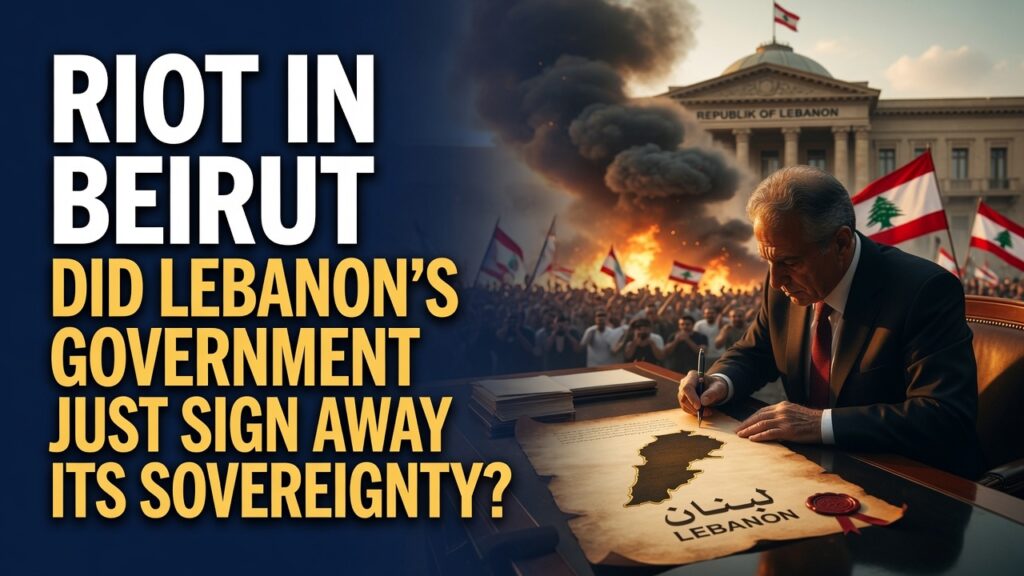
A U.S.-brokered framework signed in Washington is being celebrated in some capitals — but in Beirut, streets are on fire and the question of who governs Lebanon has never been more urgent.
Sovereignty is not a word governments surrender lightly. But in Beirut, on the night of June 27, 2026, ordinary citizens were asking whether their own government just did exactly that.
Hours after Lebanese and Israeli ambassadors signed a trilateral framework agreement at the U.S. State Department in Washington, Hezbollah supporters flooded the streets of the Lebanese capital — motorcycles roaring through central Beirut, burning tires blocking the road to the international airport, and Iranian flags flying in the southern suburbs of Dahieh. The Lebanese army deployed with tear gas to reopen the airport road. A public prosecutor issued a judicial order to identify and prosecute rioters. Lebanon’s fragile civil peace, already stretched by years of economic ruin and political rot, was bending again under the weight of a deal its own people did not author and were not asked to approve.
Support Independent Local Journalism
TheTownHall.News is a non-profit reader-supported journalism. Just $5 helps us hire local reporters, investigate important issues, and hold public officials accountable across Alameda County. If you believe our community deserves strong, independent journalism, please consider donating $5 today to support our work.What Did Lebanon Actually Sign?
The agreement is officially a Trilateral Framework between the United States, Israel, and Lebanon, signed June 26, 2026, after five rounds of talks in Washington brokered by Secretary of State Marco Rubio. On its face, it is a structured roadmap: the Lebanese Armed Forces would restore “effective sovereign authority over all Lebanese territory,” Israeli forces would begin a sequenced withdrawal from occupied southern Lebanon, and — critically — Hezbollah would be fully disarmed and dismantled as a condition for Israeli military departure.
Israel committed to withdrawing from two initial areas south of the Litani River as a pilot program, transferring them to Lebanese military control. But Israeli Prime Minister Benjamin Netanyahu was explicit: IDF forces would remain in Lebanon “as long as Hezbollah is not disarmed.” The agreement also requires Lebanon and the United States to block reconstruction funds from flowing to any entity affiliated with non-state armed groups — a provision that effectively targets Hezbollah’s political and social infrastructure, not just its weapons.
Rubio called it “the beginning of the beginning.” Lebanese President Joseph Aoun called it “the first step on the path towards Lebanon restoring its sovereignty.” Lebanese Prime Minister Nawaf Salam said the deal “aims to achieve Israel’s withdrawal from all Lebanese territories.”
The question no one in Washington answered at the signing ceremony: what happens when Hezbollah, which controls large parts of Lebanon, refuses to disarm?

Is This Peace — or a New Kind of Occupation?
Since March 2, 2026, Israel has waged a sustained air and ground offensive across southern Lebanon, Beirut, and the Bekaa Valley. More than 4,000 people have been killed, according to the Lebanese Ministry of Public Health. Approximately one-fifth of Lebanon’s territory remains under Israeli military occupation. On the very day the framework was signed, Israeli airstrikes killed two people in the town of Mayfadoun, and the IDF dropped evacuation leaflets over al-Mansouri — neither action paused for the diplomacy happening seven thousand miles away in Washington.
20% of Lebanon’s population has been displaced by fighting since the Israeli offensive began in March. The question the framework does not answer: where do they go if Israeli forces stay indefinitely pending Hezbollah’s disarmament?
That sequencing is the core of the controversy. The deal does not force Israel out. It conditions Israeli withdrawal on verified Hezbollah disarmament — a benchmark that could extend Israeli military presence in Lebanon indefinitely, since Hezbollah has flatly refused to comply and retains significant military capability.
“If a government signs away conditions it cannot enforce, on a timeline it cannot control, to satisfy a foreign power that is still bombing its territory — is that diplomacy, or is it capitulation?”
Supporters of the deal argue it is the only realistic path to ending a war that Lebanon did not choose and cannot win alone. Critics argue it rewards Israeli military aggression with a permanent legal foothold.
What Do Hezbollah and Its Allies Actually Believe?
Hezbollah Secretary-General Naim Qassem declared the Washington agreement “null and void” and called it “humiliating, shameful and a surrender of sovereignty.” His position is coherent on its own terms: Hezbollah views itself as Lebanon’s primary deterrent against Israeli military power, a role the Lebanese Armed Forces have historically been unable to fill. Qassem argues that disarmament before full Israeli withdrawal amounts to unilateral surrender, and that the Iran-U.S. memorandum of understanding — which separately called for “the immediate and permanent termination of military operations on all fronts, including Lebanon” — should serve as the actual basis for ending the conflict.
Support Independent Local Journalism
TheTownHall.News is a non-profit reader-supported journalism. Just $5 helps us hire local reporters, investigate important issues, and hold public officials accountable across Alameda County. If you believe our community deserves strong, independent journalism, please consider donating $5 today to support our work.Hezbollah MP Mohammad Raad went further, accusing the Lebanese government of “complete submission to America and the Zionist enemy.” Hezbollah lawmaker Hassan Fadlallah warned that enforcing the deal would require moving “toward civil war.” Yemen’s Houthis, an Iran-backed proxy, amplified that warning, declaring the deal would lead to “a devastating Lebanese civil war or a direct Zionist occupation of Lebanon.”
These are maximalist positions from an armed group with obvious interests in preserving its weapons. But the underlying challenge is real: the Lebanese government committed to achieving “complete and verified disarmament of all non-state armed groups” — a commitment the Lebanese state has never been able to fulfill in three decades of trying, and which no international agreement has ever achieved on Lebanese soil.
Are Lebanese Citizens Paying the Price for a Deal They Never Chose?
Lebanon did not enter this war by democratic consensus. Hezbollah’s decision to resume rocket strikes on Israel following the assassination of Iranian Supreme Leader Ali Khamenei in February 2026 drew immediate criticism from Lebanese politicians and citizens who understood that their country — already economically devastated, already structurally broken — would bear the cost of that decision.
If a militia can drag an entire nation into a regional war without a popular mandate, and a government can then sign a peace framework without public deliberation, the question of who actually governs Lebanon deserves a clear answer.
The Lebanese economy has not recovered from the 2019 financial collapse, the 2020 Beirut port explosion, or the years of political deadlock that followed. The displacement of roughly 20% of the population since March has deepened a humanitarian crisis already beyond the state’s capacity to manage. International reconstruction funds — which the framework agreement specifically restricts from flowing to Hezbollah-linked entities — may be the only lifeline. Whether those funds actually reach Lebanese citizens, rather than being captured by the same political networks that have looted the country for decades, is an accountability question the agreement does not resolve.
What Happens If the Deal Collapses?
Analysts are skeptical. Ahron Bregman, a senior teaching fellow in the Department of War Studies at King’s College London, described the framework as an attempt “to drive a wedge between the Lebanese and Iranian fronts” — and added that it “won’t work, not in a million years.” The core tension is structural: Israel insists it will only leave when Hezbollah is disarmed; Hezbollah insists it will not disarm until Israel leaves; and the Lebanese government has committed to achieving both outcomes without the military or institutional capacity to enforce either.
Netanyahu framed the deal as a strategic win, saying it allows Israel to remain in southern Lebanon as long as Hezbollah remains armed. That framing suggests Israeli forces could be entrenched in Lebanese territory for years — a reality that would transform what was brokered as a peace framework into a formalized occupation agreement.
The real danger is not that this deal fails noisily — it is that it fails quietly, while Lebanese civilians remain displaced, Israeli forces remain deployed, and the political class in Beirut declares the process ongoing.
Key Questions This Story Raises
- If Lebanon committed to verified Hezbollah disarmament, what international enforcement mechanism will ensure that commitment is met — and who pays when it isn’t?
- Netanyahu stated that Israeli forces will remain in Lebanon indefinitely if Hezbollah remains armed. At what point does a “sequenced withdrawal” become a permanent occupation?
- The framework restricts reconstruction funds from flowing to Hezbollah-linked entities — but Lebanon’s political economy is deeply intertwined with those networks. Who audits that commitment, and what leverage does the international community have if it is violated?
The Accountability Question No One in Washington Is Answering
Secretary Rubio called the deal a first step. President Aoun called it a path to sovereignty. Prime Minister Salam called it an affirmation of U.N. resolutions that have existed and been ignored for decades. What they did not address is the democratic deficit at the center of this process: a government negotiating a transformative security agreement with a neighbor it has never had diplomatic relations with, in a foreign capital, without a parliamentary vote, while its own population burns tires in the streets.
Not everyone in Lebanon opposes the deal. Maronite Christian Kataeb Party leader Samy Gemayel publicly congratulated Aoun and Salam, calling it an “achievement accomplished by the Lebanese state.” Jordan and the United Arab Emirates welcomed it. The Druze, the Christian communities, and the Sunni political establishment have largely been more receptive than Hezbollah and its Shia base. Lebanon is a sectarian mosaic, and this agreement is no exception.
But receptiveness is not the same as agency. The Lebanese people did not vote on this framework. They did not debate it in parliament. They learned about it from a State Department press release and a pre-recorded Netanyahu video while their neighborhoods were still being bombed.
The real question is not whether Lebanon’s government made the right deal. The real question is whether Lebanon’s government had the sovereign authority to make it — and whether its citizens will ever be given the chance to answer that question for themselves.
Think this story deserves a wider audience? Share it. Want daily accountability coverage? Subscribe to The Town Hall News.