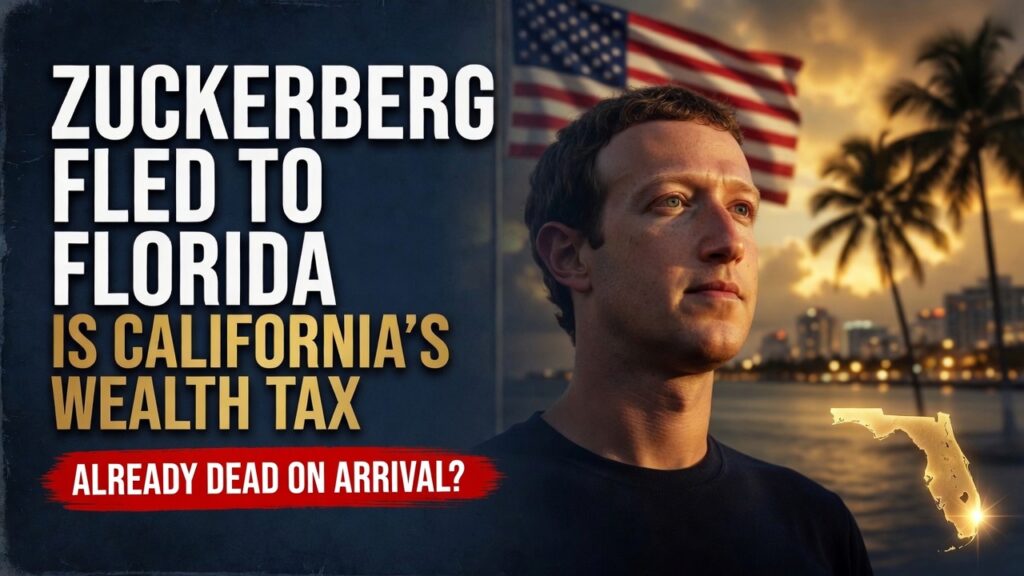
Mark Zuckerberg Fled to Florida — Is California’s Billionaire Tax Already Dead on Arrival?
What Is California Not Telling You About Its Billionaire Tax Exodus?
Before a single vote is cast, California has already lost an estimated $1.1 trillion in taxable wealth — and the people who held it are in Florida.
As the California Billionaire Tax Act officially lands on the November 3, 2026 ballot, millions of middle-class Californians are left asking the question no politician will answer directly: when the billionaires leave, who picks up the bill?
Support Independent Local Journalism
TheTownHall.News is a non-profit reader-supported journalism. Just $5 helps us hire local reporters, investigate important issues, and hold public officials accountable across Alameda County. If you believe our community deserves strong, independent journalism, please consider donating $5 today to support our work.The initiative qualified on June 17, after proponents submitted nearly double the required signatures — over 980,000 verified. It would impose a one-time 5% wealth tax on any California resident worth more than $1 billion, as of January 1, 2026, with revenues earmarked for healthcare, education, and food assistance programs. The projected haul: $100 billion. The actual outcome, if current trends hold, may be far darker for state finances.
What Does the Billionaire Tax Actually Do?
The proposal is specific. Anyone who was a California resident as of January 1, 2026, and holds a net worth exceeding $1 billion would owe 5% of that total wealth — not income, not capital gains, but the entire accumulated fortune. Payment would be due April 15, 2027, with the option to spread it across five annual installments at a 7.5% annual deferral charge on the remaining unpaid balance.
The initiative was sponsored by the Service Employees International Union-United Healthcare Workers West and co-authored by economists and tax law professors from UC Berkeley, UC Davis, and the University of Missouri. Supporters framed it as an emergency response: Congress cut roughly $100 billion in Medicaid funding through the “One Big Beautiful Bill Act” last year, and California needed a replacement source.

The fix was aimed at roughly 200 people. The problem is that many of those 200 people saw it coming.
The retroactive snapshot date of January 1, 2026 was deliberately engineered to prevent departures. It created a narrow window: stay in California on New Year’s Day 2026, and you potentially owe billions. The logic was airtight on paper. In practice, it triggered one of the largest voluntary wealth migrations in American state history.
Who Actually Left — and How Much Did They Take?
Mark Zuckerberg did not wait for November. In early 2026, he and Priscilla Chan purchased a $170 million waterfront estate on Miami’s Indian Creek Island — a private enclave of 41 homes, 24/7 security, and neighbors including Jeff Bezos and Carl Icahn. Under the wealth tax, Zuckerberg would have owed approximately $12 billion. A Meta spokesperson declined to confirm a residency change, but the scale and timing left little ambiguity.
Google co-founders Larry Page and Sergey Brin both established primary residency in Florida before the January 1 deadline. Page purchased over $173 million in real estate in Miami’s Coconut Grove. Brin acquired a $51 million waterfront mansion on Allison Island. Together, their departures represent roughly $25 billion in would-be tax revenue — gone before the initiative qualified.
Support Independent Local Journalism
TheTownHall.News is a non-profit reader-supported journalism. Just $5 helps us hire local reporters, investigate important issues, and hold public officials accountable across Alameda County. If you believe our community deserves strong, independent journalism, please consider donating $5 today to support our work.Travis Kalanick, Uber’s co-founder, completed his move to Austin on December 18, 2025. Asked about the timing, he said publicly it was “prior to January.” Peter Thiel shifted his family investment firm’s operations to Miami in late December 2025. Elon Musk, Jeff Bezos, and Larry Ellison had already relocated in prior years.
$1.1 trillion. That is the estimated taxable wealth that has effectively left California’s prospective tax base before voters cast a single ballot — and the question no Sacramento official wants to answer is: what happens to the state’s finances now?
The Hoover Institution ran the analysis. Nearly 30% of the targeted tax base departed before the initiative even qualified, collapsing the projected $100 billion revenue figure to roughly $40 billion. When long-term lost income tax revenue is factored in, the net present value of the entire initiative turns negative — by an estimated $24.7 billion.
Is California’s Own Governor the Most Important Opponent of This Tax?
Here is the detail that rarely leads the coverage: the most powerful Democrat in California is actively working to defeat this initiative.
Governor Gavin Newsom called the proposal “really damaging to the state” and told Politico it “makes no sense.” He mounted a behind-the-scenes pressure campaign to persuade the union to withdraw the measure before the June 25 ballot-finalization deadline. He offered to back a scaled-down 2% legislative levy as a compromise. The union refused. Newsom rejected the compromise anyway on the grounds that the initiative’s structural flaws remained unchanged.
When the governor of California is begging voters to reject a California tax, that is not a partisan talking point — that is a five-alarm fiscal warning.
Both leading candidates to succeed Newsom also oppose the measure. Democratic frontrunner Xavier Becerra called it “sketchy policy,” adding: “Every Californian must pay their fair share, but no billionaire should pay taxes at rates lower than teachers or nurses — but this is sketchy policy.” Republican Steve Hilton called it economy-destroying. Planned Parenthood and the California Medical Association issued a joint statement calling the initiative a “flawed response.” The bipartisan coalition against this measure is not a Wall Street astroturf campaign. It includes healthcare organizations, elected Democrats, and labor unions who simply read the fiscal projections.
California’s top 1% of earners already generate nearly 40% of the state’s income tax revenue. When that concentration of wealth leaves, the fiscal gap does not disappear. It shifts — to the middle class that remains.
What Do Supporters of This Tax Actually Believe?
The initiative’s defenders make a serious argument, and it deserves honest engagement. Economists Emmanuel Saez and Gabriel Zucman — two of the measure’s co-authors — contend that because billionaires structurally avoid income tax on most of their wealth (stock holdings that appreciate without being sold generate no taxable income until the moment of sale), the lost income tax revenue from departing billionaires is smaller than critics suggest. Their calculation: even if every targeted billionaire left California, it would take 25 years for the cumulative loss in annual income tax payments to exceed what the one-time wealth tax would raise.
Senator Bernie Sanders endorsed the measure, arguing it would close the gap between billionaires’ effective tax rates and those paid by nurses and firefighters. Congressman Ro Khanna backed it as a practical response to federal Medicaid cuts. Proponents also note that polls show early majority voter support, and that the funds would directly stabilize hospitals facing closure in communities that have no alternatives.
These are not frivolous positions. The core equity argument — that billionaires pay lower effective tax rates than working Californians — is supported by peer-reviewed research from the National Bureau of Economic Research.
But an argument that might have been correct in theory was undermined the moment it was announced publicly. The exodus it triggered has already cost California more in future income tax revenue than the initiative’s own authors projected the tax would raise. You cannot close a fiscal gap with a tax that empties the tax base before the vote.
What Happens After November — If It Even Passes?
Assume voters approve the initiative on November 3. Not a dollar is collected on November 4.
Legal scholars across the political spectrum have flagged the retroactive structure as constitutionally exposed on multiple grounds: due process violations from retroactive taxation, Dormant Commerce Clause conflicts, Equal Protection claims, and a potential collision with California’s own constitutional 0.04% cap on property-based assessments. The Tax Foundation has further warned that due to specific drafting provisions, the effective rate for some taxpayers could substantially exceed 5%.
Sergey Brin and Eric Schmidt co-founded “Building a Better California,” an opposition political committee that raised over $80 million in the first quarter of 2026. The group is pursuing three separate counter-initiatives for the November ballot: one amending the California Constitution to prohibit retroactive taxation entirely, one blocking the wealth tax from circumventing Proposition 98’s education funding rules, and a third requiring more audits of special tax revenue.
If voters approve the billionaire tax and simultaneously approve the counter-initiatives designed to nullify it, California will spend years in litigation — while the healthcare programs the tax was supposed to fund remain unfunded.
“California didn’t lose its billionaires to a tax. It lost them to the announcement of one. Every dollar that left is a dollar that will never come back — regardless of what happens in November.”
Key Questions:
- If roughly 30% of the targeted tax base has already departed, who bears the long-term cost of that lost annual income tax revenue — and will California’s middle class ever be told directly?
- Can California legally enforce a retroactive wealth tax on individuals who changed their residency before the vote — and how many years of litigation stand between the initiative passing and a single dollar being collected?
- If the governor, both gubernatorial frontrunners, and major healthcare organizations all oppose this measure, what does it mean that it qualified for the ballot anyway — and who is actually making fiscal policy in California?
California’s Billionaire Tax Act is now a live ballot question heading into November. The union that pushed it says it will save hospitals and feed children. The governor who governs the state says it will hollow out the tax base and make things worse. The economists who wrote it say the departure math is manageable. The Hoover Institution says the net result is negative by $24.7 billion.
Voters will decide. But the wealth has already voted with its feet.
The real question is not whether California’s billionaires should pay more — it is whether a state can afford to let ideology outrun arithmetic. And if this initiative fails, or passes and collapses in court, who exactly pays for the healthcare system it was supposed to rescue?
The question California cannot avoid answering is the one it has been postponing for years: when the wealthiest leave and the bill comes due, who is left to write the check?
What do you think — is it already too late for California to reverse course? Share this article and tell us.
Still have questions? Subscribe to The Town Hall News for daily coverage of the stories that matter. Think others need to hear this? Share it. Want to make your voice count? Contact your California state representative and ask them directly where the healthcare funding will come from if this initiative fails or stalls in court.