Canada Wildfire Crisis 2026: What’s Really Happening Now
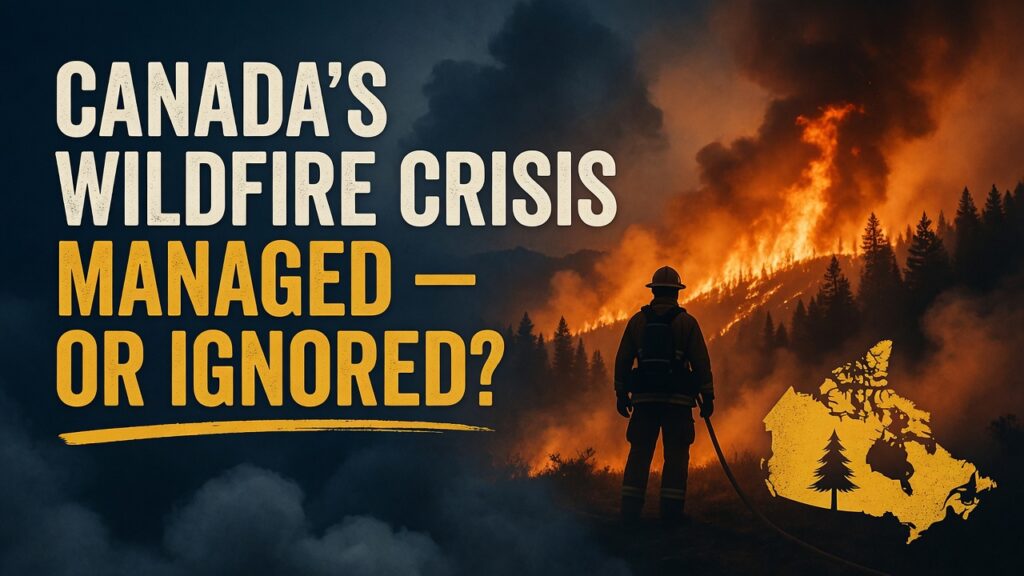
As nearly 900 fires burn across Canada, millions of Americans are choking on the smoke. The question officials keep dodging: who is actually in charge of stopping this?
Skies over Toronto turned orange this week. So did the skies over Chicago, Boston, and New York City. That is not a coincidence. It is the direct result of a wildfire season that officials themselves admit “had a slow start” and is now making up for lost time fast, with nearly 900 active fires burning from British Columbia to the Atlantic provinces as of July 17, 2026.
This matters right now because the crisis is no longer confined to Canada. Smoke has degraded air quality for an estimated 100 million Americans, closed highways, and forced First Nations communities in northwestern Ontario to evacuate with little warning after fires exploded on July 13. One firefighter has already died fighting these blazes. The season is far from over, and officials are already warning that August could be worse.
Support Independent Local Journalism
TheTownHall.News is a non-profit reader-supported journalism. Just $5 helps us hire local reporters, investigate important issues, and hold public officials accountable across Alameda County. If you believe our community deserves strong, independent journalism, please consider donating $5 today to support our work.Who Is Really in Charge of Stopping These Fires?
Wildfire response in Canada is a patchwork of federal funding, provincial firefighting agencies, and municipal emergency management — a structure that sounds coordinated on paper but often leaves individual communities scrambling when fires move fast. In northwestern Ontario, residents in at least one community were forced to carry out an emergency evacuation without the support of emergency services, according to a local leader’s public statement. That is not a minor logistical hiccup. That is a system failing the people it is supposed to protect.
If a fire can outrun the emergency response meant to protect you, who is actually accountable when it does?
Ontario has recorded 453 wildland fires so far this year, compared to 349 at the same point in 2025 and a 10-year average of 312 [Ontario Ministry of Natural Resources data]. That is not a modest uptick. It is a trend line moving in the wrong direction, year after year, while emergency infrastructure struggles to keep pace.
Is Government Spending Matching the Scale of the Problem?
Natural Resources Canada recently announced $1.25 million for six wildfire preparedness projects, including risk mapping, evacuation coordination, and training up to 38 Indigenous wildland firefighters [Government of Canada announcement]. Those are worthwhile investments. But measured against a season already producing nearly 900 simultaneous fires and cross-border smoke affecting a hundred million people, the scale of the response raises an obvious question.

$1.25 million. The question no one in Ottawa wants to answer: is that a serious commitment, or a rounding error next to the size of the crisis?
Fiscal accountability does not mean opposing wildfire funding. It means demanding that spending be proportional to risk, transparently tracked, and delivered before communities are already burning — not after.
Why Are Highways Closing and Communities Being Left in the Dark?
Highway closures have become a near-daily feature of this wildfire season, cutting off supply routes and complicating evacuations in real time. In Armstrong, Ontario, a rail worker captured video as flames closed in on a train, with a crewmember heard saying they were “encased in flames.” That is the human reality behind the statistics — and it raises a legitimate question about whether warning systems and evacuation planning are keeping pace with how fast these fires now move.
Would your family have enough warning to get out safely if this happened in your town tomorrow?
Officials say they are prioritizing “protection of life, property and infrastructure” and focusing resources where suppression is most likely to succeed. That is a reasonable operational strategy under pressure. It does not erase the fact that some communities were left evacuating without emergency support at all.
Support Independent Local Journalism
TheTownHall.News is a non-profit reader-supported journalism. Just $5 helps us hire local reporters, investigate important issues, and hold public officials accountable across Alameda County. If you believe our community deserves strong, independent journalism, please consider donating $5 today to support our work.What Do the Numbers Actually Tell Us?
The 2026 season is not yet Canada’s worst on record — that distinction still belongs to 2023. But raw totals can obscure the real story: officials themselves describe this season as marked by “the rapid expansion of large fires within a short period” rather than steady, predictable growth [CIFFC/CWFIS data]. That distinction matters. A slow-building crisis gives responders time to adapt. A rapid-expansion crisis does not.
“We’re encased in flames now.” — a rail crewmember, describing conditions near Armstrong, Ontario, as fire closed in on a train
That single sentence captures what statistics alone cannot: how quickly “manageable” becomes “emergency” on the ground.
What Do Supporters of Canada’s Current Wildfire Policy Actually Believe?
Defenders of the current approach make a fair point worth engaging honestly: wildfire seasons are inherently unpredictable, and no amount of funding can prevent fires from starting when heat, drought, and wind align. They argue that Canada’s firefighting agencies are stretched thin because the scale of this season is genuinely unprecedented in its speed, not because of policy failure, and that the $1.25 million in new preparedness funding represents meaningful, targeted investment rather than a token gesture.
There is real merit here. Climate conditions are a legitimate driver, and no government fully controls where lightning strikes or where drought hits hardest. But preparedness and response speed are within government control, and that is precisely where accountability belongs. Funding decisions, evacuation coordination, and communication systems are policy choices — not weather. When a community evacuates without emergency support, that is a planning failure, not a forecasting one. Acknowledging the role of weather does not excuse under-resourced response infrastructure.
What Happens If No One Demands Better Answers?
Every wildfire season that passes without a serious accounting of what worked and what failed makes the next season’s failures more predictable. Communities in northwestern Ontario are living that reality right now, with homes already destroyed and more fires still active. Without pointed questions from taxpayers, voters, and a free press, the pattern repeats.
Key Questions This Story Raises:
- Is current wildfire preparedness funding actually proportional to the scale of a season already producing nearly 900 simultaneous fires?
- Why were some communities forced to evacuate without emergency services support, and what accountability follows that failure?
- If this pace continues into August as officials themselves predict, what specific changes — not just funding announcements — will be made before it happens again?
So Who Is Actually Being Held Accountable Here?
Officials have acknowledged the season’s severity and announced new funding. That is a start, not a resolution. Real accountability means publicly tracking whether evacuation systems actually reached every threatened community this year, not just announcing preparedness dollars for next year.
Is Canada’s wildfire response being managed — or is government simply reacting to a crisis it failed to adequately prepare for? The smoke drifting over American cities suggests the answer isn’t settled yet — and it’s the public, not politicians, who will have to keep asking.
Still have questions about how this crisis reached your region? Stay informed — subscribe for daily coverage. Think others need to see this? Share the article. Want your voice to count? Contact your local emergency management office or provincial representative and ask directly what evacuation coordination looks like where you live.