Bordeaux Wildfires: Did Preparedness Failures Make It Worse?
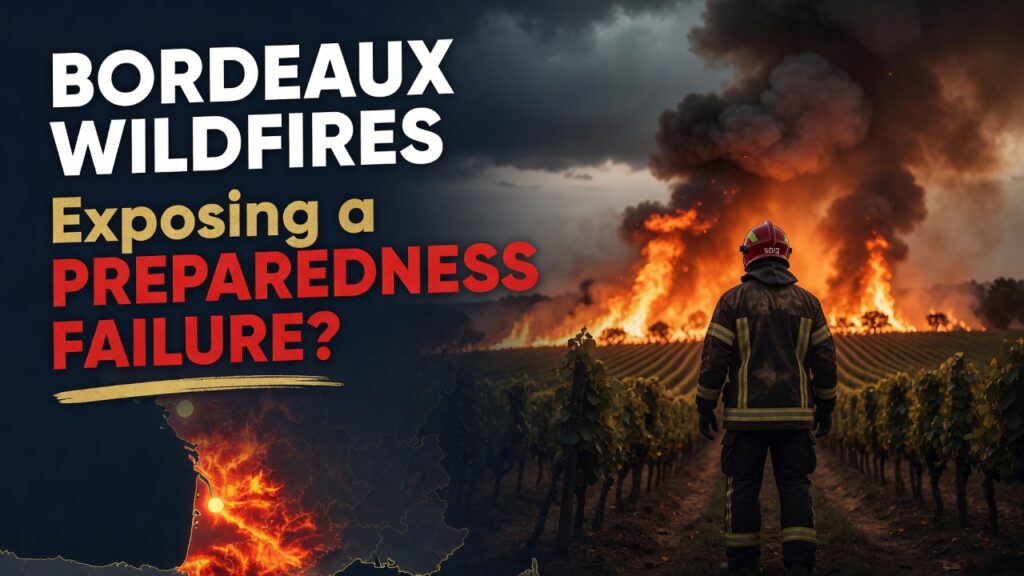
As emergency crews battle historic wildfires racing toward one of France’s most iconic cities, a harder question is emerging alongside the smoke: did years of underinvestment in prevention turn a bad fire season into a national emergency? As France and Spain scramble to contain the blazes, millions across Europe are asking who bears responsibility for the readiness gap now on full display — and who will pay to close it.
Are the flames outside Bordeaux burning through more than forests?
Flames are closing in on Bordeaux. More than 300,000 people across France and Spain have already fled their homes.
This is not a distant tragedy playing out in some remote corner of Europe. It is unfolding around a metropolitan area of roughly one million people, threatening centuries-old wine country and, according to CNN’s reporting, facilities tied to France’s nuclear deterrent. The fires erupted in Gironde last Tuesday and, within days, forced what officials are calling France’s largest peacetime evacuation since World War II [AP, CNN reporting].
How Bad Has the Damage Already Gotten?
The numbers are staggering by any measure. In France, roughly 220,000 people have been evacuated from the Gironde region alone, with a second fire in the Landes region displacing tens of thousands more. Authorities say the Gironde blaze has already burned about 42,000 hectares and destroyed close to 140 homes [French prefecture data, AP].
In Spain, more than 75,000 people have evacuated and another 30,000 have been ordered to shelter in place. Ávila province is now home to the largest wildfire in Spain’s recent history, having scorched over 50,000 hectares, according to Spain’s environment minister [Spanish government statement]. One death has been confirmed in Manises.
These are not abstract statistics. They represent families sleeping on cots in exhibition centers, elderly residents pulled from care homes overnight, and small business owners watching their livelihoods burn.
Support Independent Local Journalism
TheTownHall.News is a non-profit reader-supported journalism. Just $5 helps us hire local reporters, investigate important issues, and hold public officials accountable across Alameda County. If you believe our community deserves strong, independent journalism, please consider donating $5 today to support our work.Who Is Actually Responsible for Wildfire Readiness?
This is the uncomfortable question officials would rather not dwell on. Wildfire risk in southern Europe has been rising for years, and both governments have known it. Data from Copernicus, the EU’s climate monitoring service, shows France has already experienced 3.4 times its annual average number of fires in 2026, while Spain has seen 1.7 times its average [Copernicus data].
If governments have known the risk was climbing for years, why does the response still look improvised? That is not a rhetorical jab — it is the question taxpayers in both countries are entitled to ask before the next fire season arrives.
Emergency response has been aggressive once the fires started. France deployed a military A400M cargo aircraft converted for firefighting, and thousands of firefighters have been mobilized on both sides of the border. But reactive heroics, however impressive, are not the same as prevention — and prevention is cheaper, safer, and far less dramatic than what’s happening now.
What Happens When Prevention Takes a Back Seat to Reaction?
Fire prevention — controlled burns, forest thinning, defensible space requirements, and adequately staffed rural fire services — rarely makes headlines. It doesn’t generate dramatic footage of military aircraft dropping retardant. But it is the difference between a contained brush fire and a 42,000-hectare inferno bearing down on a city of a million people.
Local officials in Gironde have leaned heavily on farmers and residents for water tanks, terrain knowledge, and firebreak assistance, even as the regional prefect cautioned against uncoordinated individual initiatives. That tension says something important: when institutional capacity is stretched, ordinary citizens end up filling the gap, often without official coordination or credit.
A million people live in a metro area now watching a wildfire creep toward their homes. When did that become an acceptable level of national risk?
If the risk was rising for years and the data was available, why did it take a fire this size to force a serious conversation about prevention funding?
What Do the Numbers Actually Tell Us?
300,000. That’s the number of people displaced across France and Spain by this single wave of wildfires [AP, CNN]. The question no official wants to answer on camera: how much of that displacement could have been prevented with earlier investment in forest management and rural firefighting capacity?
Every evacuation order, every shelter cot, every acre of destroyed vineyard carries a cost that eventually lands on taxpayers, whether through emergency spending, agricultural losses, or long-term rebuilding. Fiscal accountability doesn’t stop at the edge of a burning forest.
Is This Just Bad Luck, or a Preview of What’s Coming?
Officials in both countries have pointed to shifting winds, arid conditions, and unusually dry vegetation following a wet winter as key drivers of the fires’ intensity [CNN reporting]. Those are legitimate meteorological factors. But weather explains why a fire spreads quickly. It does not explain why prevention infrastructure wasn’t ready for a risk that data services like Copernicus had already flagged as rising.
Framing this purely as an act of nature lets policymakers off the hook too easily. Citizens deserve a straight answer about whether current funding for wildfire prevention and rural emergency services matches the scale of the risk, not just after the flames arrive, but before.

Key Questions This Story Raises:
- Why did prevention funding apparently lag behind years of rising fire-risk data?
- Who will be held accountable for the gap between known risk and actual readiness?
- What concrete changes, if any, will follow once the immediate crisis ends?
What Do Supporters of Current Wildfire Policy Actually Believe?
Defenders of the current approach make a fair point worth engaging honestly: wildfire behavior has become genuinely harder to predict, and no amount of funding eliminates risk entirely. They argue that France and Spain have responded with real resources: military aircraft, thousands of firefighters, and rapid, well-organized evacuations that, so far, have limited the loss of life to one confirmed death.
That’s a legitimate defense, and it deserves credit. Rapid, disciplined evacuation orders almost certainly saved lives this week. But effective emergency response and adequate prevention investment are not substitutes for one another. They answer different questions. A government can execute evacuations well and still have underfunded the forest management that might have kept the fire smaller in the first place. Both can be true at once, and only one of them gets debated before the next election.
What Should Happen Once the Fires Are Out?
Once the smoke clears and the news cameras move on, the real test begins. Will French and Spanish officials commission an honest, public review of what prevention funding looked like before this fire season, and whether it matched the risk data already available to them? History suggests these reviews are easy to promise and easy to quietly shelve.
Residents in Gironde and Ávila deserve more than sympathy from their governments. They deserve a transparent accounting of what was spent, what was skipped, and what changes before the next dry summer arrives.
The Question That Should Outlast the Headlines
Long after the flames near Bordeaux are extinguished, one question should remain uncomfortably alive in the minds of voters. If the risk was rising for years and the data was available, why did it take a fire this size to force a serious conversation about prevention funding? The real question isn’t whether another fire season like this one is coming. It’s whether anyone in charge will act before it does.
What do you think — should governments be doing more to fund prevention before disaster strikes? Share this and let us know.
Support Independent Local Journalism
TheTownHall.News is a non-profit reader-supported journalism. Just $5 helps us hire local reporters, investigate important issues, and hold public officials accountable across Alameda County. If you believe our community deserves strong, independent journalism, please consider donating $5 today to support our work.Still have questions about how European wildfire policy affects accountability and preparedness here at home? Stay informed, subscribe for daily coverage. Think others need to see these numbers? Share this article. Want your voice to count on issues of fiscal accountability and public safety? Contact your local representative and ask how emergency preparedness funding is allocated in your own community.