New York ICE Law: Inside the Local Cops, Local Crimes Act
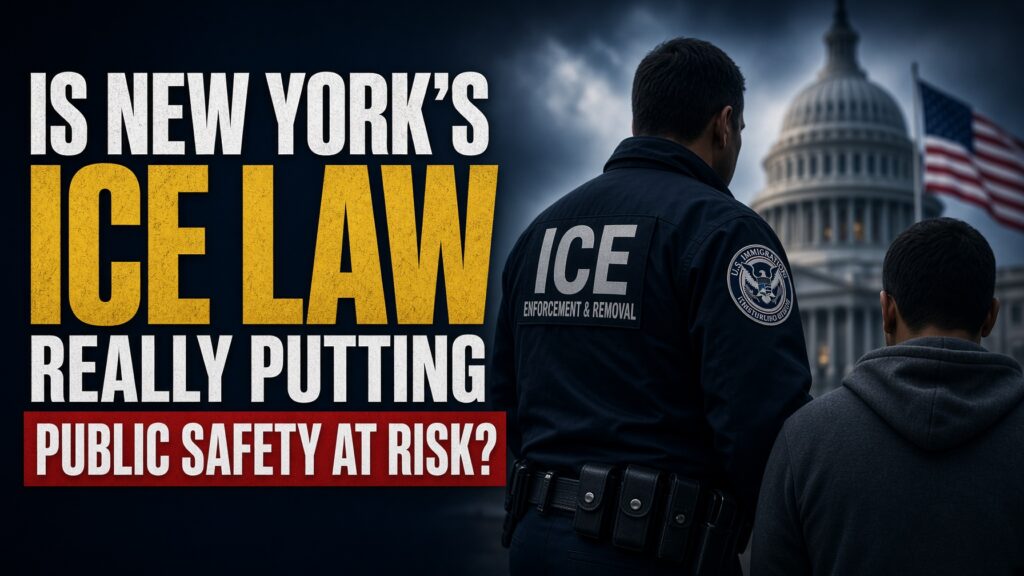
As the Local Cops, Local Crimes Act formally takes effect, county sheriffs and a sitting county executive are refusing to fall in line — and New Yorkers are left asking who’s still watching the criminals ICE wanted off the streets.
New York just told local police to stop calling ICE.
As of August 25, 2026, a new state law bars local law enforcement agencies from cooperating with federal immigration authorities, even on illegal aliens with criminal records. The mandate arrived days after a bomb threat tied to a woman who’d pledged allegiance to ISIS rattled the State Capitol — timing that has made the law’s critics considerably harder to dismiss.
Support Independent Local Journalism
TheTownHall.News is a non-profit reader-supported journalism. Just $5 helps us hire local reporters, investigate important issues, and hold public officials accountable across Alameda County. If you believe our community deserves strong, independent journalism, please consider donating $5 today to support our work.What Does the Local Cops, Local Crimes Act Actually Do?
Governor Kathy Hochul signed the Local Cops, Local Crimes Act in May 2026, and it took full effect this week. The law bans New York counties, cities, and police departments from entering or maintaining 287(g) agreements — the formal partnerships that let local officers assist ICE with civil immigration enforcement. It also bars local jails from being used to hold people for ICE civil detention.
State officials say the goal is trust: immigrant communities, they argue, report crime more readily when local police aren’t seen as an arm of federal deportation efforts. Hochul framed it as a matter of local priorities. “Local cops will assist ICE only if a real crime has been committed,” she said. On civil immigration matters, in her words, ICE is now “on their own” [Governor’s office statement].
Who Actually Had These Agreements — And Who’s Refusing to End Them?
Twelve to thirteen New York counties had active 287(g) agreements with ICE when Hochul signed the bill. Attorney General Letitia James sent letters in July ordering those agencies to unwind their partnerships by the August 25 deadline. Eleven counties fell in line [state attorney general’s office].
Nassau County did not. County Executive Bruce Blakeman — a Republican now running against Hochul for governor — has kept the county’s ICE cooperation in place, and James responded Tuesday by issuing subpoenas to Nassau and other non-compliant counties. ICE’s own records reportedly still showed active agreements in five counties, including Nassau, Niagara, Steuben, Cattaraugus, and Rensselaer, as recently as this month [Newsweek review of ICE records].

Why Are Sheriffs Calling This “Government Overreach”?
Broome County Sheriff Fred Akshar said his department would comply with the new law — but he didn’t do it quietly. In a public letter, Akshar called the mandate “an egregious act of government overreach” and vowed to challenge and ultimately overturn it. When the sheriffs enforcing a law call it overreach on their way to complying with it, that’s not a minor objection — that’s a warning.
Akshar isn’t alone in that view. Republican lawmakers and several county officials argued throughout the legislative fight that local-federal cooperation reduces crime rather than driving it underground, and that the law strips police of a tool without replacing it with anything else.
What Happened the Last Time Nassau County Cooperated With ICE?
Blakeman has pointed to a specific result of Nassau’s now-banned cooperation: county officials say the arrangement helped remove roughly 2,000 illegal migrants with criminal records from Nassau County, without ICE needing to raid a church, school, daycare, or hospital to do it [Nassau County Executive’s office].
2,000. That’s how many people with criminal records Nassau says it helped ICE remove without a single raid on a school or house of worship — the question is what happens to that number now.
Supporters of the state law dispute that cooperation was ever necessary for public safety in the first place, arguing ICE can pursue criminal cases through federal channels without deputizing local police. That disagreement is now headed toward a courtroom, not a resolution.
Support Independent Local Journalism
TheTownHall.News is a non-profit reader-supported journalism. Just $5 helps us hire local reporters, investigate important issues, and hold public officials accountable across Alameda County. If you believe our community deserves strong, independent journalism, please consider donating $5 today to support our work.Is New York Trading Public Safety for a Political Statement?
Is a law passed to send “a message to the Trump administration” really about protecting New Yorkers — or about protecting a political brand?
That’s the uncomfortable question underneath the Local Cops, Local Crimes Act. The law was first introduced in the wake of high-profile federal immigration operations elsewhere in the country, and Hochul has repeatedly cast it in national, anti-Trump terms rather than purely local ones. Whatever the intent, the practical effect is that local police in Nassau, Niagara, Steuben, Cattaraugus, and Rensselaer counties can no longer flag a criminal illegal alien for ICE the way they could a week ago.
State officials counter that “civil” immigration status was never a police matter to begin with, and that criminal conduct — the kind that actually threatens public safety — remains fully prosecutable under existing law regardless of immigration status. That’s a fair legal distinction. It is a harder argument to make to a family in a county that just lost the tool it used to flag repeat offenders for removal.
What Do Supporters of the Local Cops, Local Crimes Act Actually Believe?
Supporters of the law, including Governor Hochul and Attorney General James, make an argument worth taking seriously rather than dismissing. They contend that 287(g) partnerships blur the line between local policing and federal civil enforcement, discouraging immigrant crime victims and witnesses from coming forward and ultimately making communities less safe, not more. New York is also directing nearly $4 billion toward public safety funding, which supporters say shows the state isn’t abandoning enforcement — just redirecting it toward local crime rather than immigration status [state budget figures].
That argument has real merit on the trust question; researchers have documented reduced crime reporting in communities that fear police contact could trigger deportation. But it does not fully answer why counties that used 287(g) agreements specifically to target people already convicted of crimes — not entire immigrant communities — are now barred from doing so. Protecting crime victims and shielding convicted criminals from federal removal are not the same policy goal, even if this law treats them as one.
Key Questions This Story Raises:
- If eleven counties complied and Nassau didn’t, does New York actually have the legal authority to force a county to end its own law enforcement partnerships?
- What happens to the roughly 2,000 removals Nassau credits to ICE cooperation now that the agreement is banned statewide?
- Does banning 287(g) agreements make immigrant communities safer, or does it just make it harder to track people who already have criminal records?
Where Does This Fight Go From Here?
Two questions remain wide open. The first is legal: whether Nassau or other resistant counties can successfully challenge the law in court, and whether Albany can lawfully withhold state funding from counties that refuse to comply. Neither question has been resolved as of this week.
The second question is political, and it may matter more. Blakeman is running against Hochul for governor this year, and Nassau’s defiance of a signature Hochul law is now a live campaign issue playing out in real time, not a hypothetical. How that standoff resolves will likely shape how far other red-leaning counties are willing to go in resisting state immigration mandates going forward.
So is New York’s ICE law a genuine step toward community trust, or a political statement that leaves counties less equipped to track criminal illegal aliens than they were last week? The honest answer depends on whether Albany can actually enforce it — and whether Nassau backs down. The real question isn’t whether Hochul had the authority to sign this law. It’s whether New Yorkers will be safer, or just more exposed, once every county falls in line.
Still have questions about how this law affects your community? Stay informed — subscribe for daily coverage of accountability and public safety issues. Think your neighbors need to see this? Share this article. Want your voice to count? Contact your county sheriff’s office or county legislature and ask directly whether your county has ended its 287(g) agreement — and if not, why not.