Nepal Tibet Flood: A Warning System That Never Came
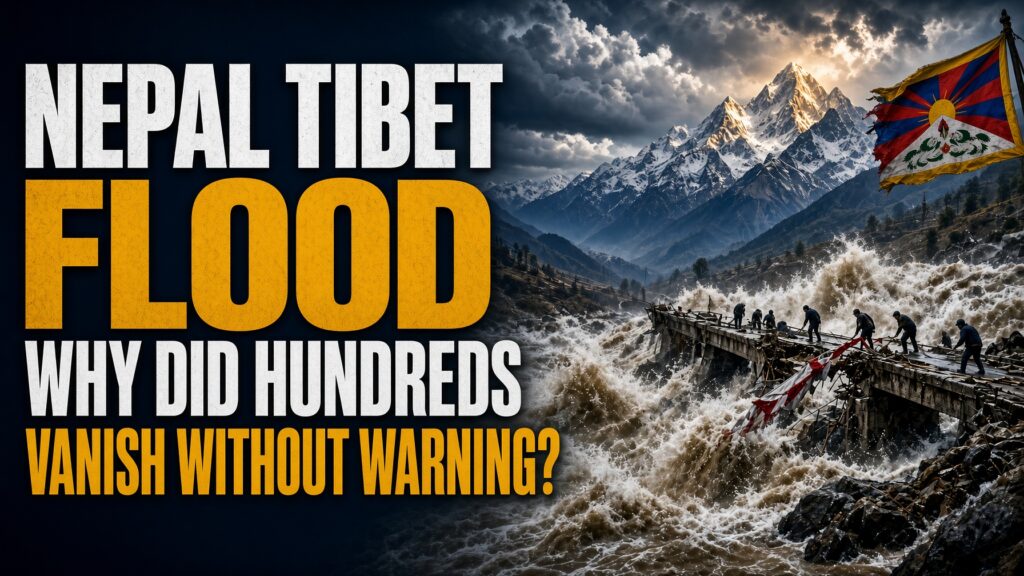
A wall of water and debris tore through the Nepal-Tibet border on a normal Wednesday morning, and as the death toll climbs, one question is growing louder than the rest: why did no warning reach the people in its path?
A wall of water erased entire villages in seconds. Nepali police say at least 95 people are confirmed dead, with the toll expected to rise as floodwaters recede and rescuers reach areas still cut off from the outside world.
The disaster struck the Bhote Koshi River gorge on the Nepal-Tibet border on the morning of August 26, 2026. An earthquake measuring magnitude 4.4 was recorded near the border at roughly the same moment an ice-and-rock avalanche tore into a tributary called the Lhende Khola, damming it before the blockage gave way and sent a surge downstream [USGS; Nepal foreign ministry statement]. Scientists are still untangling which came first — the quake or the collapse — but the result on the ground isn’t in dispute: Rasuwagadhi, Timure, and Syabrubesi were devastated within minutes, and the flood pulse pushed downstream toward Nuwakot and the plains of northern India.
Support Independent Local Journalism
TheTownHall.News is a non-profit reader-supported journalism. Just $5 helps us hire local reporters, investigate important issues, and hold public officials accountable across Alameda County. If you believe our community deserves strong, independent journalism, please consider donating $5 today to support our work.What Do We Actually Know About the Death Toll?
Nepali police have confirmed at least 95 deaths as of the most recent update, a figure officials expect to climb once search teams reach areas still without power or phone service [Nepal Police]. On the Chinese side of the border, in Gyirong county, Tibet, state broadcaster CCTV reported three confirmed deaths and 265 people still missing, based on what it called a preliminary verification [CCTV, Chinese state media].
Nearly 400 travelers remain out of contact according to Nepal’s Tourism Board, and the reason is geographic as much as tragic. Late August is peak season on the Rasuwagadhi-Kyirong crossing, the main overland route for pilgrims making the Kailash Mansarovar Yatra, a journey sacred to Hindus, Buddhists, Jains, and Bon practitioners. The missing list reportedly includes more than 100 Indian nationals, several Americans, and travelers from the United Kingdom, South Korea, Malaysia, and South Africa [Nepal Tourism Board].
Why Wasn’t Anyone Warned in Time?
If a nearly identical flood struck this same border region just thirteen months earlier, why did Wednesday’s disaster still arrive without warning? In July 2025, a permafrost collapse on the Tibetan side sent a flash flood down the same river system, killing at least nine people and destroying the Friendship Bridge linking Nepal and China. Nepali lawmakers publicly pressed their own government afterward to establish a formal cross-border information-sharing arrangement with Beijing specifically to prevent a repeat.
That arrangement, if it exists in any binding form, didn’t function on Wednesday. Nepali journalist Parshuram Kaphle wrote publicly that China failed to provide timely information about the approaching surge, asking pointedly why Nepal should keep paying the “price of one-sided love” for a relationship in which Kathmandu accommodates Beijing’s concerns but gets no reciprocal warning when disaster originates on Chinese soil [reported by Free Press Journal]. Chinese officials have not issued a public response addressing that specific criticism as of this writing.

Is This a Freak Accident — Or a Predictable Failure?
Neither government has offered evidence that Wednesday’s flood was unforeseeable. Glacial lake outburst floods and permafrost collapses have become a documented, recurring hazard across the Himalayan border region as warming temperatures destabilize high-altitude ice and rock. Researchers have spent years studying exactly this kind of event, and pilot early-warning systems already exist at several vulnerable glacial lakes in Nepal, Pakistan, Bhutan, and India [climate research literature].
The problem has never been a lack of scientific understanding. It’s been slow funding, incomplete monitoring networks on smaller tributaries, and — in this case — a cross-border relationship that apparently still doesn’t guarantee real-time alerts when a hazard originates upstream in another country’s territory.
Who Is Actually Accountable When a Border River Floods?
This is the uncomfortable question hanging over both governments. Nepal’s Prime Minister Balendra Shah has pledged “the state is with you with all its means and resources,” and Nepali authorities issued downstream alerts in Uttar Pradesh and Bihar that reportedly prompted the evacuation of roughly 5,000 people, with plans to move up to 12,000 more [Indian state disaster officials]. That response, once the water was already moving, appears to have functioned reasonably well.
The failure sits further upstream, literally and politically. A government can evacuate thousands downstream in hours — so why can’t two governments manage a phone call before the water even starts moving? Responsibility for that gap doesn’t rest with any single agency. It rests with a bilateral relationship that has now failed to prevent mass casualties from the same type of disaster twice in thirteen months.
Is it really a natural disaster if the same failure to warn happens again, in the same river valley, a little over a year later?
What Happens to the People Still Missing?
Rescue operations remain underway, with Nepali Army helicopters searching for people stranded on rooftops and along riverbanks cut off by destroyed roads and bridges. Communication lines into Rasuwa district have been down intermittently since the flood hit, complicating both the search effort and any accurate accounting of the missing.
Support Independent Local Journalism
TheTownHall.News is a non-profit reader-supported journalism. Just $5 helps us hire local reporters, investigate important issues, and hold public officials accountable across Alameda County. If you believe our community deserves strong, independent journalism, please consider donating $5 today to support our work.- That’s how many people Chinese state media says remain unaccounted for on the Tibetan side alone — the question is how many of that number are still alive, and how much longer rescuers have to find out [CCTV].
What Do Defenders of the Current System Actually Believe?
Officials on both sides would likely argue this criticism is unfair in the moment. Himalayan geography is genuinely unpredictable; permafrost collapses and ice-rock avalanches can occur with only minutes of warning even with modern monitoring, and no early-warning network anywhere in the world catches every event with total certainty. China has, at other points, alerted Nepal to heavy rainfall likely to cause flooding, showing the channel for cooperation does exist.
That defense has real merit, and it should be taken seriously rather than dismissed as an excuse. But it doesn’t fully answer the question raised by Nepali lawmakers after last year’s nearly identical disaster: was a formal, reliable, real-time notification system ever actually built, or did the conversation end once the news cycle moved on? A natural hazard being hard to predict is different from a known, recurring hazard corridor still lacking the basic infrastructure to warn the people living in it.
Key Questions This Story Raises:
- Did any formal early-warning agreement exist between Nepal and China after last year’s near-identical flood, and if so, why didn’t it function on Wednesday?
- How many of the hundreds still missing are pilgrims and tourists who had no way of knowing the route sat inside a documented hazard corridor?
- What obligation, if any, does a government have to warn a neighboring country when a hazard originates on its own territory and threatens lives across the border?
Why This Story Won’t End When the Water Recedes
Floodwaters will eventually drop, roads will eventually reopen, and the immediate search-and-rescue phase will eventually give way to recovery and rebuilding. None of that answers the harder question this disaster has now raised twice in barely more than a year: whether two governments sharing one of the world’s most hazardous river corridors are willing to build the warning infrastructure that could actually save lives next time.
So is this Nepal-Tibet flood a tragic, unavoidable accident of geology — or the second act of a preventable failure that officials on both sides had over a year to fix? The honest answer may be some of both. The real question isn’t whether the mountains are dangerous. Everyone already knows that. It’s whether anyone with the power to build a warning system will still remember that lesson once the headlines fade.
Still have questions about how this disaster unfolded? Stay informed — subscribe for daily coverage of the international stories that matter. Think others need to see this? Share this article. Want your voice to count? Contact your representatives in Congress and ask what, if any, disaster-preparedness cooperation the United States offers to Himalayan nations facing recurring glacial flood risk — and whether American citizens traveling through known hazard corridors receive adequate State Department advisories before they go.