Is the IDF Enforcing Its Own Rules on West Bank Land Burning?
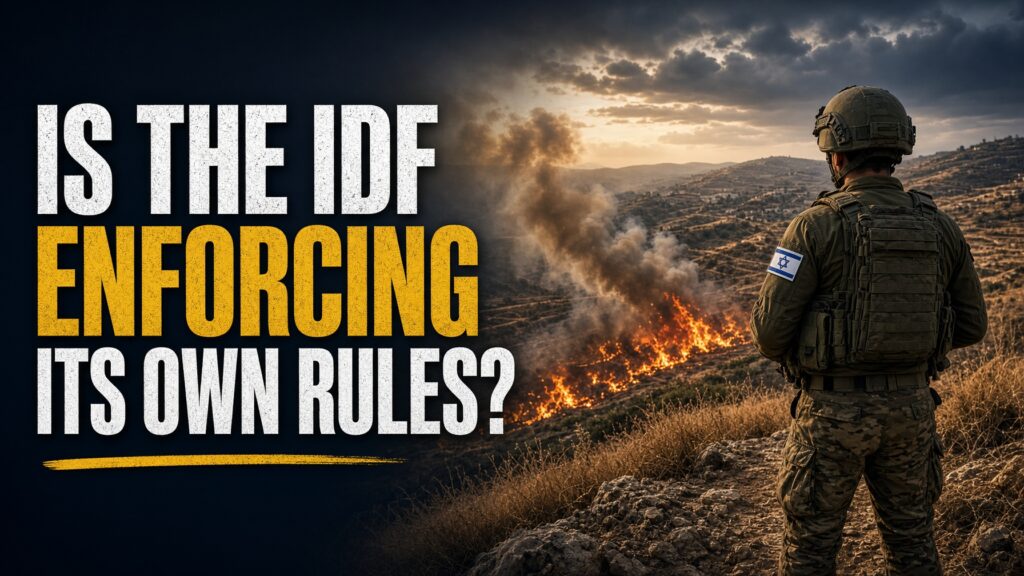
Israel’s own military directives require soldiers to protect Palestinian farmers during the olive harvest. As fields keep burning and trees keep falling, a growing body of documented incidents raises a harder question: is anyone enforcing that rule?
Olive trees are burning across the West Bank again. The question is who is supposed to stop it — and why they so often don’t.
The timing matters. Israel’s High Court of Justice ruled back in 2006 that military commanders must not deny Palestinian residents access to their own agricultural land, and standing army directives require soldiers to actively protect olive harvesters from interference. Yet the 2025 harvest season produced the worst documented damage since 2020, according to the United Nations, and 2026 has already brought fresh video evidence of Israeli forces setting fire to Palestinian farmland.
What Actually Happened This Olive Season?
The numbers are not in dispute among monitors on the ground. The UN’s Office for the Coordination of Humanitarian Affairs recorded 126 attacks across 70 West Bank towns and villages in the opening weeks of the 2025 harvest, with more than 4,000 olive trees and saplings vandalized. A later tally from Palestinian monitoring groups put the total closer to 158 attacks for the season, with dozens of incidents involving trees cut, bulldozed, or set ablaze.
Some of this destruction came directly from the Israeli military rather than settlers acting alone. In August 2025, the army ordered roughly 3,000 olive trees uprooted near the village of al-Mughayyir outside Ramallah, citing a security threat to a nearby settlement access road. Separately, footage verified by Al Jazeera in June 2026 showed the aftermath of Israeli forces setting fire to olive groves in the village of Rummanah, near Jenin.
Support Independent Local Journalism
TheTownHall.News is a non-profit reader-supported journalism. Just $5 helps us hire local reporters, investigate important issues, and hold public officials accountable across Alameda County. If you believe our community deserves strong, independent journalism, please consider donating $5 today to support our work.Why Do Soldiers Have a Legal Duty to Protect the Harvest?
This is not a matter of opinion or advocacy framing. Israel’s own High Court ruled nearly two decades ago that military commanders may not use closures to cut Palestinian farmers off from their land, and the army’s own operating directives require troops to shield olive pickers from interference during the harvest. If Israeli law already requires soldiers to protect this harvest, why does the damage keep getting worse every year?
That legal backdrop turns each burned grove from a tragic but isolated incident into a test of whether an existing rule is actually being enforced. Reporting from the Times of Israel in November 2025 described troops standing by while settlers felled olive trees and torched farmland in multiple villages during the harvest, with no arrests reported in several of the documented cases.
Who Is Actually Being Held Accountable?
Israel does have a track record of disciplining soldiers for misconduct in the West Bank — but the record is thin. In one case reported earlier this year, paratrooper commanders who vandalized Palestinian vehicles in the village of Dir Debuan received sentences of 20 to 30 days in military prison. None were expelled from the service; the officers involved were simply reassigned to desk duties.
A month behind a desk is not much of a deterrent when the property being destroyed belongs to someone who has no vote in the system doing the punishing. That imbalance is precisely why documented land-burning incidents keep drawing international attention, even when Israeli officials insist each case is reviewed individually.
Is a rule only real if it comes with a consequence for breaking it?
How Widespread Is the Broader Pattern?
The olive harvest incidents sit inside a larger trend that UN monitors have tracked since early 2024. More than 2,370 settler attacks against Palestinians were recorded in the West Bank between January 2024 and July 2025, with the Ramallah area alone logging 585 incidents and the Nablus region another 479. Israel’s government has responded to some incidents by deporting foreign activists who accompany harvesters, including 32 activists removed in October 2025 near Burin under a general military order restricting who may be present on the land during harvest season.
4,000. That’s the number of olive trees the UN says were vandalized in just the opening weeks of one harvest season — the question no Israeli oversight body has fully answered is how many of those cases actually ended in a soldier or settler facing consequences.
Does Misinformation Make This Harder to Track?
Yes, and that cuts against everyone trying to report this story honestly. Fabricated and AI-generated clips claiming to show Israeli military misconduct have circulated repeatedly over the past year, including at least one confirmed synthetic video falsely depicting soldiers burning an American flag. Fact-checkers have also debunked out-of-context footage recycled from unrelated raids and relabeled with false claims about soldiers’ identities or actions.
That noise makes the verified incidents easy to dismiss and the fabricated ones easy to weaponize. Real, documented destruction of Palestinian farmland gets lost in a flood of fake clips — and that serves no one except the people responsible for the real thing. Separating confirmed reporting from viral fabrication isn’t a side issue here; it’s the only way accountability claims hold up to scrutiny.

What Do Supporters of Israel’s Current Approach Actually Believe?
Defenders of the military’s conduct make an argument worth taking seriously rather than dismissing outright. They point out that the West Bank remains an active security environment, that soldiers operate under real threat from attacks on troops and settlers alike, and that isolated incidents of misconduct — which the IDF itself has called contrary to its values in past cases — do not amount to a deliberate policy of land destruction. Some also argue that security-related tree removals, like the al-Mughayyir case, are defensible military judgments about protecting access roads, not acts of retaliation.
That argument has real weight on the security point; soldiers in a contested territory do face genuine danger, and not every removal order is illegitimate. But it does not fully answer why UN-documented tree destruction has climbed for consecutive years despite a two-decade-old court ruling requiring the opposite, or why disciplinary outcomes for confirmed misconduct remain so light. A security justification for one case does not explain a pattern spanning hundreds of separate incidents.
What Happens if Nothing Changes Next Harvest?
Every olive season without stronger enforcement makes the next one more predictable. Palestinian farmers already report shrinking access to groves their families have worked for generations, and each unpunished incident makes the next one likelier rather than less likely. That is the actual stake here — not any single video, but whether an ally that receives billions in U.S. support enforces the rules it has already written for itself.
Key Questions This Story Raises:
- Why has documented olive tree destruction in the West Bank increased in recent years despite a 2006 Israeli court ruling requiring the opposite?
- What specific disciplinary consequences, if any, have followed the confirmed 2025 and 2026 incidents cited by UN monitors and international reporters?
- Should continued U.S. military assistance come with clearer accountability benchmarks for enforcing Israel’s own protections for Palestinian farmland?
So is the IDF enforcing its own rules, or are those rules mostly words on paper while the groves keep burning? The legal standard has existed for nearly twenty years. What’s missing isn’t a law — it’s consistent enforcement of the one that already exists. The real question isn’t whether Israel has rules protecting Palestinian farmland from military and settler destruction — it’s whether anyone with the power to enforce them plans to start.
Still have questions about accountability in the West Bank? Stay informed — subscribe for daily coverage of foreign policy and government accountability. Think others need to see how this pattern keeps repeating? Share this article. Want your voice to count? Contact your member of Congress and ask what accountability standards, if any, are attached to U.S. military assistance to Israel regarding documented property destruction in the West Bank.