Sakurajima Eruption: What Japan’s Own Monitoring Data Actually Shows
As dramatic footage of Japan’s most active volcano spreads online, millions of readers are asking whether Kagoshima is facing a catastrophe — or whether the panic is outrunning the facts.
A volcano just erupted in Japan. That sentence alone is not news.
Sakurajima, the towering stratovolcano across the bay from Kagoshima City, has been erupting continuously since 2017, and social media posts describing this week’s activity as an apocalyptic, “Godzilla-like” disaster have been circulating widely. On September 8, 2026, Japan’s Meteorological Agency (JMA) confirmed a fresh eruption at the volcano’s Minamidake crater. What the agency did not confirm is any change in alert status, any evacuation order, or any casualties — details that matter enormously to anyone trying to separate real risk from viral exaggeration.
Support Independent Local Journalism
TheTownHall.News is a non-profit reader-supported journalism. Just $5 helps us hire local reporters, investigate important issues, and hold public officials accountable across Alameda County. If you believe our community deserves strong, independent journalism, please consider donating $5 today to support our work.What Actually Happened on September 8?
JMA recorded an eruption at Minamidake crater at 12:46 p.m. local time on September 8, 2026, producing an ash column that rose to roughly 1,300 meters above the crater before drifting south [JMA advisory]. The agency classified the emission as medium in volume. Nothing in that description matches the “monstrous, apocalyptic plumes” language that has been driving shares online.
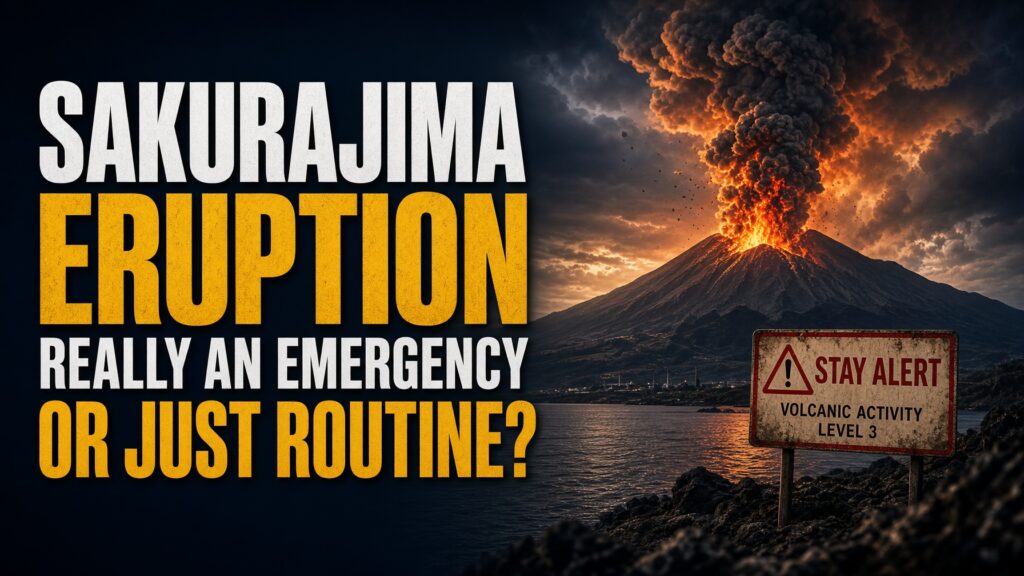
Sakurajima’s volcanic alert level remained at 3, on a five-level JMA scale, both before and after the eruption. That level restricts access within roughly two kilometers of the Minamidake and Showa craters — a standing precaution, not a new emergency measure introduced this week.
Is This Actually New, or Has It Been Happening for Years?
This is the question viral posts consistently skip. Sakurajima has been in a documented, ongoing eruptive phase since 2017, and JMA’s own activity logs show eruptions occurring at the volcano on a near-weekly basis throughout 2026 alone [JMA activity log]. A volcano that has erupted for nine straight years isn’t “unleashing” anything new — it’s doing what it does most days of most years.
Since 1900, Sakurajima has shown eruptive activity in 83 of 127 years, making it one of the most consistently active volcanoes on Earth [Smithsonian Global Volcanism Program]. Framing a single, routine, medium-sized ash emission as a sudden crisis ignores that baseline entirely.

How Dangerous Is Alert Level 3, Really?
Alert level 3 is a meaningful precaution, not a false alarm. It means unauthorized entry near the active craters is restricted and that JMA is watching for the kind of large ballistic rock ejections and pyroclastic flows the volcano has produced during past active stretches this year [JMA activity log]. It is also three notches below the maximum.
For comparison, when Sakurajima genuinely escalated in July 2022, JMA raised the alert to level 5 — the highest tier — and advised roughly 120 residents in two nearby towns to evacuate their homes [wire-confirmed, AP/NPR]. Even then, authorities reported no deaths or injuries. Nothing in the current September 2026 activity approaches that threshold.
If Japan’s own alert system says level 3, why are online posts describing conditions that would only match a level 5 evacuation order?
- That’s the number of years since 1900 in which Sakurajima has shown active eruptive behavior. The question worth asking isn’t whether it erupted this week — it’s why anyone found that surprising.
Who Actually Lives in the Shadow of This Volcano?
Kagoshima City sits roughly 8 to 10 kilometers across the bay from the crater and is home to a metropolitan population in the hundreds of thousands [Smithsonian Global Volcanism Program]. Frequent eruptions since the 8th century have deposited ash on the city for well over a thousand years, and daily life there is built around that reality rather than disrupted by it.
That long history matters for context. Ashfall alerts, road-clearing routines, and public advisories are standing municipal functions in Kagoshima, not emergency improvisations triggered by any single eruption. Treating routine ashfall management as evidence of a city under siege misrepresents how the region actually functions.
Support Independent Local Journalism
TheTownHall.News is a non-profit reader-supported journalism. Just $5 helps us hire local reporters, investigate important issues, and hold public officials accountable across Alameda County. If you believe our community deserves strong, independent journalism, please consider donating $5 today to support our work.Why Are So Many Americans Seeing This as Breaking News?
Because outrage and disaster imagery travel faster online than context does. The original post that prompted widespread sharing used language — “Godzilla-like,” “apocalyptic,” “monstrous” — engineered for engagement rather than accuracy, paired with emoji and a demand for reaction in the comments. Dramatic footage without dates, sourcing, or alert-level context isn’t journalism — it’s a template for going viral at the expense of the truth.
That pattern isn’t unique to this story. Recycled or exaggerated disaster content is a recurring feature of viral social platforms, and volcanic eruptions — visually striking by nature — are a common target. Readers deserve outlets willing to check the underlying data before amplifying the fear.
Is footage frightening enough to go viral the same thing as evidence of an actual emergency?
What Would Actually Signal a Real Escalation?
Genuine warning signs exist, and they are specific. An alert-level increase from JMA — particularly to level 4 or 5 — would signal a real escalation, as would an official evacuation order, reports of pyroclastic flows reaching inhabited areas, or confirmed casualties. None of those conditions have been reported as of this writing.
Monitoring data also shows ongoing ground deformation beneath the Aira Caldera and elevated sulfur dioxide emissions, which JMA tracks as part of its long-term assessment of the volcanic system [JMA activity log]. That kind of technical monitoring — sustained, methodical, and public — is precisely the government function that responsible journalism should hold up as the standard, not obscure behind sensationalized footage.
What Do Defenders of the Viral Posts Actually Believe?
It’s worth taking the other side seriously rather than dismissing it outright. Defenders of dramatic eruption content argue that Sakurajima is genuinely one of the most active and closely watched volcanoes on Earth, that ash plumes and ballistic rock ejections are real hazards worth public attention, and that engaging visuals do more to inform casual readers than a dry government bulletin ever could.
There’s something to that. A JMA advisory bulletin, written in technical shorthand, will never reach as many people as a dramatic video clip. But accessibility is not a license for inaccuracy. The same striking footage can be paired with accurate captions — alert level, date, and confirmed impact — without inventing an apocalypse that official data doesn’t support. Engagement and honesty are not mutually exclusive; this week’s viral posts simply chose not to combine them.
Key Questions This Story Raises:
- Why do exaggerated disaster claims consistently outperform accurate government bulletins on social media?
- What specific alert-level change or official order would actually indicate rising danger at Sakurajima?
- How much public trust in real emergency warnings gets eroded every time a routine event is falsely framed as a catastrophe?
So is the Sakurajima eruption a Godzilla-sized emergency, or a well-documented, closely monitored routine event being sold as something it isn’t? The official record points clearly to the latter. The real question isn’t whether Japan’s most active volcano erupted again this week — it’s whether readers will trust verified monitoring data over whichever version of events happens to be loudest.
Still have questions about what’s really happening in Kagoshima? Stay informed — subscribe for daily coverage that checks viral claims against primary sources. Think your friends and family have already seen the exaggerated version? Share this article. Want your voice to count on how platforms handle viral misinformation? Contact your representative’s office and ask what oversight, if any, applies to algorithm-driven disaster misinformation on major social platforms.