HUD Citizenship Verification: Is Accountability Finally Arriving?
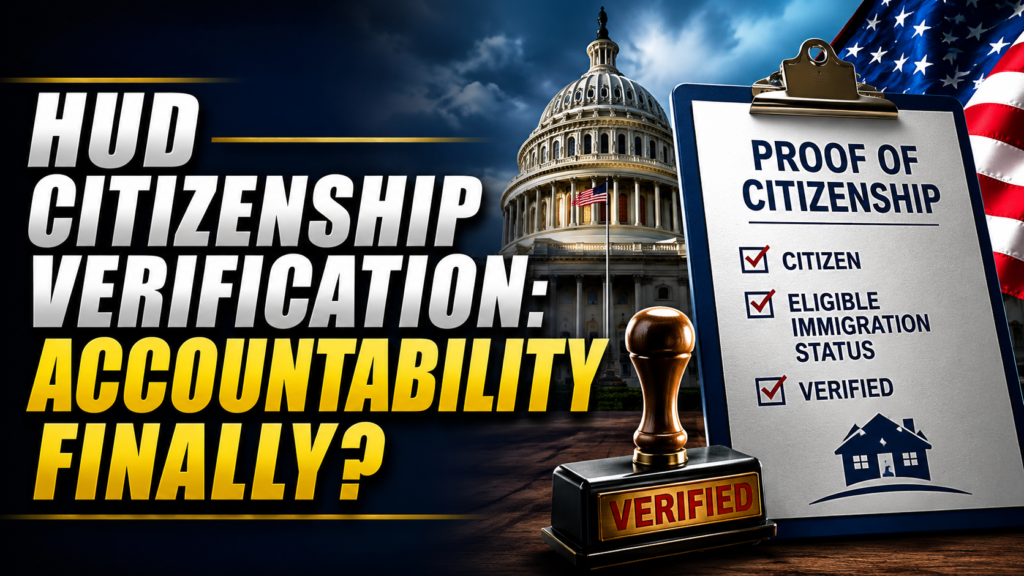
HUD Citizenship Verification Rules Raise Questions About Housing Accountability
As federal housing officials place renewed emphasis on citizenship and immigration-status verification, Americans are asking a fundamental question: who qualifies for taxpayer-funded benefits, and how should those rules be enforced?
The debate goes far beyond housing policy. It touches on government accountability, public trust, fiscal responsibility, and whether existing laws are being applied consistently.
Something important is changing.
Federal housing assistance has long operated under eligibility requirements, but recent statements from U.S. Department of Housing and Urban Development (HUD) officials suggest a stronger focus on verification and enforcement. The discussion has quickly become a flashpoint in a broader national debate about immigration, public benefits, and the role of government.
Support Independent Local Journalism
TheTownHall.News is a non-profit reader-supported journalism. Just $5 helps us hire local reporters, investigate important issues, and hold public officials accountable across Alameda County. If you believe our community deserves strong, independent journalism, please consider donating $5 today to support our work.Why does this matter now? Because housing affordability remains a major concern across the country, while policymakers face growing pressure to demonstrate that taxpayer-funded programs are being administered according to existing law.
What Is Actually Changing?
At the center of the debate is HUD’s renewed emphasis on verifying eligibility for federal housing assistance programs. Public statements from HUD leadership indicate that recipients may face increased documentation requirements to confirm citizenship or another legally eligible immigration status where required under existing federal rules.
The distinction matters. Much of the public conversation has focused on dramatic claims circulating online, but the core policy discussion concerns enforcement mechanisms rather than the creation of entirely new eligibility standards.
Federal housing programs have historically included eligibility requirements. The question now is whether enforcement will become more rigorous and whether agencies will devote additional resources to verifying compliance.

Government programs only work when the public believes the rules apply equally to everyone.
That principle sits at the heart of the current debate.
Who Is Really Paying for This Policy?
Supporters of stronger verification argue that taxpayers ultimately fund federal housing assistance and therefore have a legitimate interest in ensuring benefits reach eligible recipients.
Critics often frame the issue primarily as an immigration debate. Yet many voters see it through a different lens: accountability. They ask whether government agencies are accurately tracking who receives benefits and whether existing laws are being consistently enforced.
When confidence in administration declines, public trust declines with it.
Support Independent Local Journalism
TheTownHall.News is a non-profit reader-supported journalism. Just $5 helps us hire local reporters, investigate important issues, and hold public officials accountable across Alameda County. If you believe our community deserves strong, independent journalism, please consider donating $5 today to support our work.$61 billion. The question many taxpayers are asking: how should federal housing resources be prioritized? [federal budget category estimates]
Housing assistance funding represents a substantial public investment. For many Americans struggling with rent, rising property taxes, and inflation, questions about eligibility verification are increasingly viewed as fiscal questions rather than purely political ones.
Why Are So Many Americans Starting to Ask Questions?
The answer may be simple: affordability.
Across the country, housing costs remain a major concern. Waiting lists for housing assistance programs can stretch for months or even years in some jurisdictions. At the same time, local governments face budget pressures and taxpayers are demanding greater transparency.
When resources are limited, eligibility standards attract more scrutiny.
If government cannot clearly explain who qualifies for public benefits, how can citizens evaluate whether the system is working?
This concern extends beyond housing. Similar debates have emerged regarding healthcare, education funding, and other publicly supported programs.
Many Americans are not necessarily demanding new laws. They are demanding confidence that existing laws are being followed.
What Do the Numbers Actually Tell Us?
The available evidence suggests that public housing policy operates within a complex regulatory framework that includes citizenship and immigration-status considerations, income requirements, family status criteria, and numerous administrative procedures.
That complexity often creates confusion.
Some viral social media posts imply sweeping policy changes when the reality may involve administrative adjustments, enforcement priorities, or updated verification procedures. Understanding that distinction is essential.
Facts matter more than slogans. Enforcement policy is not always the same thing as changing the law.
The broader issue is whether government agencies possess reliable systems for verifying eligibility while minimizing administrative errors and protecting lawful recipients from unnecessary disruption.
That balance is difficult to achieve, but it remains essential.
Is This the Accountability Moment We’ve Been Waiting For?
Perhaps.
Public confidence in institutions often depends less on outcomes alone and more on transparency. Citizens generally want assurance that officials are applying standards consistently and explaining decisions clearly.
If HUD’s renewed emphasis on verification produces greater transparency, supporters believe it could strengthen confidence in housing programs. If implementation proves confusing or inconsistent, however, critics may argue that the effort creates new administrative burdens without solving underlying problems.
The success of the policy will likely depend on measurable results rather than political messaging.
Can agencies verify eligibility accurately?
Can they reduce errors?
Can they demonstrate responsible stewardship of taxpayer funds?
Those questions may ultimately determine public judgment.
If eligibility rules exist, shouldn’t government be able to prove they’re being enforced?
What Do Supporters of This Policy Actually Believe?
Supporters generally argue that taxpayer-funded benefits should be administered according to established legal requirements and that stronger verification promotes fairness.
They contend that public trust erodes when citizens believe eligibility standards are not being consistently enforced. In their view, verification protects both taxpayers and qualified recipients by ensuring limited resources reach intended beneficiaries.
Critics, meanwhile, argue that aggressive enforcement can create administrative complexity, increase compliance costs, and potentially affect eligible families who encounter documentation challenges.
Both perspectives raise legitimate concerns.
A balanced assessment recognizes that accountability and administrative fairness are not mutually exclusive goals. Effective governance requires both accurate verification and safeguards against wrongful exclusion.
The key question is not whether verification should exist. The real question is whether implementation can be conducted efficiently, transparently, and fairly.
Are Our Leaders Even Listening Anymore?
Public frustration often reflects a deeper concern about responsiveness.
Citizens want policymakers to acknowledge competing priorities: affordability, legal compliance, efficient administration, and public confidence. Too often, debates become trapped in partisan narratives that obscure practical questions about management and oversight.
Housing policy affects real families, real communities, and real budgets.
That reality demands more than political talking points.
It requires clear communication, measurable outcomes, and a willingness to evaluate results honestly. If verification efforts improve accountability without creating unnecessary hardship, supporters will point to them as evidence of responsible governance. If they fail to deliver meaningful improvements, critics will likely gain traction.
Either way, voters deserve transparency.
Key Questions
□ Will stronger verification improve public confidence in housing assistance programs?
□ Can eligibility enforcement be strengthened without creating excessive administrative burdens?
□ How should policymakers balance fiscal accountability with efficient access for qualified recipients?
What Happens If No One Speaks Up?
Public policy works best when citizens remain engaged.
Housing assistance is not merely a budget item. It reflects broader questions about government competence, legal consistency, and stewardship of public resources. Regardless of where one stands politically, those questions deserve careful examination.
The coming months may reveal whether increased verification efforts produce meaningful results or simply generate another cycle of political controversy.
That is why this debate matters.
The fundamental issue extends beyond housing. It concerns whether public institutions can maintain trust by demonstrating accountability while serving the people they were created to help.
As this discussion continues, Americans may find themselves asking one final question: if government cannot clearly demonstrate who qualifies for taxpayer-funded benefits, how can citizens accurately judge whether the system is working at all?
The real question isn’t whether this debate will continue—it’s whether anyone will be satisfied with the answers.