Is Israel Sabotaging Trump’s Iran Deal — and Making America Pay the Price?
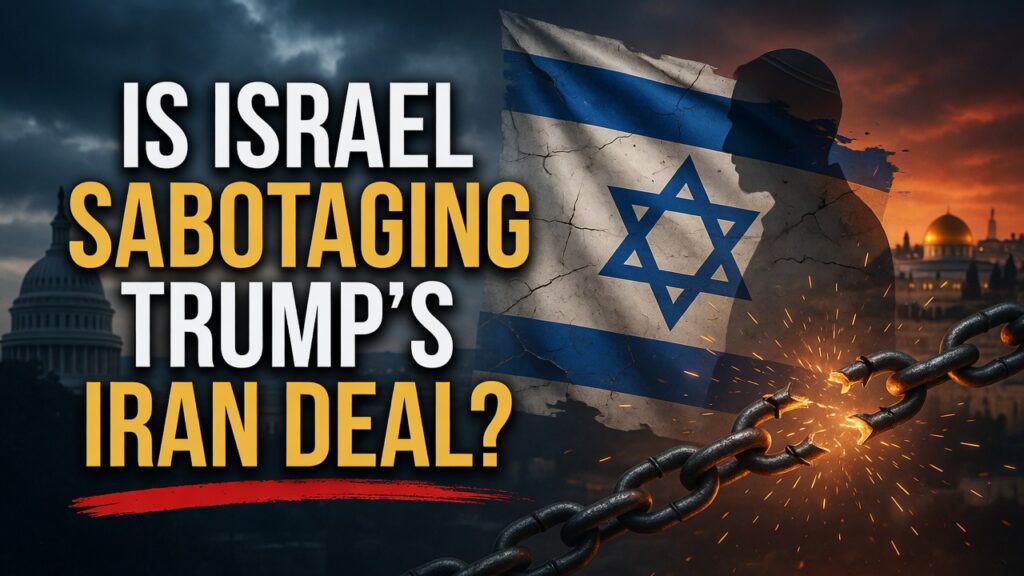
As Washington and Tehran inch toward a historic agreement that would reopen the Strait of Hormuz, Israel’s continued military campaign in Lebanon has twice derailed the talks — and the White House is running out of patience.
America stood on the edge of a genuine foreign policy breakthrough this week. Then Israel launched more than 80 strikes across Lebanon in a single day, and the whole thing nearly fell apart.
That is not a rhetorical point. It is what happened. Israel and Hezbollah agreed to a ceasefire on Friday after a deadly escalation in Lebanon looked set to derail Washington-Tehran peace talks in Switzerland. Vice President JD Vance scrapped his plans to travel to Switzerland for the next round of U.S.-Iran talks following the signing of an agreement aimed at ending the war. This is the second time in two months that Israeli military action has forced the United States to pull back from the negotiating table. At some point, a pattern becomes a policy. NBC NewsFox News
Support Independent Local Journalism
TheTownHall.News is a non-profit reader-supported journalism. Just $5 helps us hire local reporters, investigate important issues, and hold public officials accountable across Alameda County. If you believe our community deserves strong, independent journalism, please consider donating $5 today to support our work.What Did the US-Iran Agreement Actually Say About Lebanon?
The answer is unambiguous, and it matters. The 800-word, 14-point memorandum of understanding makes Lebanon a central part of the ceasefire agreement. “The United States of America and the Islamic Republic of Iran and their allies in the current war are signing this MOU to declare the immediate and permanent termination of military operations on all fronts, including in Lebanon,” the document reads. CNN
There is no asterisk. There is no footnote carving out a Hezbollah exception. The text says all fronts. Israel was aware of that language. On April 8, shortly after a ceasefire to the 2026 Iran war was announced and Hezbollah signaled a pause in attacks, Israel launched what it described as its “most powerful attacks” on Lebanon, killing at least 357 people. CBS News spoke to diplomats who agreed that initially President Donald Trump had included Lebanon in the ceasefire, and even Israel had initially agreed to those terms. Wikipedia
If Israel agreed to the ceasefire terms and then ignored them hours later, that is not a miscalculation — that is a choice.
How Close Is the US to Losing This Deal Entirely?
Dangerously close. The economic stakes for American consumers are enormous. President Trump announced the US is lifting its naval blockade on Iranian ports and that the Strait of Hormuz will reopen after the agreement is signed, describing it as “permanently toll free.” The Strait of Hormuz handles roughly 20 percent of the world’s oil supply — a figure that translates directly to what Americans pay at the pump and to heat their homes. CNN

Iranian officials did not travel as planned to Switzerland, insisting that the fighting in Lebanon must stop before talks can take place. Iran’s position is straightforward: the ceasefire means what it says. Every Israeli strike in Lebanon gives Tehran a legitimate reason to walk away from negotiations that Washington has spent months building. Al Jazeera
20% of the world’s oil supply transits the Strait of Hormuz. The question no one in Washington wants to answer plainly: how long can America afford to let one ally hold that equation hostage?
Is Trump Finally Losing His Patience With Netanyahu?
The public record suggests the answer is yes — and that it has been building for weeks. Axios reported that Trump lashed out at Netanyahu during a call over Israel’s actions in Lebanon, with one U.S. official summarizing Trump’s message as calling the Israeli leader “f—ing crazy.” Trump later confirmed he made the remark in an interview, while also saying he likes Netanyahu and works “very well” with him. Fox News
Earlier this month, Trump told ABC News he deterred Netanyahu from conducting “a major raid of Beirut, Lebanon,” describing the situation as “a little glitch” that he “turned around very quickly.” CNN
The vocabulary is revealing. A superpower’s chief diplomatic initiative is not a “glitch.” When the President of the United States has to personally intervene on multiple occasions to stop an ally from conducting raids that would torpedo American foreign policy, something structural has broken down.
Support Independent Local Journalism
TheTownHall.News is a non-profit reader-supported journalism. Just $5 helps us hire local reporters, investigate important issues, and hold public officials accountable across Alameda County. If you believe our community deserves strong, independent journalism, please consider donating $5 today to support our work.“Donald J. Trump is the only head of state in the entire world who is sympathetic to the nation of Israel at this moment in time.” — Vice President JD Vance, June 19, 2026
That statement, delivered at the White House on Thursday, was less an expression of solidarity than a warning. Vance was telling Israel — publicly — that its margin for error with this administration is gone.
What Do Supporters of Israel’s Lebanon Campaign Actually Believe?
It is worth engaging this argument seriously rather than dismissing it. Israel’s defenders make a coherent case: Hezbollah is a designated terrorist organization that has spent years building a missile arsenal pointed at Israeli cities; the 2024 ceasefire was serially violated by Hezbollah long before Israel escalated; and no sovereign country can accept rocket fire on its soldiers and civilians indefinitely.
The IDF accused Hezbollah of “blatant ceasefire violations,” saying Hezbollah attacks came after four Israeli soldiers were killed when a tank was struck by a Hezbollah explosive. Hezbollah said its attacks were themselves a response to Israeli forces attempting to advance on the Ali al-Taher hilltop, a strategic position overlooking Nabatiyeh. PBS
Both sides have genuine grievances about who fired first. That is precisely the point. In a conflict where each escalation triggers a counter-escalation, only external pressure can break the cycle. That pressure is supposed to come from Washington. But Washington’s leverage over Israel is only as strong as American willingness to use it — and right now, that willingness is being tested.
Israel has a right to self-defense. It does not have a right to conduct a campaign that collapses American diplomatic strategy and drives up energy prices for every family in the United States.
What Happens to American Interests if This Deal Fails?
The consequences are concrete and near-term. A collapsed US-Iran agreement means the Strait of Hormuz remains a pressure point, oil markets remain volatile, and the broader framework for nuclear negotiations — the actual long-term objective — never gets off the ground. Trump announced “major combat operations” against Iran on February 28, with massive joint US-Israeli strikes targeting military, government, and infrastructure sites. Following a two-week ceasefire, initial US-Iran talks in Pakistan in April failed to reach a peace deal. Months of military risk, lives lost, and diplomatic capital spent — all of it contingent on a final agreement that Israel’s Lebanon campaign keeps threatening to undo. ABC News
The clock is ticking for the United States and Iran to finalize a peace deal within 60 days, and technical negotiations had not begun as planned on Friday. Every day of delay is a day the deal can unravel, a day oil markets remain uncertain, and a day the window for a nuclear agreement narrows. CNN
If American diplomacy fails in the Middle East this summer, the question conservatives should be asking is: who actually cost us that deal?
Key Questions
- If Israel agreed to ceasefire terms that explicitly included Lebanon and then launched its largest strikes in the same hours, what should the United States do when an ally ignores a signed framework?
- At what point does unconditional American military and financial support for Israel become a liability to U.S. national interests rather than an asset?
- Is the Trump administration prepared to attach conditions to aid if Israeli military action continues to sabotage the one deal that would reopen global energy markets?
The real question is not whether Israel has the right to defend itself. It does. The question is whether American taxpayers and energy consumers should be held responsible for the consequences of military decisions made in Jerusalem. And more urgently: does the Trump administration have both the will and the leverage to enforce the agreement it spent months negotiating — or will it allow one difficult ally to hand Iran a diplomatic victory by walking away from the table?
The ceasefire announced Friday afternoon may hold. The pattern of the last two months suggests it may not. What is certain is that the United States cannot close a deal, reopen a strait, and stabilize energy markets while simultaneously watching an ally treat every signed agreement as optional.
Think this story matters? Share it and tell us what you think — should the US attach conditions to military aid if Israel keeps jeopardizing the Iran deal?
Stay informed: subscribe to The Town Hall for daily coverage of the issues Washington would rather you not think too hard about.