Stacie Laughton Sentenced to 33 Years for Child Exploitation — What Took So Long?
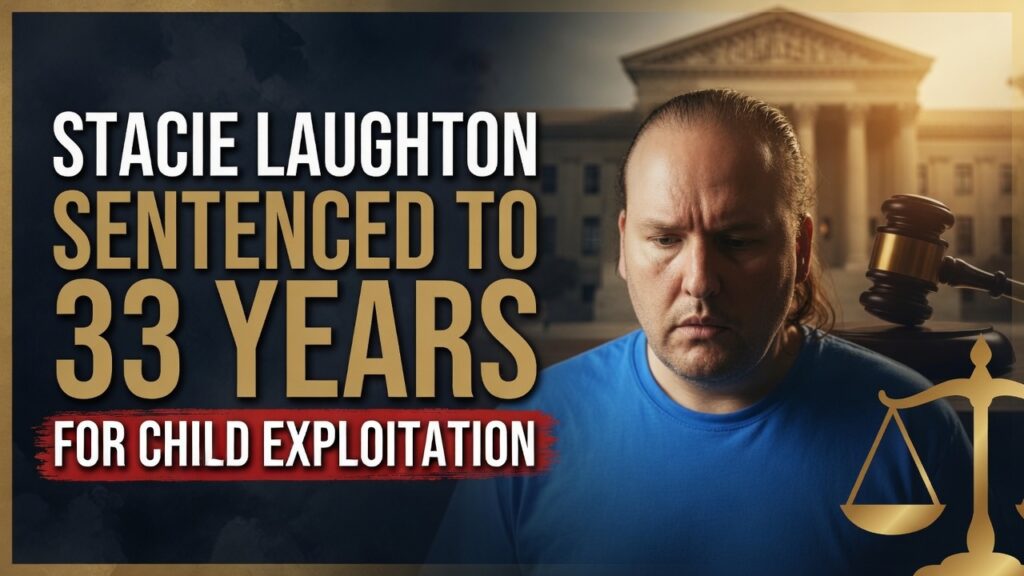
A former Democratic state representative is heading to federal prison for over three decades. The sentencing closes a criminal chapter — but it opens a much harder political question.
A convicted child predator was celebrated as a trailblazer. On Thursday, June 19, 2026, a federal judge in Boston made sure Stacie Marie Laughton will spend the next 33 years paying for it.
Laughton, 42, a former New Hampshire Democratic state representative, was sentenced to 400 months in federal prison after pleading guilty to three counts of aiding and abetting the sexual exploitation of children. The case involves explicit photographs of toddlers taken at a Massachusetts daycare — children as young as three years old. But the sentencing is only part of the story. The other part is how someone with Laughton’s criminal record managed to keep returning to public office while party leaders looked the other way.
Support Independent Local Journalism
TheTownHall.News is a non-profit reader-supported journalism. Just $5 helps us hire local reporters, investigate important issues, and hold public officials accountable across Alameda County. If you believe our community deserves strong, independent journalism, please consider donating $5 today to support our work.What Did Stacie Laughton Actually Do?
The facts of this case are as disturbing as they are clear. Laughton’s former intimate partner, Lindsay Groves, 40, was employed at the Creative Minds Early Learning Center in Tyngsborough, Massachusetts. According to federal prosecutors, Laughton induced Groves to photograph children — some still in diapers — during bathroom breaks and diaper changes, then send those images via text message.
Law enforcement recovered more than 10,000 text messages exchanged between the two over a single one-month period in 2023. Those messages contained detailed, explicit discussions about the images and active coordination for the ongoing abuse of the children in Groves’ care. Prosecutors noted that Laughton discussed “potential or fantasized sexual contact with kids” extensively throughout that period.
10,000 text messages. In one month. The question every parent of a daycare child deserves answered: how was this allowed to go on?
Groves was sentenced to 22 years in federal prison earlier this month after pleading guilty to sexual exploitation and distribution of child pornography. Laughton received the harsher sentence for the role of orchestrating the abuse.

Is This Justice — Or Just the Beginning of the Reckoning?
“A convicted felon was elected to the New Hampshire Legislature. Then it happened again. And when the crimes finally came to light, they involved children as young as three years old. At what point does the political system that kept elevating this person share responsibility?”
The sentencing delivers accountability in a courtroom. But it doesn’t answer the institutional question that parents, voters, and civic watchdogs across New Hampshire are now asking: how did Stacie Laughton keep getting back into public life?
Laughton’s history of legal troubles was not hidden. In 2012, Laughton was elected to the New Hampshire House of Representatives and was widely celebrated as the first openly transgender person elected to a U.S. state legislature. But Laughton resigned before ever taking office — after reports surfaced of prior felony convictions for credit card fraud and falsifying evidence.
Then, inexplicably, Laughton ran again. And won again. And resigned again — this time in December 2022, after being arrested on stalking and harassment charges. That was just months before the child exploitation conduct with Groves began in May 2023.
Who Kept Putting This Person on the Ballot?
That is the question New Hampshire Democrats have not answered publicly, and the silence is damning.
Laughton was a registered Democrat who ran under the Democratic Party banner multiple times. The party’s then-chairman, Ray Buckley, once publicly called Laughton part of “the backbone of the Granite State.” That quote now hangs over the party like an indictment of its own judgment.
Support Independent Local Journalism
TheTownHall.News is a non-profit reader-supported journalism. Just $5 helps us hire local reporters, investigate important issues, and hold public officials accountable across Alameda County. If you believe our community deserves strong, independent journalism, please consider donating $5 today to support our work.When a party chairman calls a twice-convicted felon the “backbone” of the state, voters deserve to ask: what exactly is that party’s backbone made of?
The pattern here is not a one-time failure of vetting. It is a repeated, documented institutional failure. Laughton’s prior felony convictions were publicly known. The stalking arrest in 2022 was publicly known. The party continued to allow Laughton to run under its banner regardless.
This is not about partisan point-scoring. It is about the basic civic standard of due diligence that every political party owes the voters it seeks to represent — and the children who cannot yet vote at all.
What Do Defenders of This Record Actually Argue?
To be fair, some will argue that political parties cannot legally bar candidates from running in primaries based on criminal history alone. There is truth to that. Democratic primaries are open processes, and the party machinery does not always control who wins a local legislative seat.
Others will note that Laughton’s prior convictions — identity fraud and evidence tampering — did not automatically predict child exploitation. No one, they might argue, could have seen this specific crime coming.
These arguments deserve a hearing. But they do not hold up under scrutiny. The stalking and harassment arrest in late 2022 was a direct, recent warning sign. The exploitation of the children at Creative Minds began within months of that arrest. And throughout this entire period, no Democratic official publicly called for Laughton to step aside, seek mental health treatment, or remove themselves from public life. The silence was active — not merely passive.
Voters are not asking the party to predict every crime. They are asking it to exercise basic judgment when a candidate’s track record becomes indefensible.
What Happens to the Children and the Families Left Behind?
The court proceedings have largely focused on the perpetrators. But the victims of this case — children between the ages of three and five at the time of the abuse — will carry this with them far beyond any sentence handed down in a Boston courtroom.
The real victims of this case cannot vote, cannot testify about the politics that preceded it, and cannot demand accountability. That burden falls on the rest of us.
The parents who trusted Creative Minds Early Learning Center with their most vulnerable children had no way of knowing that one of its employees was being solicited to abuse their kids. That is a betrayal that no prison sentence fully remedies.
The Tyngsborough community, the families, and the children deserve more than a verdict. They deserve a serious public accounting of how institutional failures — in politics, in hiring, in oversight — created the conditions for this crime to occur.
Key Questions
- How many times does a candidate need a criminal record before a political party refuses to run them under its banner?
- What systemic oversight failures at Creative Minds Early Learning Center — or in Massachusetts daycare licensing — allowed this abuse to occur?
- Will New Hampshire Democratic leadership publicly account for the party’s repeated endorsement of a candidate with Laughton’s documented history?
Is There a Lesson Here That Goes Beyond One Verdict?
There is. And it applies far beyond New Hampshire.
The Laughton case illustrates what happens when institutions — political parties, civic organizations, media outlets — prioritize identity-based milestones over basic accountability standards. Laughton was celebrated repeatedly as a “first” in American politics. That framing created social pressure to overlook inconvenient facts. The result was not just embarrassing. It was catastrophic for the children harmed.
Accountability journalism exists precisely for moments like this — not to relitigate a verdict already handed down, but to ask what structures failed, who knew what and when, and what must change so it cannot happen again.
The 33-year sentence is justice, imperfect and delayed. The harder work — demanding answers from the institutions that enabled the path to this courtroom — is just beginning.
The real question isn’t whether Stacie Laughton deserved that sentence. It’s whether the people who kept handing her a microphone and a ballot line will ever be asked to account for what they missed — or what they ignored.
Think this story deserves more attention? Share it. Want to stay informed on accountability journalism covering government failures and public safety? Subscribe to The Town Hall’s daily briefing. And if you want your voice heard, contact your state representatives — they work for you.