Lebanon Ceasefire Already Breaking Down — What America Must Do Next
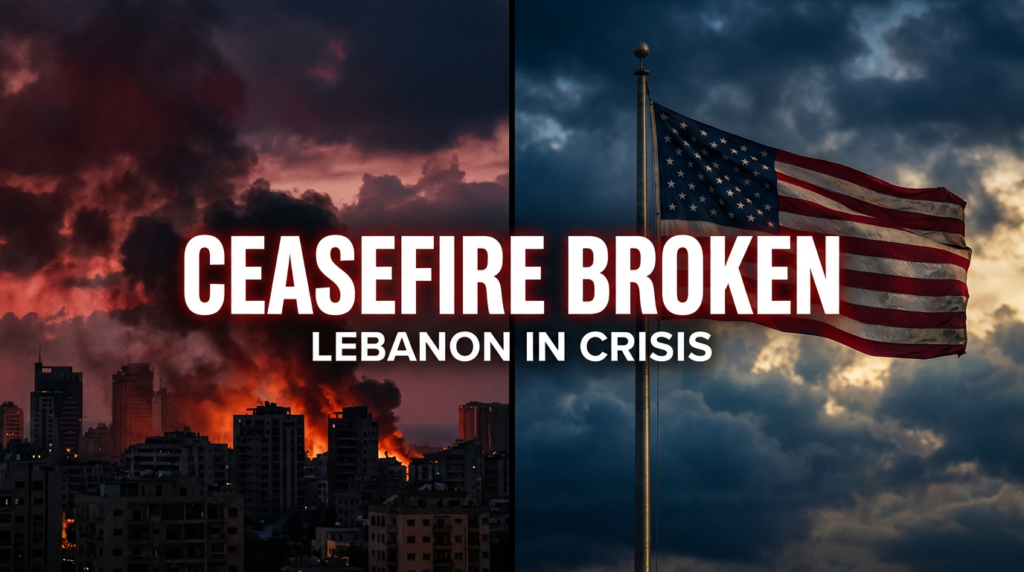
Just 48 hours after a U.S.-brokered 10-day truce took effect, bombs are falling again over Beirut. The rapid collapse of the Lebanon ceasefire is more than a regional crisis — it’s a defining test of American credibility, diplomatic resolve, and the price of half-measures in the world’s most volatile neighborhood.
On April 16, 2026, the Trump administration announced what it called a landmark achievement: a 10-day ceasefire between Israel and Lebanon, brokered directly by the United States. For a brief moment, it looked like American diplomacy had pulled off something historic — the first direct diplomatic engagement between the two nations in decades.
That moment lasted less than 48 hours.
Support Independent Local Journalism
TheTownHall.News is a non-profit reader-supported journalism. Just $5 helps us hire local reporters, investigate important issues, and hold public officials accountable across Alameda County. If you believe our community deserves strong, independent journalism, please consider donating $5 today to support our work.By the following day, Israeli forces had struck over 100 targets across Lebanon in under 10 minutes — the largest single wave of strikes since March 1. At least 182 people were killed in one of the bloodiest single days of the conflict. Hezbollah, which was never a formal signatory to the agreement, fired rockets into northern Israel. Lebanon’s government formally accused Israel of violating the truce. And Iran shut the Strait of Hormuz again. The ceasefire — in the bluntest terms — is hanging by a thread, if it isn’t already dead.
Why the Ceasefire Was Flawed From the Start
Let’s be direct: a ceasefire that excludes one of the primary belligerents was never going to hold.
Hezbollah — the Iran-backed militant group that has operated as a state-within-a-state in Lebanon for decades — did not sign the April 16 agreement. The group acknowledged the ceasefire publicly but pointedly refused to commit to abiding by it, urging its supporters to remain vigilant. That wasn’t ambiguity. That was a warning.
This is the fundamental flaw in how Western powers continue to approach asymmetric conflicts. Sovereign governments can sign agreements. Non-state armed groups that answer to Tehran — not Beirut — cannot be bound by them in any meaningful way. Lebanon’s government has long lacked the sovereign authority to enforce its own territory, a failure that has cost its civilian population enormously and that no ceasefire declaration can paper over.

The agreement’s own terms reflected this uncomfortable reality: Lebanon was asked to “take steps to prevent Hezbollah and other non-state armed groups from carrying out attacks against Israel.” That is a tall order for a government that does not control significant portions of its own south. Accountability without authority is not policy — it is wishful thinking.
The Real Cost: 182 Dead and a Region on the Brink
The human toll of this breakdown is not abstract.
At least 182 people were killed on a single day as Israel expanded its strikes across Beirut, hitting commercial and residential areas in what the Israeli military described as defensive action against ongoing threats. The ceasefire’s terms did permit Israel to respond to “imminent or ongoing threats” — but the scale and speed of the strikes left little room for restrained interpretation.
Meanwhile, Iran — whose role in funding and arming Hezbollah is well-documented — closed the Strait of Hormuz on April 18, just two days after briefly reopening it. Iran’s parliament speaker, Mohammad Bagher Qalibaf, accused Washington of breaking three of Tehran’s 10 conditions for ending hostilities, calling planned talks “unreasonable.” Whether or not Tehran’s grievances have merit, the pattern is depressingly familiar: use a ceasefire window to regroup, extract diplomatic concessions, then resume pressure when talks stall.
A ceasefire that one party treats as a tactical pause is not peace. It is a countdown.
Support Independent Local Journalism
TheTownHall.News is a non-profit reader-supported journalism. Just $5 helps us hire local reporters, investigate important issues, and hold public officials accountable across Alameda County. If you believe our community deserves strong, independent journalism, please consider donating $5 today to support our work.What Critics Get Wrong About “Diplomatic Solutions”
There is a school of thought — popular in certain foreign policy circles — that argues any ceasefire, however fragile, is preferable to continued fighting. That position is not without compassion. But it fundamentally misreads how bad actors operate.
When a ceasefire is announced without enforcement mechanisms, without buy-in from all parties, and without clear consequences for violations, it does not stop conflict. It pauses it — and often gives the party most willing to exploit ambiguity a decisive tactical advantage.
Critics who blame Israeli airstrikes for the ceasefire’s collapse ignore a foundational question: what is a nation supposed to do when rockets are being fired at its northern towns while a truce is theoretically in effect? The agreement explicitly preserved Israel’s right to self-defense. That wasn’t an oversight — it was an acknowledgment of reality on the ground.
Those who argue that diplomatic restraint alone will produce regional stability have not seriously reckoned with the track record. Hezbollah has grown stronger, not weaker, during periods of Western engagement that lacked enforcement teeth. Good intentions do not deter rocket fire.
America’s Credibility Is Now on the Line
VP JD Vance publicly acknowledged the deal was “fragile” even as it was being announced — a moment of diplomatic candor that now looks prescient.
The United States invested significant political capital in brokering this agreement. It was framed as evidence that American leadership could still shape outcomes in the Middle East. But a ceasefire that fractures within 48 hours does not demonstrate strength — it demonstrates the limits of diplomatic pressure when it isn’t backed by clear consequences for non-compliance.
If America’s word means something on the world stage, that meaning must be enforced — not simply declared.
This is not a partisan point. It is the foundational logic of deterrence. Nations and non-state actors comply with agreements when the cost of breaking them exceeds the cost of holding them. That calculus has not been clearly established in Lebanon. Until it is, the current 10-day window risks becoming yet another footnote in a long history of failed truces.
What a Credible Path Forward Actually Looks Like
The United States does not need to deploy forces to Lebanon to reassert its credibility. But it does need to make clear — through policy, not rhetoric — that ceasefire violations carry real consequences.
That means holding Iran diplomatically and economically accountable for Hezbollah’s continued armament and rocket operations. It means demanding that Lebanon’s government exercise genuine sovereignty in its south — with international support structured to make that possible. It means establishing and communicating clear red lines for what constitutes a breach, and being willing to enforce them. And it means recognizing the Lebanese civilian population as the greatest victim of this conflict — caught between a militant group that uses residential areas as military cover and an adversary determined to eliminate that threat at any cost.
The 10-day clock is still running. But time without intention is just delay.
The Broader Lesson: Accountability Doesn’t Stop at the Water’s Edge
Americans have every right to ask hard questions about their country’s involvement in this conflict. How much diplomatic and financial capital is being spent? What does a successful outcome actually look like? And who is held accountable when agreements fail?
These are not isolationist questions. They are the questions of a citizenry that takes civic responsibility seriously — both toward national interest and the principle that commitments must carry weight.
Law and order does not stop at the shoreline. The same principle that holds individuals and institutions accountable for breaking their word in domestic life applies equally to nations and armed factions on the world stage. Without enforcement, agreements are paper. Without accountability, diplomacy is theater.
Key Takeaway
The Lebanon ceasefire isn’t just a Middle East story. It is a live test of whether American diplomacy still carries genuine weight — and whether the world’s most destabilizing actors believe there are real consequences for breaking agreements. The answer, so far, is deeply concerning.
Conclusion: The Clock Is Running — Don’t Look Away
The facts on the ground are stark: more than 182 civilians killed in a single day, rockets fired at Israeli towns, the Strait of Hormuz closed again, and both sides trading accusations of ceasefire violations. The 10-day window remains technically open, but confidence in it is evaporating.
What happens in the coming days will say a great deal about the durability of American leadership in the region — and whether diplomacy without enforcement is worth anything at all. This is not the time for talking points. It is the time for clarity, accountability, and honest leadership from Washington, Jerusalem, and Beirut alike.
History does not reward nations that announce peace and then walk away. The world is watching. And the clock is ticking.
Stay informed. Share this article with someone who needs to read it. Support independent journalism that follows the facts wherever they lead — and holds power accountable at home and abroad.