Pentagon Bus Crash Injures 23, Including 10 Defense Department Officials — Who’s Accountable?
A head-on collision at one of America’s most secure transit hubs has left two dozen people injured and accountability questions unanswered. When government workers commuting to the Pentagon aren’t safe, something has gone seriously wrong.
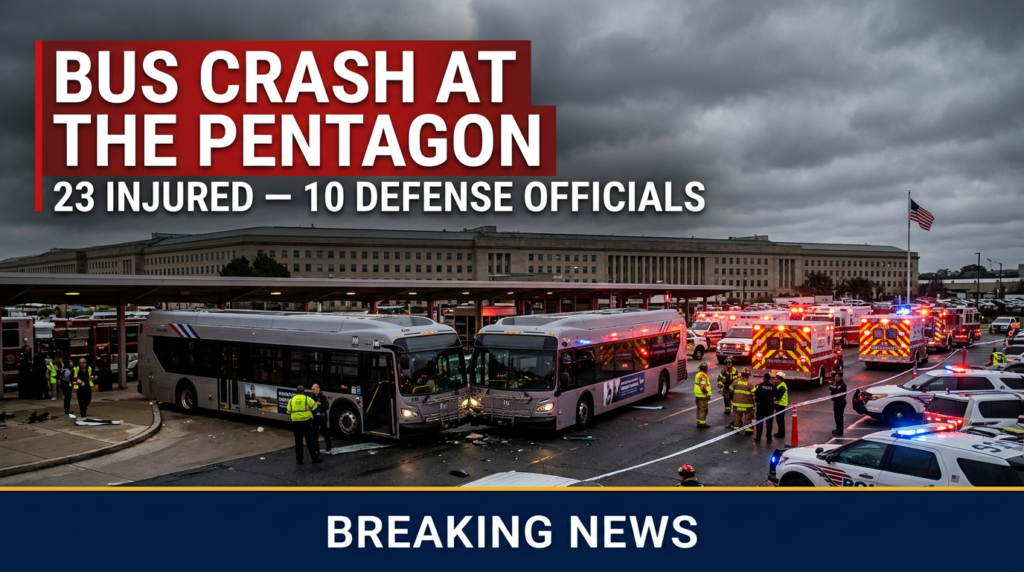
At 7:20 on a Friday morning, commuters heading to work at the Pentagon expected an ordinary start to their day. Instead, two public transit buses — an OmniRide commuter vehicle and a Fairfax Connector bus — collided head-on at the Pentagon Metro Station’s south parking lot in Arlington, Virginia. The result: 23 people injured, 18 hospitalized, and a major transit corridor thrown into chaos.
Ten of those injured were Department of Defense personnel — civilian and military staff heading into one of the world’s most security-conscious facilities. The crash didn’t happen inside those walls. It happened at a bus terminal meant to be a routine transit stop. The question now isn’t just what went wrong. It’s who’s responsible — and why this kind of preventable incident keeps happening at the doorstep of America’s military headquarters.
Support Independent Local Journalism
TheTownHall.News is a non-profit reader-supported journalism. Just $5 helps us hire local reporters, investigate important issues, and hold public officials accountable across Alameda County. If you believe our community deserves strong, independent journalism, please consider donating $5 today to support our work.What We Know About the April 24 Pentagon Bus Crash
The collision occurred at approximately 7:20 a.m. on Friday, April 24, 2026, at the Pentagon’s south parking lot bus terminal — a major transit interchange used daily by thousands of federal workers, contractors, and Northern Virginia commuters.
Officials described the incident as a “low-speed” head-on collision between the two public transit vehicles. Despite that characterization, the impact was severe enough to send 18 people to local hospitals for medical evaluation and treatment, while five others were treated at the scene and released.
The Pentagon Force Protection Agency (PFPA) launched an investigation immediately, closing the Metro Access Road near the Pentagon while first responders worked the scene. The Washington Metropolitan Area Transit Authority (WMATA) activated an alternate transit plan, diverting all affected bus traffic to Pentagon City station to manage the disruption.
As of this reporting, investigators have not publicly identified the cause of the crash. No timeline has been given for the release of findings.

A Symbol of Something Bigger
This crash didn’t happen in a vacuum. It happened steps from the Pentagon — the symbolic and operational heart of America’s national defense infrastructure — at a hub that processes thousands of government employees every single workday.
The fact that 10 Department of Defense personnel were among the injured is not a footnote. It is a headline. These are the men and women who support the defense of this nation, commuting on public transit just like millions of other Americans. When their morning commute ends in hospitalization, the agencies responsible for their safe transport need to answer for it — plainly and promptly.
There’s a broader civic principle at stake: government agencies entrusted with public funds and public safety must be held to rigorous, transparent standards. Not just the Pentagon — but every transit authority that serves it and the communities around it.
Transit Safety and the Accountability Gap
OmniRide and Fairfax Connector are both Northern Virginia transit operators — publicly funded, publicly trusted. Commuters pay fares. Taxpayers fund subsidies. In return, they expect a basic standard of operational safety.
A head-on collision between two buses at a controlled transit terminal is not a random act of nature. It is, by definition, a failure of operational protocol. Whether the cause turns out to be driver error, inadequate safety procedures, poor terminal layout, or equipment failure — something failed. And that failure put 23 people in pain on an ordinary Friday morning.
Support Independent Local Journalism
TheTownHall.News is a non-profit reader-supported journalism. Just $5 helps us hire local reporters, investigate important issues, and hold public officials accountable across Alameda County. If you believe our community deserves strong, independent journalism, please consider donating $5 today to support our work.The public deserves answers, and they deserve them quickly. Too often, when government-adjacent agencies are involved, investigations drag on for months, reports get quietly buried, and accountability evaporates. The workers and citizens who depend on these systems every day don’t have the luxury of vague timetables.
Transit agencies funded by the public must be accountable to the public. Full stop.
The Security Dimension Nobody Should Ignore
There is another layer to this story that deserves serious attention: the national security implications of a chaotic, injurious incident directly outside the Pentagon.
The Pentagon is not an ordinary office building. It is the headquarters of the U.S. Department of Defense — housing senior military commanders, classified operations, and critical infrastructure. Any disruption near its perimeter, even one that appears to be a straightforward accident, demands rigorous and transparent scrutiny.
To be clear: there is no evidence this was anything other than a transit accident. But the PFPA is investigating for a reason. The security environment around the Pentagon depends on predictability and control. A bus crash that closes roads, triggers emergency response, and sends government employees to hospitals is exactly the kind of disruptive scenario that security planners work to prevent — for reasons that go well beyond traffic management.
Americans who believe in law, order, and institutional integrity should want those questions addressed fully and on the record.
What Critics Will Say — And Why They’re Missing the Point
Some will argue this is being over-politicized — that accidents happen, buses crash, and we shouldn’t draw sweeping conclusions from a single incident.
That argument misses the point entirely.
Nobody is claiming this was a conspiracy or a manufactured scandal. The argument is straightforward: when publicly funded transit operators allow a head-on collision at a major federal transportation hub — injuring more than two dozen people including Defense Department employees — accountability is not optional. It is the minimum obligation of any institution that operates on public trust and public money.
A private company whose vehicles collided in this manner would face immediate regulatory scrutiny, civil litigation, and reputational damage. Public transit agencies deserve no less scrutiny — and arguably more, because they are shielded from market competition and backed by taxpayer dollars. Personal responsibility must extend to institutions, not just individuals. Those in charge of operations must own their failures, not explain them away with language about low speeds and ongoing investigations.
The Real Cost When Public Systems Fail
Beyond the immediate injuries, incidents like this carry real and measurable costs — financial, institutional, and deeply human.
There will likely be workers’ compensation claims from Defense Department employees injured during a government-subsidized commute. WMATA’s emergency rerouting of bus service adds direct operational costs to an already strained regional transit budget. Road closures ripple outward, disrupting thousands of additional commuters across Northern Virginia with consequences that compound throughout the workday.
And then there’s the human dimension that numbers alone don’t capture. Eighteen people were transported to hospitals on a Friday morning when they expected to start their workday. Even in a “low-speed” collision, injuries from bus crashes can include serious trauma — whiplash, fractures, concussions, and lasting pain. For some of those 18 individuals, the consequences of April 24 will extend far beyond the morning commute.
Fiscal accountability isn’t just about balancing budgets. It’s about ensuring that every dollar invested in public infrastructure — including transit — produces real safety outcomes for real people.
Key Takeaway
This is a developing story, and the investigation is ongoing. But the core facts are already on record:
- Two publicly funded buses collided head-on at the Pentagon’s primary transit terminal
- 23 people were injured — 18 hospitalized, 5 treated and released on-site
- 10 of the injured were Department of Defense personnel
- No cause has been officially determined
- The PFPA and partnering agencies are actively investigating
What happens next is the real test. Will investigators produce a clear, timely, publicly accessible report? Will the transit agencies involved face genuine accountability rather than bureaucratic deflection? Will meaningful reforms be implemented before another incident occurs at this critical location?
Those aren’t partisan questions. They are fundamental civic ones — and every American who rides a public bus, pays taxes, or values government accountability has a stake in the answers.
Accountability Doesn’t Stop at the Bus Terminal
A head-on bus crash at the Pentagon is not just a local traffic story. It is a test of whether public institutions — funded by citizens and trusted with their daily safety — can be held to real standards of performance and transparency.
Twenty-three people were hurt on a routine Friday morning commute. Ten of them serve in support of America’s national defense. They deserved a safe ride to work. They did not get one.
The public deserves to know why — and what will be done to ensure it never happens again. That is not a political demand. It is the most basic civic expectation: that those entrusted with public resources answer for how they use them.
Hold the line. Demand transparency. Stay informed.
This story is actively developing. Follow updates as the investigation progresses, share this article to keep public pressure on transit authorities, and support independent journalism that asks the hard questions. Civic accountability begins with an informed public — and it begins with you.