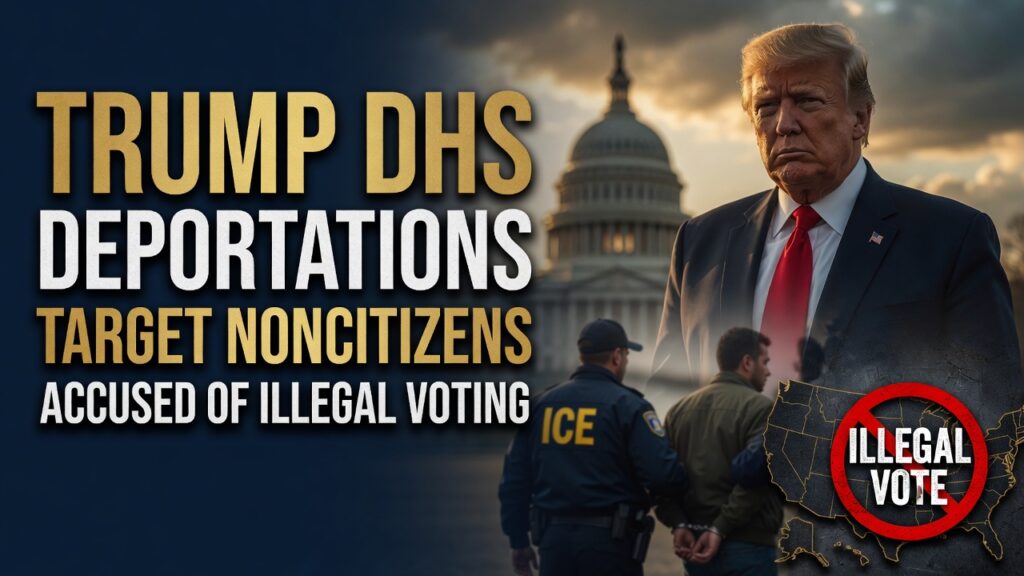
Trump DHS Deportations Target Noncitizens Accused of Illegal Voting: Is Election Accountability Finally Here?
As the Trump administration moves to accelerate deportation proceedings for noncitizens found to have voted illegally, a new debate is emerging over voter records, state transparency, and the role of the courts. Americans are increasingly asking whether existing safeguards are enough—and who should be responsible for enforcing them.
A new immigration directive is raising major questions.
The issue matters now because the Department of Homeland Security announced in June 2026 that immigration authorities will prioritize deportation proceedings against noncitizens determined to have unlawfully participated in U.S. elections. The move comes amid continuing disputes between federal officials and several states over access to voter information.
Support Independent Local Journalism
TheTownHall.News is a non-profit reader-supported journalism. Just $5 helps us hire local reporters, investigate important issues, and hold public officials accountable across Alameda County. If you believe our community deserves strong, independent journalism, please consider donating $5 today to support our work.What Did DHS Actually Change?
The answer is narrower than some headlines suggest.
Voting by noncitizens in federal elections was already illegal under existing law. What changed is the administration’s enforcement approach. DHS has directed immigration attorneys and ICE personnel to move such cases more quickly through the deportation process when evidence exists that a foreign national unlawfully cast a ballot.
The policy does not create a new criminal offense. Instead, it changes how immigration authorities prioritize cases already considered deportable under federal law.
Supporters say the measure reinforces confidence in elections and demonstrates that laws should be enforced consistently.

“Election laws only matter if violations carry consequences.”
Why Are States and Federal Officials Fighting Over Voter Data?
At the center of the dispute is access to information.
Federal officials have sought additional voter records from states to help identify potential cases involving noncitizens. Several states have cooperated to varying degrees, while others have raised privacy concerns and challenged requests in court.
State officials opposing broader disclosure argue that voter databases contain sensitive information and that federal requests must remain within legal limits.
Critics of those states argue that transparency is essential if election laws are to be enforced effectively.
Support Independent Local Journalism
TheTownHall.News is a non-profit reader-supported journalism. Just $5 helps us hire local reporters, investigate important issues, and hold public officials accountable across Alameda County. If you believe our community deserves strong, independent journalism, please consider donating $5 today to support our work.If government agencies cannot verify who is voting, how can citizens have confidence that the rules are being applied equally?
What Do the Numbers Actually Tell Us?
Cases involving noncitizen voting are relatively rare compared with the total number of ballots cast nationwide.
Election experts and researchers have repeatedly found that documented instances of illegal voting represent a small fraction of overall votes. At the same time, federal authorities maintain that even isolated violations deserve enforcement because public trust depends on equal application of the law.
More than 150 million Americans participated in the 2024 presidential election.
The question many voters are asking: how much illegal voting is too much?
The debate increasingly centers not only on scale, but also on accountability.
“Even rare violations raise larger questions about public confidence.”
Is the Supreme Court About to Step In?
At this moment, no.
Despite speculation circulating online, the Supreme Court has not announced emergency action involving the new DHS directive or ongoing disputes over voter records.
Individual lawsuits involving election procedures and privacy concerns continue to move through lower courts. Future appeals could eventually reach the Supreme Court, but no immediate intervention has been announced.
That distinction matters because many social media claims imply that the nation’s highest court is already preparing to act.
As of now, there is no public evidence supporting that claim.
Why Are Supporters Calling This a Turning Point?
Supporters view the directive as part of a broader effort to restore trust.
Many advocates argue that immigration laws and election laws should work together. In their view, citizens expect clear consequences for violations regardless of how frequently those violations occur.
They also contend that transparency from states strengthens confidence in election outcomes and reduces political polarization.
“If election laws exist, shouldn’t every level of government enforce them?”
What Do Supporters of This Policy Actually Believe?
Supporters of the policy believe faster deportation proceedings reinforce the rule of law and deter future violations.
Opponents, however, argue that isolated incidents should not be used to justify broader federal access to voter information. Civil-liberties groups have expressed concerns about privacy protections and the possibility of errors affecting lawful voters.
Both arguments deserve serious consideration.
Factually, documented noncitizen voting cases remain uncommon according to multiple studies. At the same time, federal law clearly prohibits such conduct, and immigration consequences already exist under current statutes.
The debate therefore centers less on legality and more on enforcement priorities, transparency, and balancing privacy with accountability.
Could This Debate Expand Beyond Immigration?
Possibly.
Questions surrounding voter records, election integrity, and federal-state authority are likely to continue regardless of which party controls Washington.
Some legal experts expect additional lawsuits over data-sharing requirements. Others predict Congress could revisit election-related legislation in future sessions.
The controversy highlights a broader question many Americans continue to debate: how should the country balance election security with individual privacy protections?
Key Questions
• Should states provide more voter information to federal authorities?
• Where should privacy protections end and enforcement responsibilities begin?
• If disputes continue, will the Supreme Court eventually be forced to intervene?
Conclusion
The larger issue extends beyond one DHS directive.
Americans across the political spectrum want confidence in elections, transparency from institutions, and fair application of the law. The current debate reflects differing views on how best to achieve those goals.
The question that remains is simple: can the nation strengthen election confidence without sacrificing privacy and federalism?
What do you think—is it too late to find common ground?
The real question isn’t whether this debate will continue—it’s whether leaders will answer the concerns voters are already raising.
Call to Action
Still have questions? Stay informed and subscribe for daily coverage.
Think others need to hear this? Share the article.
Want to make your voice count? Contact your congressional representative and ask how election laws and voter privacy should be balanced.
Join the conversation and let us know where you stand.