Is Destroying Palestinian Water Wells a War Crime — and Why Is Almost No One Talking About It?
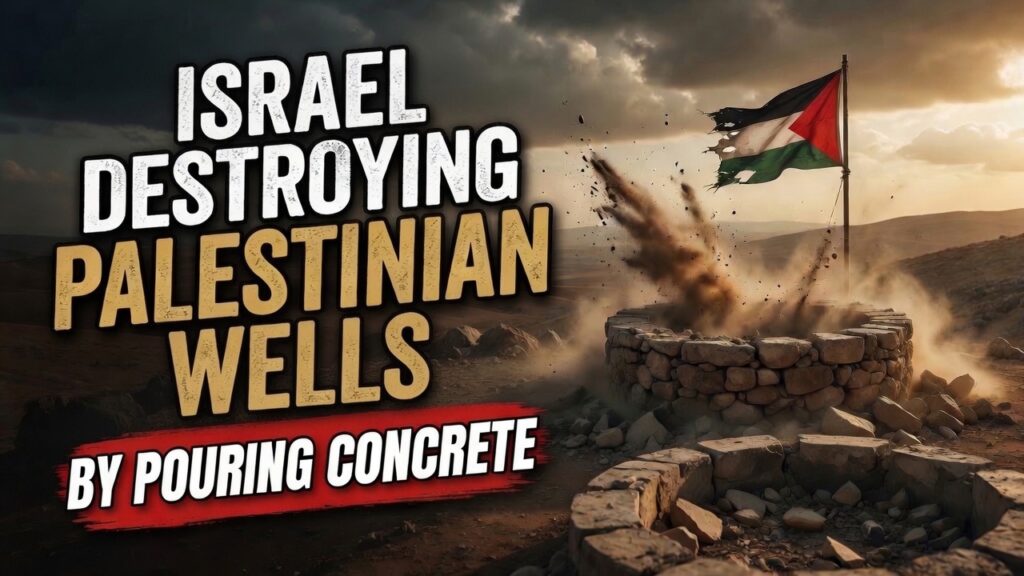
Israeli settlers and military forces have filled Palestinian wells with cement, seized springs serving hundreds of thousands, and driven entire communities from their land. The UN calls it systematic. International law calls it a war crime. Washington has largely looked away.
What Does “Weaponizing Water” Actually Look Like on the Ground?
On a February night in 2026, masked men sliced through the metal fence of the Ein Samiya pumping station in the occupied West Bank. Four workers were inside. Three fled. The fourth jumped into a manhole and crouched in the dark for 90 minutes while the attackers shattered monitors, severed electrical wires, and smashed pipes above him.
The Ein Samiya station is not a minor facility. It supplies clean water to more than 100,000 Palestinians across 19 communities northeast of Ramallah. When the attack ended, the taps ran dry for days.
Support Independent Local Journalism
TheTownHall.News is a non-profit reader-supported journalism. Just $5 helps us hire local reporters, investigate important issues, and hold public officials accountable across Alameda County. If you believe our community deserves strong, independent journalism, please consider donating $5 today to support our work.This was not an isolated incident. It was the latest entry in a documented, escalating campaign.
According to the United Nations Office for the Coordination of Humanitarian Affairs (OCHA), out of over 1,000 settler attacks against Palestinians in the West Bank in 2025, more than 350 targeted water sources and infrastructure — an average of nearly one attack per day. The targets have ranged from concrete poured into artesian wells to springs seized at gunpoint, to pipelines destroyed under military escort.
A report by Jerusalem’s Land Research Center found that Israeli forces have destroyed 1,986 wells, springs, reservoirs, and water tanks across the West Bank over the past decade.
That is not a byproduct of conflict. That is a pattern.

Has the Israeli Government Sanctioned This?
The question of whether these are rogue actors or state-sanctioned policy is no longer ambiguous.
Israeli Finance Minister Bezalel Smotrich has publicly praised settlers for seizing Palestinian water sources. In a widely circulated video, Smotrich told settler groups: “I see the results of your wonderful work.” Since October 2023, daily management of West Bank military affairs was reportedly restructured to report directly to Smotrich’s ministry — a shift that Palestinian water officials say has made Israeli military intervention against settler attacks nearly impossible to obtain.
“In the immediate aftermath of October 7, the Israeli side suspended all contact with us for weeks,” said a member of the joint Palestinian-Israeli water coordination committee, speaking to Mondoweiss. “Over time, it became clear that the entire Israeli military decision-making process for the West Bank had been placed under a civil authority reporting directly to Smotrich.”
The pattern bears out in the data. Israeli forces intervened to stop repeated settler attacks on the Ein Samiya reservoir east of Ramallah — a settlement-expansion zone where Israeli military interest diverged from settler interests. But in the South Hebron Hills and the Jordan Valley — both designated as priority settlement expansion zones — official response consisted of delays and bureaucratic deferrals while attacks continued unimpeded.
When the military protects some wells and ignores others, the distinction is not random. It maps to a land acquisition agenda.
Support Independent Local Journalism
TheTownHall.News is a non-profit reader-supported journalism. Just $5 helps us hire local reporters, investigate important issues, and hold public officials accountable across Alameda County. If you believe our community deserves strong, independent journalism, please consider donating $5 today to support our work.What Is the Scale of the Water Inequality?
To understand why destroying water infrastructure is so effective as a displacement tool, the baseline disparity must be understood.
Israel controls 80 to 84 percent of West Bank water resources under agreements signed during the Oslo Accords in 1995 — agreements that were intended to last five years. Three decades later, those same arrangements remain in force.
Under this system, Palestinians in the West Bank receive an average of approximately 70 liters of water per person per day. Israeli settlers in the same territory receive more than 300. The World Health Organization recommends a minimum of 100 liters per person per day for basic health and dignity.
In some marginalized communities — the Bedouin villages of the Jordan Valley, for instance — daily water access has dropped below 15 liters per person. Since October 2023, Palestinians in the Jordan Valley have had access to roughly 20 percent of the water available to them before that date — a supply that was already grossly inadequate.
Thirty-six percent of Palestinians in the West Bank lack consistent running water. Settlements have swimming pools.
Drone footage obtained by Reuters has captured the visual reality of this divide: withered, brown Palestinian greenhouses sitting directly adjacent to lush, irrigated settlement agriculture on the same aquifer.
“The Israeli settler consumes approximately seven times the amount of water a Palestinian citizen gets,” Jad Isaac, director of the Applied Research Institute-Jerusalem, told Al Jazeera. “The Palestinian individual’s share does not exceed 80 liters per day.”
How Does Destroying Wells Drive Displacement?
The connection between water destruction and forced displacement is not theoretical. It has played out in specific, documented communities across 2025 and 2026.
In al-Auja, near Jericho, Israeli settlers gradually blocked Palestinian access to a spring that farming families had relied on for generations. Settlers installed pumps to siphon water from the same aquifer at greater depth, leaving Palestinian pipes dry. Families who had farmed bananas and vegetables year-round found their livelihoods eliminated. In January 2026, the entire Ras Ein al-Auja Bedouin community was forced to leave.
“Staying here is becoming harder every day,” one resident told Mondoweiss. “Very soon, if this continues, we will barely be allowed to drink.”
In Salfit’s Farkha village, a spring serving 1,900 residents was blocked by Israeli bulldozers in June 2025. In Nablus, pipeline sabotage disrupted seven villages and 22,000 people for six days, with repairs blocked by military checkpoints. In South Hebron Hills, wells serving 150,000 Palestinians in Yatta were repeatedly attacked with no meaningful military response.
The pattern is consistent: destroy the water source, block the repairs, wait for the community to leave.
OCHA reported that by early 2026, nearly 700 Palestinians had been displaced due to settler attacks so far that year — with 600 of those coming from the Ras Ein al-Auja community alone, following the loss of their water supply.
Is This Illegal Under International Law?
Unambiguously, yes — under multiple frameworks.
The Fourth Geneva Convention, which governs the obligations of occupying powers, prohibits the destruction of property indispensable to the survival of the civilian population. Water infrastructure is explicitly covered. Deliberately depriving civilians of water access constitutes collective punishment, which is prohibited under Article 33.
The Rome Statute of the International Criminal Court defines the intentional deprivation of objects indispensable to survival — including water — as a war crime when directed against a civilian population.
UN Special Rapporteur on the Occupied Palestinian Territories Francesca Albanese has described the systematic destruction of Palestinian water infrastructure as part of what she characterized in her formal reports as a “genocidal strategy” — language that has been met with diplomatic controversy but has not been factually refuted.
The legal framework to call it what it is already exists. What remains to be seen is whether any enforcement mechanism will be applied.
What Is the Counterargument?
Israel’s official position rests on several pillars worth examining directly.
First, Israeli authorities argue that many Palestinian wells in Area C — which comprises 60 percent of the West Bank and remains under full Israeli military and civilian control — are “illegal” under the terms of the Oslo Accords, which require Palestinian construction permits from the Israeli Civil Administration. Palestinians counter that Israel issues such permits at a rate that makes legal construction practically impossible, and that the Oslo framework was designed as a five-year transitional arrangement, not a permanent governance structure.
Second, Israeli officials argue that military operations in the West Bank — including the ongoing “Iron Wall” operation launched in January 2025 — are security responses to Palestinian militant activity, not displacement campaigns. The IDF states that its aims are to neutralize militant infrastructure and preserve freedom of operation.
Third, some Israeli commentators distinguish between IDF actions and settler actions, arguing that settler violence, while a problem, should not be attributed to state policy.
Each of these arguments faces significant evidentiary pressure. Permitting data shows near-total denial rates for Palestinian construction applications in Area C. Human Rights Watch’s November 2025 report found that the destruction and depopulation of Nur Shams and refugee camps in Jenin and Tulkarm amounted to war crimes. And the documented restructuring of West Bank military authority under Smotrich’s ministry makes the settler/state distinction increasingly difficult to sustain.
Key Questions
- If the Oslo water framework was intended to last five years and has now persisted for three decades, what is the legal basis for Israel’s continued claim to control over 80 percent of West Bank water?
- Why have 350+ attacks on Palestinian water infrastructure in a single year produced no significant international sanction?
- What mechanism, if any, is capable of enforcing international humanitarian law in the occupied West Bank?
- At what point does systematic destruction of water infrastructure, combined with documented forced displacement, meet the legal threshold for crimes against humanity?
Who Controls the Water Controls the Land
Israeli Finance Minister Smotrich did not need to spell out the strategy in policy documents. The farmers of al-Auja, Yatta, Farkha, and Ein Samiya already understand it.
Destroy the well. Block the repair crew. Let the summer come.
The communities that have farmed these lands for generations are being presented with a choice that is not really a choice: leave voluntarily, or be made to leave by thirst. An occupation official captured it most directly in remarks reported to Palestinian farmers: “We don’t want to demolish the greenhouses ourselves. We want you to destroy them with your own hands.”
What is happening in the West Bank is not a water dispute. It is a documented, escalating campaign to render Palestinian agricultural communities uninhabitable — one well at a time.
The legal framework to call it what it is already exists. The evidence to support that conclusion is on the record. What remains to be seen is whether the international community will act on either.