Did the Federal Government Just Declare War on Illegal Voters — and Is a Judge Already Blocking It?
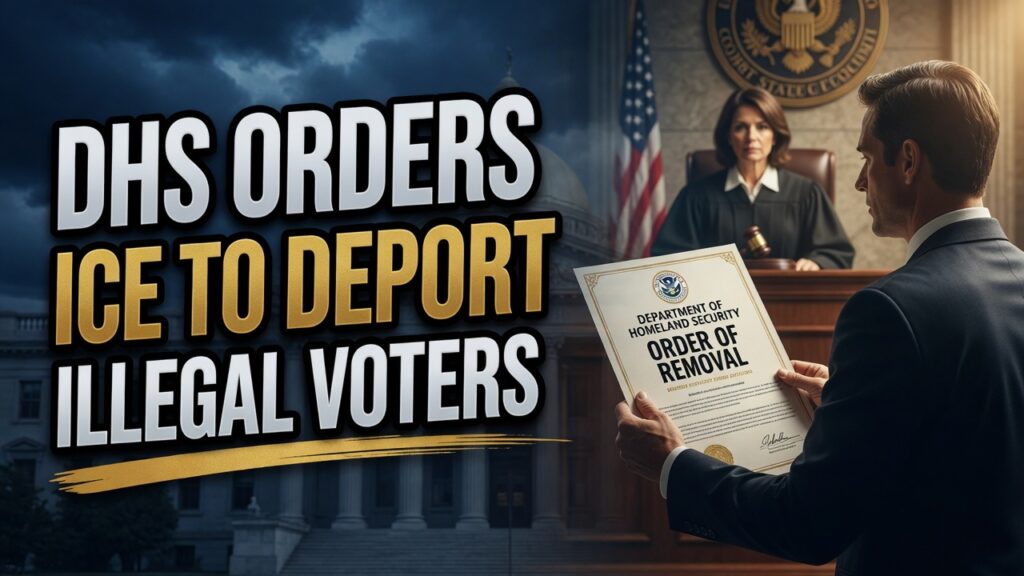
DHS issued a sweeping directive ordering ICE to deport anyone who votes illegally. A federal court just struck back. Here’s what’s really happening — and why it matters before the midterms.
The memo sitting on Charles Wall’s desk at DHS headquarters tells a simple story: vote illegally in America and get deported. No criminal conviction required. No trial. Just removal proceedings — for anyone, documented or not, who casts an unauthorized ballot in a U.S. election.
On June 9, 2026, DHS General Counsel James H. Percival II signed and released a memorandum directing OPLA — the Office of the Principal Legal Advisor, which oversees ICE’s legal enforcement arm — to invoke federal removability statutes against non-citizens who vote illegally “to the maximum extent allowed by law.”
Support Independent Local Journalism
TheTownHall.News is a non-profit reader-supported journalism. Just $5 helps us hire local reporters, investigate important issues, and hold public officials accountable across Alameda County. If you believe our community deserves strong, independent journalism, please consider donating $5 today to support our work.The directive is blunt, the legal authority is real, and the pushback from the courts has already begun.
What Does the DHS Memo Actually Say?
The Percival memo invokes multiple provisions of the Immigration and Nationality Act — specifically 8 U.S.C. §§ 1182(a)(10)(D)(i), 1227(a)(6)(A), 1182(a)(6)(C)(ii), and 1227(a)(3)(D) — which classify illegal voting and false claims of U.S. citizenship as deportable offenses.
These are not new laws. Congress has made it illegal for non-citizens to vote in federal elections since 1996. What is new is the directive to enforce those laws aggressively and systematically, treating immigration courts as the primary enforcement mechanism rather than the criminal justice system.
The memo makes two points that should alarm anyone inclined to dismiss this as political theater.

First: no criminal conviction is required. The Board of Immigration Appeals has established that removability under these statutes does not require the government to prove specific criminal intent. A non-citizen who walks into a polling place and casts a ballot — even one who claims ignorance of the law — can face removal based on administrative evidence alone.
Second: lawful residents are not exempt. The memo explicitly states that these provisions allow for the deportation of “even lawfully present aliens” who illegally participate in U.S. elections. A green card holder, a visa holder, a TPS recipient — if they vote without being a citizen, they can be removed.
“Illegal voting by aliens dilutes the votes of American citizens and undermines our democracy,” Percival wrote. “It must have consequences.”
This Isn’t Just a Policy Document — Arrests Are Already Happening
The June 9 memo is the latest escalation in an enforcement campaign that has been accelerating for months.
In March 2026, ICE and the FBI arrested Mahady Sacko, a Mauritanian national from Philadelphia who had been ordered removed by an immigration judge over two decades ago. Sacko had allegedly been voting in every presidential election since 2008 — seven federal elections — despite a final removal order upheld by the Board of Immigration Appeals in 2002.
Support Independent Local Journalism
TheTownHall.News is a non-profit reader-supported journalism. Just $5 helps us hire local reporters, investigate important issues, and hold public officials accountable across Alameda County. If you believe our community deserves strong, independent journalism, please consider donating $5 today to support our work.In May 2026, four additional non-citizens were charged with illegally voting in multiple federal elections and making false statements on citizenship applications while applying for U.S. status.
The Sacko case is significant not just as an example, but as a data point. He was not an undocumented laborer hiding in the shadows. He was a man with a documented removal order who voted repeatedly for 18 years because no system caught him. The Percival memo is built around closing exactly that gap.
The Scope Is Wider Than You Think: Naturalized Citizens Are Also Being Investigated
In February 2026, a separate internal DHS memo — obtained by multiple outlets — directed Homeland Security Investigations agents to conduct a nationwide program targeting a different category of individuals: naturalized U.S. citizens who may have voted or registered to vote before they completed the citizenship process.
The memo, headlined “Potential Voter Fraud – Denaturalization,” instructed HSI offices to review open and closed voter fraud cases and identify any individual who registered to vote or voted in any election — federal, state, or local — and subsequently became a naturalized citizen.
The legal statutes cited require that a person “knowingly” registered or voted while ineligible. But the scope of the review has unsettled federal prosecutors and law enforcement officials, who have warned that casting a broad net over naturalized citizens — people who are now fully American under law — raises serious due process concerns and could have a chilling effect on legitimate voter participation ahead of the November midterms.
The White House has been unapologetic. “President Trump is committed to ensuring that Americans have full confidence in the administration of elections, and that includes totally accurate and up-to-date voter rolls free of errors and unlawfully registered noncitizen voters,” a spokesperson said. “Noncitizen voting is a crime. Anyone breaking the law will be held accountable.”
A Federal Judge Just Blocked the Infrastructure Behind This Push
Four days ago, the enforcement campaign hit a significant legal wall.
On June 22, 2026, U.S. District Judge Sparkle Sooknanan — a Biden appointee sitting in Washington, D.C. — issued a 75-page ruling blocking the Trump administration’s expanded use of a federal database called SAVE: the Systematic Alien Verification for Entitlements system.
SAVE was originally created in 1986 to help agencies verify immigration status for benefits eligibility. Under Trump’s March 2025 executive order on election integrity, DHS overhauled it into something far more powerful: a bulk-searchable citizenship verification tool, free for state and local election officials, that could cross-reference voter rolls against Social Security numbers, naturalization records, and citizenship data pulled from multiple federal agencies — including DOGE.
At least 25 states used the revamped SAVE to scrub their voter rolls. Over 67 million voter registrations were scanned through the system.
The problem, Judge Sooknanan found: the data was unreliable, the overhaul was illegal, and real American citizens were being removed from voter rolls as a result.
“The federal government has knowingly trampled on the privacy rights of American citizens in a manner that threatens the sacred right to vote,” she wrote. “This Court cannot stand idly by while that happens.”
The ruling found that the expanded SAVE system violated three separate federal laws: the Social Security Act, the Privacy Act, and the Administrative Procedure Act. Sooknanan said that agencies had “haphazardly combined and repurposed the private information of millions of Americans, including citizenship data that they knew to be unreliable.”
Anthony Nel, a South African-born naturalized U.S. citizen living in Denton, Texas, had his voter registration cancelled after the state ran its rolls through SAVE. The system incorrectly flagged him as a potential non-citizen. He had been an American citizen for over a decade.
Percival fired back on X within hours of the ruling: “It’s amazing how hard the Left will fight to stop us from solving problems they insist do not exist.”
The DOJ vowed to continue defending the SAVE system in court.
What Are the Key Legal Questions at Stake?
The administration’s position is legally coherent on the narrow question of non-citizen voting. Federal law has always prohibited it. The INA has always classified it as a deportable offense. The Board of Immigration Appeals has confirmed that intent is not required. These are not novel legal theories — they are settled statutory provisions that have simply never been enforced at scale.
The legal fight over the SAVE database is a different matter entirely. The question there is not whether non-citizens should vote — they shouldn’t — but whether the federal government can construct a nationwide citizenship verification infrastructure using Social Security data and immigration records without congressional authorization, and whether that infrastructure is accurate enough to be trusted when the penalty for a false positive is losing your right to vote.
Judge Sooknanan’s answer: no, and no.
The administration’s election integrity efforts have now been blocked in multiple federal courts. Three separate judges have blocked provisions of the March 2025 executive order requiring proof of citizenship to register to vote. A March 2026 executive order restricting mail-in voting is also facing active legal challenges.
Key Questions
- How many non-citizens are actually voting in federal elections, and what evidence exists beyond high-profile individual cases?
- How many U.S. citizens had their voter registrations incorrectly cancelled due to the faulty SAVE database before Judge Sooknanan’s ruling?
- Will the DOJ appeal, and is this case headed to the Supreme Court before the November 2026 midterms?
- Does the investigation of naturalized citizens for pre-citizenship voting constitute a denaturalization effort, and what legal threshold triggers that outcome?
- How will the SAVE ruling affect the DHS memo’s enforcement capacity, given that administrative records were cited as the evidentiary basis for removal proceedings?
The federal government’s position on illegal voting is legally unambiguous: it is a crime, and it is a deportable offense. The Percival memo enforces laws that have been on the books for 30 years. The arrests that preceded it targeted individuals who had been ordered removed and voted anyway for nearly two decades without consequence.
The court battle over the SAVE database, however, is not about whether non-citizens should vote. It is about whether the machinery being built to stop them is reliable enough not to sweep up the citizens it claims to be protecting.
Both sides say they are defending the integrity of the vote. The federal judiciary will decide which one is right — almost certainly before November.