Costco Gas Stations Closed in Hayward — Is California Heading Into a 1979-Style Crisis at the Pump?
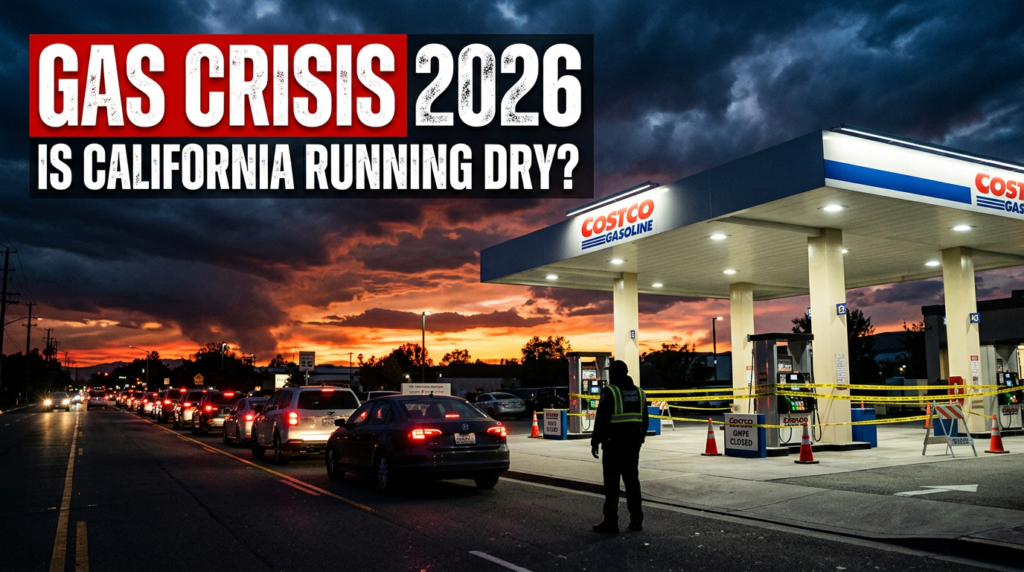
I didn’t think much of it when I pulled off the freeway toward the first Costco gas station in Hayward on Saturday. It’s usually one of the most reliable, affordable places to fill up in the Bay Area. Long lines, sure — but the pumps are always running. Costco members know the drill: you wait because the price is worth it.
Except this time, there was no line. There was no wait. There was a security guard standing at the entrance, arms crossed, delivering the same message to every driver who pulled up: the gas station is closed today.
I drove to a second Costco location in Hayward. Same thing. Security posted. Pumps dark. No explanation offered, no estimated reopening, nothing posted on a sign or on the app. Just a closed gate and a uniformed guard waving people away.
Support Independent Local Journalism
TheTownHall.News is a non-profit reader-supported journalism. Just $5 helps us hire local reporters, investigate important issues, and hold public officials accountable across Alameda County. If you believe our community deserves strong, independent journalism, please consider donating $5 today to support our work.I sat in my car for a moment and thought: when was the last time I saw this?
Then it hit me. I’ve seen this in history books. I’ve heard about it from my parents. This is how it started in 1979.
A Ghost From the Past
For those too young to remember — or who weren’t alive — the 1979 energy crisis was not a slow burn. It was a shock. The Iranian Revolution disrupted global oil supplies almost overnight, and Americans who had grown dependent on cheap, abundant gasoline suddenly found themselves sitting in lines stretching around city blocks, waiting hours just to get a few gallons. States rolled out odd-even rationing — if your license plate ended in an odd number, you could only buy gas on odd-numbered days. Even-numbered plates, even-numbered days. Fights broke out at stations. People ran out of gas waiting in line. President Jimmy Carter went on national television in July 1979 to address what he called a crisis of confidence. The pumps running dry wasn’t just an inconvenience — it was a psychological rupture. Americans realized, for the first time in modern memory, that the system they had trusted completely could simply stop working.
Fast forward to today. The details are different, but the shape of the problem is hauntingly familiar.

California’s Refinery Problem Is Not a Future Threat — It’s Here Now
California has been quietly gutting its own fuel supply for years, and the consequences are now arriving at gas stations across the state.
In October 2025, Phillips 66 shut down its Los Angeles refinery — one of the largest in the state. This spring, Valero’s Benicia refinery, located right here in the Bay Area, is closing its doors as well. Together, these two closures will eliminate approximately 17 to 18 percent of California’s total refining capacity by mid-2026, according to the U.S. Energy Information Administration.
Do the math on that. California currently consumes roughly 1.40 million barrels of gasoline per day. After the closures, the state’s maximum refining capacity will sit at just 1.34 million barrels per day — below what we actually use. And that’s assuming every remaining refinery is running at full capacity, with zero unplanned outages, zero maintenance shutdowns, zero disruptions.
There is no buffer. There is no cushion.
Making matters worse is a structural trap that California has built for itself: because the state requires a unique, specially-formulated gasoline blend — California Reformulated Gasoline (CaRFG) — that meets standards no other state uses, you cannot simply truck or rail in fuel from Nevada, Arizona, or Texas to fill the gap. Federal-spec gasoline doesn’t meet California’s standards. There are no interstate pipelines feeding into California. Every gallon that has to be imported must come by ship, through West Coast ports, from places like the Bahamas and South Korea. After the Phillips 66 closure, gasoline imports into California climbed to their highest level since at least 2016, according to a Fortune report from February.
Support Independent Local Journalism
TheTownHall.News is a non-profit reader-supported journalism. Just $5 helps us hire local reporters, investigate important issues, and hold public officials accountable across Alameda County. If you believe our community deserves strong, independent journalism, please consider donating $5 today to support our work.We are importing gas from the Bahamas to keep California running.
$7, $8 — And Possibly More
The price warnings have been sounding for over a year. A March 2025 analysis by USC’s Michael Mische projected California gas prices exceeding $8.00 per gallon once the full weight of the refinery closures is felt. Stillwater Associates, a respected energy consultancy, warned in June 2025 of an acute gasoline shortage beginning in 2026 and potentially lasting past 2030.
By last week, some gas stations in California were already crossing $7 per gallon, according to the LA Times, which noted state regulators had opened an investigation into price gouging. The statewide high as of March 30 hit $5.71 for regular — but those are averages. In parts of the Bay Area and LA, drivers were seeing numbers on the pump that looked like a typo.
State Senator Suzette Valladares has described California’s situation as a “death spiral” — tighter supply, higher prices, more people switching to EVs, fewer customers for gas stations, less investment in infrastructure, tighter supply again. The cycle compounds itself.
California has 1.6 million battery electric vehicles on the road. Out of 30.8 million total registered vehicles. The electric fleet would need to triple just to offset the coming loss in gas supply. That is not happening by next year. Or the year after.
It’s Not Just the Gas
While I was out on Saturday, taking note of the closed pumps and the security guards, I stopped at a grocery store nearby. I needed tomatoes.
They were $7.50. Up from $1.20 not long ago.
This wasn’t an isolated sticker shock. Bloomberg reported in March that tomato prices surged 6.4% in February alone — the largest monthly jump in a decade. Lettuce was up 12.2% in the same period, the steepest monthly spike since December 2018. California grocery prices are running at 3.3% annual inflation — more than double last year’s rate and well above the national average.
It is all connected. When fuel costs rise, so does everything that requires transportation, refrigeration, and logistics — which is every single item on every single grocery shelf. The inflationary pressure doesn’t stay at the pump. It spreads into the supply chain, into the cost of farming, into the price of getting a crate of tomatoes from the Central Valley to a store in Hayward.
We are watching a cost-of-living squeeze happen in real time, and most people won’t name it clearly until it’s already deeply embedded in daily life.
What Happens Next
A security guard at a Costco gas station could mean anything. Maintenance issue. A computer glitch. A routine inspection. I want to be fair about that — two closures on one day don’t prove a pattern.
But here is what I know for certain: the structural conditions for a serious, prolonged gasoline shortage in California are not a forecast anymore. They are present. The refineries are closing. The imports are inadequate. The prices are already rising sharply. And when I pulled up to not one but two Costco stations in Hayward and found them dark and guarded — my first thought wasn’t maintenance.
My first thought was 1979.
If you have a car, keep the tank full. Don’t let it drop below half. If you’re shopping, buy what you need when you see it at a reasonable price, because there’s no guarantee that price holds through next week. Pay attention to what’s happening at your local gas station, not just the number on the sign but whether it’s open at all.
The warning signs are not subtle. We just have to be willing to see them.
Tom Wong is a reporter at The Town Hall News covering Bay Area news and consumer issues. Have a tip or a story lead? Reach him at info@coral-mouse-650338.hostingersite.com