HPE California to Texas Move Exposes the Real Cost of One-Party Governance
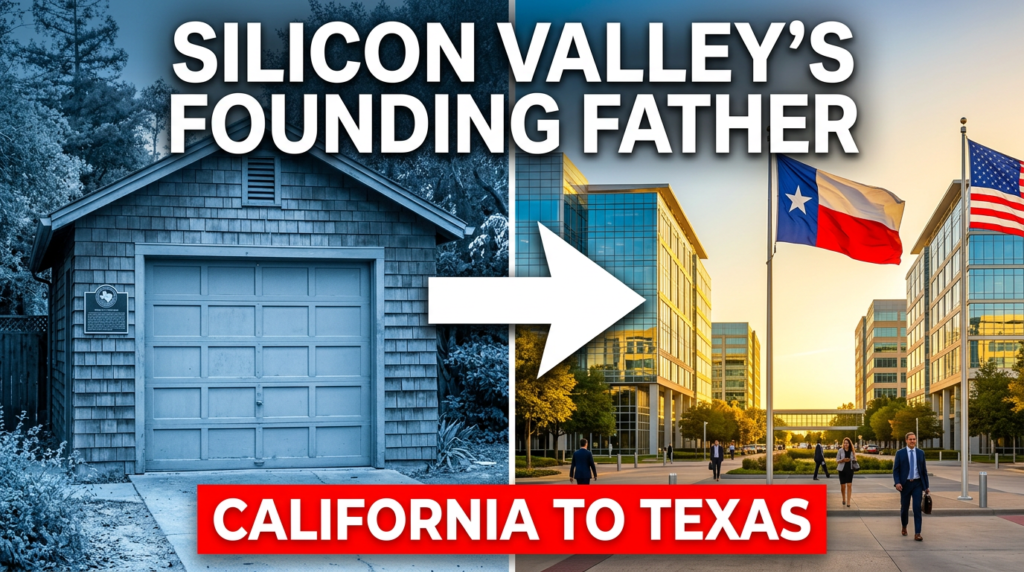
When the company that literally built Silicon Valley relocates its headquarters to Texas, it’s not a footnote in the business section. It’s a verdict. Here’s what HPE’s departure reveals about the real cost of one-party governance — and what every taxpayer and business owner needs to understand.
In 1939, two Stanford engineers named Bill Hewlett and Dave Packard started a technology company in a small Palo Alto garage with just $538. That modest space — now a California Historical Landmark — is widely regarded as the birthplace of Silicon Valley itself. What Hewlett and Packard built there helped shape the modern digital world, defined American innovation for generations, and turned a California orchard town into the global capital of technology.
Today, Hewlett Packard Enterprise (HPE) runs its global headquarters from Spring, Texas — a suburb just north of Houston. The move, announced in December 2019 and fully operational by 2022, wasn’t a protest or a political stunt. It was a straightforward business decision by executives who ran the numbers, weighed the regulatory environment, and chose accordingly. When the company that gave Silicon Valley its identity reaches that conclusion, the rest of the country would be wise to pay attention.
Support Independent Local Journalism
TheTownHall.News is a non-profit reader-supported journalism. Just $5 helps us hire local reporters, investigate important issues, and hold public officials accountable across Alameda County. If you believe our community deserves strong, independent journalism, please consider donating $5 today to support our work.The Numbers Behind the Exit
Business relocations don’t happen on a whim. They happen when the math stops working.
California imposes the highest state income tax rate in the nation — 13.3% on top earners — a rate that applies not just to billionaires, but to the engineers, executives, and entrepreneurs who build and run companies. Texas has no state income tax whatsoever. For a senior technology executive earning $500,000 annually, that single difference can translate to tens of thousands of dollars in annual savings. Multiply that across an entire leadership team, and the financial case becomes nearly impossible to argue against.
Then there’s the broader cost environment. California consistently ranks among the most expensive states in the nation for housing, commercial real estate, and business operations. Energy prices, litigation exposure, and layered regulatory compliance add further burdens. For an enterprise managing a global workforce and multi-billion-dollar infrastructure investments, these are not abstract concerns — they are existential line items on a balance sheet.
Crucially, since relocating, HPE has not struggled. The company reported fiscal first-quarter 2026 revenues of $9.3 billion — up 18% year-over-year — driven by strong AI infrastructure demand and its acquisition of Juniper Networks. The company that left Silicon Valley is posting some of the strongest growth in its recent history. That’s not a coincidence; it’s a result.

Texas Offered What California Wouldn’t
Texas Governor Greg Abbott didn’t just welcome HPE — he built a sustained policy environment designed to attract companies that felt squeezed out of high-regulation, high-cost states. The state’s pitch is direct: no income tax, a predictable regulatory framework, a rapidly growing skilled workforce, and a government that treats businesses as engines of community prosperity rather than revenue sources to be endlessly tapped.
HPE’s campus in Spring, Texas, represents precisely the kind of long-term investment that creates stable employment, builds local tax bases, and strengthens regional economies. The company’s decision wasn’t just about escaping California — it was an affirmative vote for a state that made clear it wanted the business there.
That contrast in governing philosophy matters enormously. When states compete for employers, workers and communities win. When a state operates with no incentive to reform because its political class has insulated itself from economic consequences, the opposite tends to follow.
California’s Response: Indifference as Policy
Perhaps the most revealing part of this story isn’t HPE’s departure — it’s how California’s leadership responded to it.
Reports at the time indicated that Governor Gavin Newsom’s office offered little more than a dismissive acknowledgment that companies come and go. No substantive policy review was announced. No honest reckoning with the concerns that drove the decision. Just an institutional shrug in response to the symbolic loss of the company that helped build the state’s technology identity.
Support Independent Local Journalism
TheTownHall.News is a non-profit reader-supported journalism. Just $5 helps us hire local reporters, investigate important issues, and hold public officials accountable across Alameda County. If you believe our community deserves strong, independent journalism, please consider donating $5 today to support our work.That indifference is itself a governing philosophy. It signals that retaining productive businesses and high-earning residents is simply not a priority — that California’s political calculus no longer requires it. When even the departure of Silicon Valley’s founding institution doesn’t prompt serious reflection, the message to every remaining business is unmistakable: don’t expect conditions to change.
A Pattern California Refuses to Acknowledge
HPE is far from alone. In recent years, a significant wave of companies — from large publicly traded corporations to mid-sized firms — have relocated headquarters or primary operations out of California. High-profile departures have included Tesla, Oracle, and Charles Schwab, each citing similar concerns: cost, regulatory complexity, and a policy environment perceived as structurally hostile to growth.
This is not partisan mythology. It is a documented pattern reflected in relocation data, commercial real estate trends, and population migration statistics. California has faced repeated budget shortfalls driven in part by the departure of high-earning taxpayers whose exit reduces the state’s revenue base — the very base that funds public services relied upon by millions of residents who lack the option of simply moving their office to Houston.
The consequences fall hardest not on executives who relocate comfortably, but on working- and middle-class Californians who stay — small business owners, tradespeople, and young families facing rising costs without a relocation package to soften the blow.
What Critics Get Wrong
The standard counterargument is that California’s economy remains large and resilient — and that’s accurate. The state still commands one of the world’s largest GDPs, houses a premier university system, and attracts significant venture capital investment. These are real advantages and deserve acknowledgment.
But size is not the same as direction. A state can be economically significant and still be heading the wrong way. The relevant question isn’t whether California is surviving today — it clearly is — but whether its current policy trajectory is sustainable over the next decade.
When taxation, housing costs, and regulatory complexity consistently push productive individuals and institutions to competing states, the erosion of the long-term tax base is not a hypothetical — it’s arithmetic. And arithmetic doesn’t respond to press releases.
What This Move Means for Every Business Still in California
HPE’s relocation carries significance beyond the business pages because of what this company represents. Its founders’ garage is a registered historical landmark. If that institution determined that California’s policy environment was incompatible with its long-term interests, it establishes a precedent — and a quiet permission structure — for every other company currently running the same calculation.
The businesses that remain in California largely do so because of talent networks, proximity to capital, and industry clustering — not because the state has made it easy. The moment those advantages erode sufficiently, the exit calculus shifts again. And the data suggests that process is already underway.
States that govern with fiscal discipline, regulatory restraint, and genuine respect for the businesses and individuals who generate economic activity will attract more of both. States that treat taxation as limitless and regulation as a virtue rather than a practical tool will keep reading departure announcements.
HPE made its decision. It’s thriving in Texas. The lesson is available to anyone willing to learn it.
💬 Share-worthy line: “When the company founded in a $538 garage decides California isn’t worth the cost, that’s not a corporate complaint — it’s a policy verdict.”
What We Know for Certain
The story of HPE’s move to Texas is ultimately a story about accountability — the foundational principle that policies carry consequences, that businesses respond rationally to incentives and disincentives, and that governments which ignore those realities eventually pay a measurable price.
California still has formidable strengths. But those strengths are not self-replenishing in the absence of sound fiscal and regulatory governance. HPE’s departure warranted serious, honest reckoning. It received a shrug.
Meanwhile, in Spring, Texas, a legendary American technology company is posting record growth, building AI infrastructure for the next decade, and investing in its future — in a state that actively competed to have it there.
The contrast speaks for itself.
Stay Informed. Make Your Voice Heard.
Stories like this one rarely make the front page for long — but their consequences last for decades. If this article challenged your thinking or reinforced concerns you already had, share it with someone in your network who needs to read it. Subscribe for independent coverage that follows the facts, not the political convenience. And when local, state, or federal elections come around, remember: governance has a price tag. Citizens who stay informed are the ones who hold that bill to account.