Strait of Hormuz Declared Open in 2026 — But Iranian Mines and the U.S. Blockade Tell a Different Story
Iran says the world’s most critical oil chokepoint is back in business. The U.S. Navy says otherwise — and the facts back them up.
For seven weeks, the world held its breath. Beginning February 28, 2026, Iran’s Islamic Revolutionary Guard Corps shut down the Strait of Hormuz — the narrow passage through which roughly 20 percent of the world’s oil and 20 percent of its liquefied natural gas travels every day. Tankers were struck. Crew members were killed. Brent crude climbed to $126 per barrel. And the global economy trembled.
Then America stepped in.
Support Independent Local Journalism
TheTownHall.News is a non-profit reader-supported journalism. Just $5 helps us hire local reporters, investigate important issues, and hold public officials accountable across Alameda County. If you believe our community deserves strong, independent journalism, please consider donating $5 today to support our work.After weeks of diplomatic failure — UN resolutions vetoed by Russia and China, European partners hesitating, and peace talks that collapsed in Islamabad on April 12 — the United States took decisive action. President Trump declared a full naval blockade of Iranian ports on April 13. U.S. destroyers entered the strait for the first time since the conflict began. Mine-clearing operations commenced. And now, Iran has declared the Strait of Hormuz “completely open and ready for full passage.”
It sounds like a victory. And in some important ways, it is. But the real story is more complicated — and far more consequential.
What Actually Happened in the Strait
The crisis began on February 28 when the United States and Israel launched Operation Epic Fury, targeting Iran’s military infrastructure. In retaliation, Iran’s IRGC moved immediately to close the Strait of Hormuz — deploying small vessels to lay naval mines while broadcasting VHF warnings that no ships would be permitted to pass.
The human and economic toll was swift. On March 1, the MT Skylight was struck by a projectile, killing two crew members. By March 8, Brent crude had surpassed $100 per barrel for the first time in four years. The United States destroyed 16 Iranian minelayers on March 10 and launched a broader military campaign to reopen the strait on March 19.

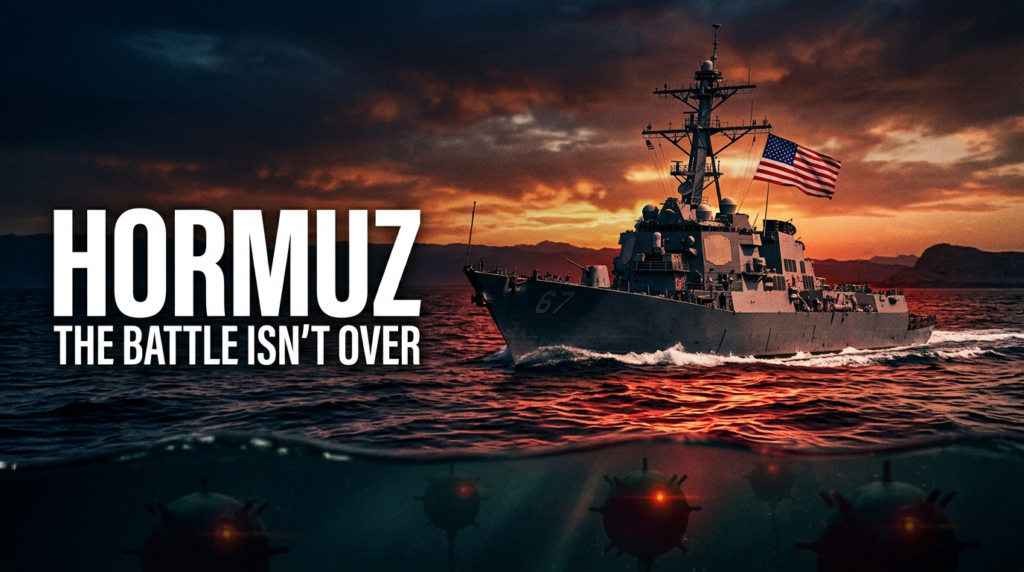
But the IRGC had already planted an unknown number of mines — and here is the detail that should alarm every American paying attention: Iran itself has admitted it cannot locate all of the mines it planted. The world’s most important energy corridor remains, to this day, a live minefield.
The Mine Problem the Media Is Underreporting
Iran deployed two primary mine types. The Maham 3 is a 300-kilogram anchored mine capable of operating in waters up to 100 meters deep. The Maham 7 is a 220-kilogram bottom-resting device with a conical shape specifically engineered to evade sonar detection. Both use magnetic and acoustic sensors to trigger detonation when a vessel passes nearby.
According to U.S. officials, Iran has indicated it lacks both the ability to locate and the capability to remove all of the mines it deployed. That is not a minor technical footnote. It means Iran opened a door it cannot fully close — and commercial vessels transiting the world’s most critical chokepoint are doing so over an incomplete minefield.
The U.S. military began mine-clearing operations on April 11, sending the USS Frank E. Petersen and USS Michael Murphy into the strait for the first time since the war began. The Navy is deploying Knifefish undersea drones, MCM anti-mine vessels, and MH-60S helicopter-launched Archerfish mine-neutralization systems. These are sophisticated tools. But clearing mines from contested, shallow waters — particularly sonar-evading devices planted in unknown quantities — is slow and dangerous work.
The IRGC has issued an unambiguous warning: any military vessel approaching the strait will be treated as a ceasefire violation and met with a “severe response.” U.S. mine-clearing crews are operating under direct threat while performing a mission the world depends on.
Support Independent Local Journalism
TheTownHall.News is a non-profit reader-supported journalism. Just $5 helps us hire local reporters, investigate important issues, and hold public officials accountable across Alameda County. If you believe our community deserves strong, independent journalism, please consider donating $5 today to support our work.The Real Cost of Seven Weeks of Inaction
It is worth pausing to account for what those seven weeks cost.
The closure of the Strait of Hormuz was not a surprise. Iran has threatened this move for decades. Yet when the moment came, the international response was predictable in its inadequacy. UN resolutions were vetoed. European partners deliberated. And Iran, emboldened by the absence of consequences, moved to extort the global economy — charging merchant ships tolls exceeding $1 million per vessel simply to transit the waterway.
This is the inevitable outcome of treating a state sponsor of terrorism as a reliable diplomatic partner without meaningful enforcement. Personal responsibility and the rule of law are not values that apply only to citizens. They must apply to nations. When rogue actors face no consequences, working families pay the price — in higher gas bills, higher shipping costs, and higher prices for nearly everything that moves by sea.
Brent crude peaked at $126 per barrel during this crisis. The downstream effects touched every household in America and across the world.
What Critics of the U.S. Response Get Wrong
Critics of the U.S. action have raised legitimate concerns: that a naval blockade risks escalation, that unilateral military decisions undermine multilateral frameworks, and that diplomacy should have been given more time.
These arguments deserve honest engagement. The risks of military escalation are real. And the collapse of the Islamabad Talks on April 12 is a reminder that diplomatic channels carry value even when progress is difficult.
But the counterargument is grounded in what actually happened. Seven weeks of multilateral effort failed to move a single tanker safely through the strait. Iran’s April 8 ceasefire was exploited within 24 hours — the IRGC began charging tolls and restricting traffic almost immediately, rendering the agreement functionally worthless. The talks in Islamabad did not fail because America overreached. They failed because Iran’s negotiating posture was not made in good faith.
When diplomacy is used as a stalling mechanism by an adversary with a history of deception, infinite patience is not a strategy. It is a vulnerability.
The Blockade Is Still in Force — and That Matters
Despite Iran’s public declaration, the U.S. naval blockade remains fully active as of April 17, 2026. The Pentagon has confirmed that 13 ships have been turned back. Vessels that previously paid Iran’s illegal tolls are being intercepted. And Naval Forces Central Command has expanded the blockade to include sanctioned ships — tightening economic pressure beyond the strait itself.
This is not a posture of withdrawal. It is sustained enforcement, backed by the political will to see it through.
The Strait of Hormuz may be declared open. It is not yet safe. And America is not yet done.
What This Means for Long-Term Energy Security
The 2026 Hormuz crisis has exposed structural vulnerabilities in global energy infrastructure that demand lasting responses — not just tactical ones.
The United States must press allies — particularly in Europe and Asia — to contribute meaningfully to the security of global sea lanes. The burden cannot fall permanently on the U.S. Navy alone. Burden-sharing is both a fiscal necessity and a strategic one. At the same time, accelerating domestic energy production and LNG export capacity remains a core national security priority. Dependence on unstable transit corridors is a liability that this crisis has priced in stark terms.
The mine-clearing mission must also be completed with full transparency. Commercial shipping operators and trading nations deserve accurate information about the remaining threat in the water — not for political purposes, but as a basic matter of maritime safety and global commerce.
Conclusion: The Declaration Is Not the Victory
Iran’s announcement that the Strait of Hormuz is “completely open” is a diplomatic signal, not an operational reality. Live mines remain in the water. The U.S. blockade is in force. The ceasefire is fragile. And the underlying conditions that allowed this crisis to unfold — sustained Iranian aggression, institutional failure at the multilateral level, and years of insufficient deterrence — have not been resolved.
What has been demonstrated is that American resolve, backed by military capability and political will, can achieve what institutions alone cannot. That is not a case for permanent unilateralism. But it is a clear and powerful reminder of what American strength means for global stability.
The strait may be open. The work is not finished.
Key Takeaway: Iran cannot locate all of the mines it planted in the Strait of Hormuz. U.S. mine-clearing operations are underway — under direct threat from the IRGC. Iran’s “open” declaration may move markets. On the water, the hazard is real and ongoing.
If this article helped you understand what’s actually happening in the Strait of Hormuz, share it with someone who needs the full picture. The mainstream coverage has focused on declarations and diplomatic signals. The operational reality — live mines, an active blockade, a collapsed peace process — deserves wider attention. Stay informed, stay engaged, and support independent journalism that doesn’t filter the facts through political convenience.