Strait of Hormuz Open: Trump’s Naval Strategy Forces Iran’s Hand — But the Real Battle Is Just Beginning
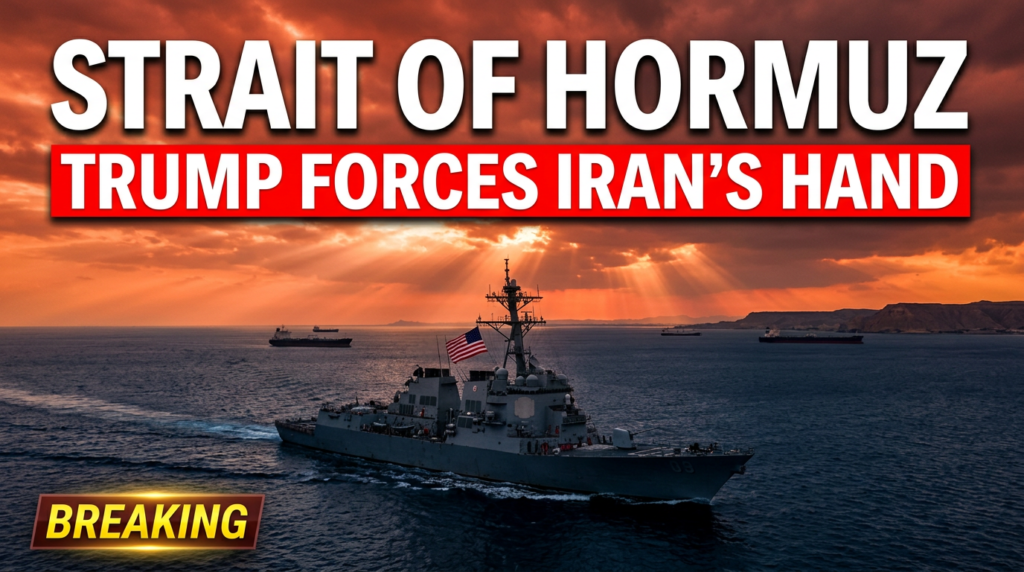
Iran declared the Strait of Hormuz “completely open and ready for full passage” — but with sea mines still lurking beneath the waterway and a full U.S. naval blockade in force, the real story is far more consequential than a single press release from Tehran suggests.
For nearly seven weeks, the world’s most critical oil chokepoint sat under Iranian control — closed, mined, and held hostage by a regime that has spent decades testing the limits of American resolve. Then came the announcement heard around the world’s trading floors: Iran declared the Strait of Hormuz “completely open and ready for full passage.”
Cue the headlines. Cue the social media victory laps. But before Americans start celebrating at the pump, they need the full picture — because the situation on the water is messier, more dangerous, and more significant than a single statement from Tehran can capture. What is unambiguous, however, is this: maximum American pressure — diplomatic, military, and economic — is what brought Iran to this moment. Not UN resolutions. Not multilateral hand-wringing. American strength.
Support Independent Local Journalism
TheTownHall.News is a non-profit reader-supported journalism. Just $5 helps us hire local reporters, investigate important issues, and hold public officials accountable across Alameda County. If you believe our community deserves strong, independent journalism, please consider donating $5 today to support our work.How We Got Here: Seven Weeks That Shook Global Energy Markets
On February 28, 2026, Iranian forces closed the Strait of Hormuz to all foreign shipping following U.S. and Israeli airstrikes. The IRGC issued blunt radio warnings: “No ship is allowed to pass.” By March 4, the regime claimed “complete control” of the waterway.
The stakes could not be higher. The Strait of Hormuz — a 21-mile-wide passage between Iran and Oman — carries approximately 20 percent of global oil consumption and roughly 20 percent of worldwide LNG trade, according to the U.S. Energy Information Administration. Nearly 90 percent of Gulf crude exports flow through it. When Iran slammed that door shut, it wasn’t merely a military maneuver. It was economic warfare waged against the entire world.
President Trump responded with methodical escalation. On March 12, he announced the U.S. Navy would begin escorting oil tankers. On March 19, American forces deployed A-10 Thunderbolt II jets and AH-64 Apache gunships to destroy Iranian fast-attack watercraft and drone assets. On March 21, Trump issued a 48-hour ultimatum: fully reopen the strait, or Iranian power plants would be targeted.
The message was unmistakable — and it was one only a credible military posture could send.

The Islamabad Talks Collapse — And America Draws a Hard Line
April offered a brief window of diplomacy. Pakistan’s Prime Minister Shehbaz Sharif appealed to Trump for a two-week ceasefire and a negotiated resolution. Talks in Islamabad appeared to offer a path out of the crisis — and for a moment, it seemed like the international community might deliver.
Then it all fell apart.
On April 12, Vice President JD Vance announced the collapse of the Islamabad Talks. Within hours, Trump declared a formal naval blockade of Iran — the most significant U.S. naval escalation in the region in decades. By April 15, Admiral Brad Cooper confirmed the blockade was fully operational, covering all Iranian ports and coastal shipping lanes.
That same week, Russia and China — true to form — vetoed a UN Security Council resolution that would have authorized international military force to reopen the strait. The message from Moscow and Beijing was unmistakable: they would rather shield a belligerent regime than stabilize global energy markets. For those who still believe the UN is a reliable instrument of international order, consider this your instructive moment.
Iran’s “Open Strait” Announcement — Real Victory or Strategic Spin?
Here is where the story gets complicated — and where intellectual honesty matters.
Support Independent Local Journalism
TheTownHall.News is a non-profit reader-supported journalism. Just $5 helps us hire local reporters, investigate important issues, and hold public officials accountable across Alameda County. If you believe our community deserves strong, independent journalism, please consider donating $5 today to support our work.Iran’s announcement that the strait is “completely open” has been treated in some quarters as a decisive Trump victory — a forced capitulation by a regime buckling under maximum pressure. There is real merit to that reading. Iran is clearly feeling the economic and military squeeze.
But the facts on the water tell a more cautious story.
Iranian sea mines are still believed to be deployed beneath the strait, making full commercial navigation hazardous until clearance operations are complete. U.S. Navy destroyers entered the strait on April 11 specifically to begin that mission — a process that demands time, expertise, and sustained American naval presence. As of April 14, a U.S. destroyer was still turning back Iranian oil tankers attempting to depart.
Iran’s threats to “set fire” to unauthorized vessels have not been formally rescinded. CENTCOM has confirmed it will not impede freedom of navigation for ships transiting to non-Iranian ports — but that assurance comes from Washington, not Tehran.
The strait may be declared open. Whether it is safely and permanently open is an entirely different question.
The Real Cost of Energy Dependence — A Lesson in Fiscal Reality
The 2026 Hormuz crisis is a masterclass in why energy policy is national security policy — and why every American who values fiscal responsibility should be paying close attention.
Every day the strait remained closed, global oil markets tightened. Every tanker rerouted around the Cape of Good Hope added cost and supply-chain disruption that flowed downstream to consumers — at the gas pump, at the grocery store, in utility bills. The crisis has triggered what analysts are calling the “2026 Iran war fuel crisis,” with specific energy shortages already reported across multiple nations.
China receives approximately 37.7 percent of all oil exports passing through the Strait, according to Visual Capitalist. Nearly 80 percent of all oil transiting the strait is destined for Asia. This is not a regional problem. It is a global one — and working families on every continent absorbed the consequences of Iranian belligerence.
Americans who believe in free markets understand instinctively that the cheapest form of energy policy is strength. A credible U.S. military posture — not UN committees, not diplomatic theater — is what ultimately moved Iran toward the negotiating table.
When America projects strength, markets respond. When America retreats, adversaries fill the vacuum.
What Critics Get Wrong
Some commentators have framed the U.S. naval blockade as reckless escalation — a unilateral provocation that risks destabilizing an already volatile region. That critique deserves a fair hearing.
Naval blockades carry genuine legal and diplomatic complexity. The situation remains fluid, and a miscalculation at sea could carry serious consequences. These are risks responsible analysts must acknowledge.
But the critics miss the more fundamental point: Iran was the aggressor. Tehran closed an internationally recognized shipping lane used by dozens of nations — including close U.S. allies in Europe and Asia. The economic harm inflicted on energy-importing nations across the developing world was not caused by American assertiveness. It was caused by Iranian belligerence.
Standing by while a hostile regime holds global energy markets hostage is not diplomacy. It is appeasement dressed up as restraint.
What Comes Next — And Why Every American Family Has a Stake
The coming days will be decisive. Trump has indicated that U.S.-Iran talks could potentially resume. Mine clearance operations are ongoing. The blockade holds. Iran’s economy — already under severe strain — faces pressure its leadership cannot indefinitely absorb.
For American families, the stakes are direct. A genuine, verified reopening of the strait would ease global oil supplies and deliver meaningful relief to households still navigating the economic pressures of 2026. But a premature declaration of victory — one that allows Iran to regroup, rearm, and reassert control — would simply reset the clock on the next crisis.
Sustainable energy security requires sustainable deterrence. Half-measures have consequences that ordinary Americans ultimately pay for.
Key Takeaway: Iran’s announcement may signal the beginning of a resolution — or it may be a tactical pause by a regime buying time. What is not in dispute is that American strength and presidential resolve brought Iran to this moment. The question is whether the United States has the strategic patience to see it through.
The Lesson Is Bigger Than Oil
Seven weeks ago, Iran closed the world’s most important energy chokepoint and dared the global community to respond. Today, American warships are clearing Iranian mines, a naval blockade is in full force, and Tehran — under pressure it did not anticipate — has announced the strait open.
This is a story about more than crude oil futures. It is a story about what happens when a nation leads with clarity and resolve rather than apology and accommodation. It is a story about fiscal reality — the hidden tax that energy disruption places on working families who have no diplomatic staff and no hedge funds to protect them. And it is a story about accountability: holding a hostile regime responsible for its actions in a language it actually understands.
The work is not finished. The mines haven’t all been cleared. The talks have not resumed. The blockade remains. But the direction — driven by American strength, American presence, and American will — is clear.
Stay informed. The next 72 hours will matter.