Outside Spending in the 2026 Midterms: How Dark Money Distorts Local Primary Elections
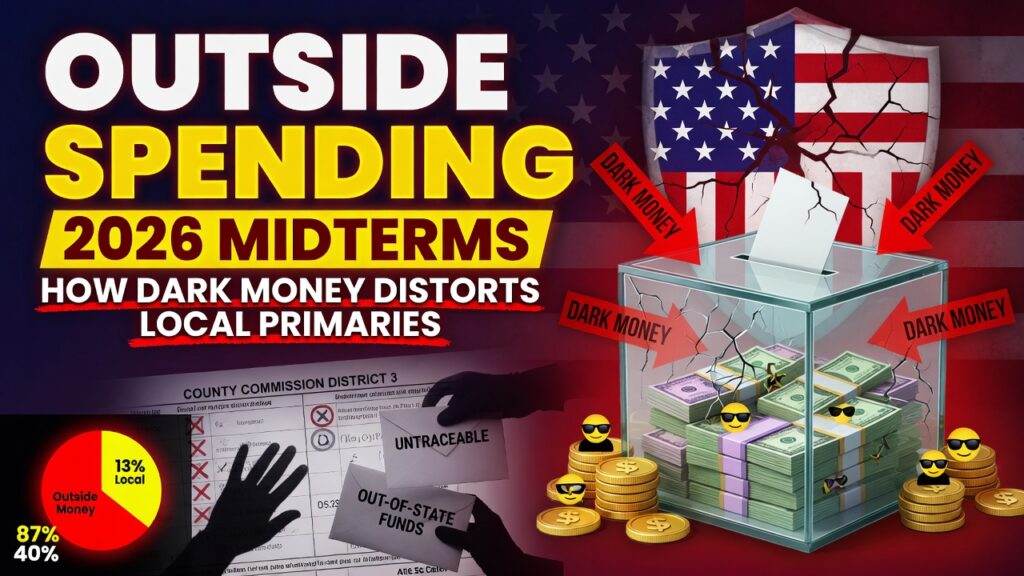
Coordinated special interest operations are pouring unprecedented millions into local primary races, overriding local candidate choices and threatening the core principles of fiscal transparency and community-level representation.
The fundamental promise of American representative democracy is that local communities choose the leaders who best reflect their distinct regional values. When a mother or father steps into a voting booth during a primary election, they expect their vote to carry the weight of their own family’s interests, grounded in principles of personal responsibility, strong community governance, and fiscal accountability. Yet, as the 2026 midterm cycle intensifies, a massive influx of centralized special interest spending is threatening to upend this local autonomy, replacing community-driven consensus with heavily bankrolled national agendas.
The scale of this financial intervention has transformed ordinary congressional primaries into high-stakes proxy wars. Armed with a $100 million war chest entering this election cycle, the American Israel Public Affairs Committee (AIPAC) and its chief campaign vehicle, the United Democracy Project (UDP), have deployed unprecedented capital to reshape the legislative landscape. While every advocacy group possesses the constitutional right to express its views, the targeted nature of these multi-million-dollar blitzes has raised profound concerns across the political spectrum about whether local voters are still the ones steering their own representation.
The Threat to Representative Accountability
When outside entities dump seven-figure sums into compact legislative districts, the primary casualty is local accountability. In a healthy civic culture, representatives answer directly to the families they serve, defending their records on local infrastructure, regional economic health, and the protection of constitutional liberties. Massively funded outside campaigns disrupt this feedback loop by shifting the entire focus of a race toward thematic, distant issues that may have little to do with a community’s daily struggles.
Support Independent Local Journalism
TheTownHall.News is a non-profit reader-supported journalism. Just $5 helps us hire local reporters, investigate important issues, and hold public officials accountable across Alameda County. If you believe our community deserves strong, independent journalism, please consider donating $5 today to support our work.This pattern was starkly evident in the historic Republican primary in Kentucky’s 4th Congressional District. Outside political action committees poured nearly $35 million into a single intra-party contest to unseat incumbent Representative Thomas Massie, establishing it as the most expensive House primary in American history. The United Democracy Project alone contributed over $4.1 million to the effort, while the Republican Jewish Coalition (RJC) Victory Fund added another $3.9 million. By overwhelming local airwaves with aggressive messaging, these groups effectively nationalized a race that should have been an authentic referendum on local leadership and fiscal restraint.
Shifting Focus From Fiscal Responsibility
For voters who prioritize limited government and strict fiscal accountability, the current trend of campaign spending represents a troubling misalignment of priorities. When outside organizations dominate the airwaves, critical discussions regarding national debt, out-of-control federal spending, and localized regulatory relief are frequently crowded out. Instead of debating how to curb inflation or protect taxpayers, candidates are forced to litigate complex foreign policy doctrines that lie far beyond the immediate needs of their constituents.
The sheer volume of capital deployed by centralized entities distorts the organic political process. Representative Massie, a consistent advocate for strict constitutional adherence and fiscal conservation, was largely targeted for his disciplined opposition to foreign aid packages—a stance deeply rooted in traditional conservative principles of domestic fiscal restraint. When outside groups spend millions to punish a lawmaker for prioritizing domestic fiscal discipline, they send a chilling message to other representatives who wish to question massive federal outlays or foreign commitments.
“When outside groups spend millions to punish a lawmaker for prioritizing domestic fiscal discipline, they send a chilling message to other representatives who wish to question massive federal outlays.”
The Erosion of Local Free Speech
Free speech is the lifeblood of a self-governing republic, but its effectiveness relies on an open, transparent marketplace of ideas. When special interest PACs utilize their vast financial superiority, they do not merely participate in the debate—they frequently drown out the organic speech of local citizens and grassroots volunteers. A community’s ability to engage in authentic civic dialogue becomes nearly impossible when a single out-of-state entity controls the vast majority of local advertising space.

Furthermore, investigative reports have highlighted a growing trend toward tactical opacity in these spending operations. Recent analyses show that instead of running advertisements under easily recognizable national brandings, prominent PACs have increasingly routed funds through hyper-local front groups and obscurely named shell organizations. By avoiding direct mention of foreign policy and focusing instead on unrelated domestic grievances, these campaigns effectively obscure the true source of funding until long after the ballots are cast, leaving voters in the dark about who is actually financing the political messaging entering their homes.
Unintended Consequences in the Primary Field
The aggressive deployment of massive outside capital has also demonstrated a recurring tendency to backfire, producing erratic political outcomes that undermine long-term stability. When centralized committees attempt to micromanage local primaries from Washington or New York, they frequently misread the unique cultural dynamics of the districts they seek to influence. This strategic disconnect can fracture stable coalitions and pave the way for highly ideological candidates who do not represent the mainstream views of the community.
A clear example of this occurred earlier this cycle in New Jersey’s Democratic primary, where UDP dropped $2.3 million to oppose former Representative Tom Malinowski over his nuanced stance on foreign aid conditions. This massive financial intervention fractured the moderate voting bloc, inadvertently clearing a direct path for Analilia Mejia—a candidate holding far more progressive, anti-war views—to capture the nomination. A similar dynamic played out in Illinois’s 7th Congressional District, where an aggressive $2.3 million outside push failed to unseat the established local leadership, proving that heavy top-down spending often alienates the very voters it intends to persuade.
Protecting Parental Rights and Family Autonomy
The preservation of traditional civic values requires a political system that respects the role of the family and the authority of parents in guiding their communities. When external political entities attempt to engineer election outcomes, they often bring along cultural and political priorities that clash with local family values. Parents trying to focus on local school board accountability, safe neighborhoods, and community-level economic security find their local media ecosystems saturated with hostile, nationalized attack ads.
Strong families thrive in stable, predictable civic environments where local institutions are responsive to the people who actually live, work, and raise children there. By replacing local volunteers and town-hall style debates with automated text loops and highly polished television attacks, big-money operations erode the face-to-face civic relationships that form the bedrock of local communities. When national entities treat local congressional districts merely as squares on a grand geopolitical chessboard, the immediate concerns of everyday households are inevitably marginalized.
Support Independent Local Journalism
TheTownHall.News is a non-profit reader-supported journalism. Just $5 helps us hire local reporters, investigate important issues, and hold public officials accountable across Alameda County. If you believe our community deserves strong, independent journalism, please consider donating $5 today to support our work.Understanding the Arguments for Robust Political Action
Supporters of extensive PAC operations argue that robust political spending is an essential expression of First Amendment rights and a vital tool for defending core national interests. From this perspective, like-minded citizens have every right to pool their resources to ensure that the U.S. Congress remains firmly committed to key international alliances and strategic security partnerships. Proponents contend that in an era of rising global instability, special interest advocacy serves as a necessary bulwark against candidates who might favor isolationist foreign policies or weaken vital international commitments.
| Campaign Strategic Factors | Traditional Local Model | Modern Super PAC Model |
| Primary Funding Source | Local small donors & regional businesses | Centralized national networks & billionaires |
| Core Message Focus | Regional economy, infrastructure, local values | Single-issue litmus tests & foreign policy |
| Accountability Mechanism | Face-to-face town halls & local constituent services | High-volume media buys & independent expenditures |
| Transparency Level | Direct candidate disclosures | Complex shell networks & delayed FEC filings |
While the constitutional right to combine resources for political advocacy remains a foundational element of American liberty, a critical distinction must be maintained between healthy participation and total financial dominance. When the financial footprint of a single outside entity dwarfs the combined contributions of the actual residents living within a district, the democratic balance is broken. Acknowledging the right to advocate does not mean ignoring the destabilizing impact that absolute financial asymmetry has on the principle of local self-governance.
Restoring Balance to American Civic Life
Resolving the crisis of dark money and top-down political engineering does not require expanding the regulatory power of the federal bureaucracy. Instead, it demands a renewed commitment to the principles of absolute transparency, decentralization, and heightened civic engagement from everyday citizens. True accountability is achieved when voters possess the clear, unvarnished facts about who is funding political speech, allowing them to judge the motives behind the messaging independently.
The solution to overwhelming outside influence lies in the hands of the voters themselves. By actively seeking out independent sources of information, refusing to be swayed by anonymous attack ads, and participating vigorously in local civic organizations, families can reclaim control over their political destiny. When a community stands united on a foundation of shared values, personal responsibility, and constitutional literacy, even the largest special interest war chests lose their power to dictate terms.
Key Takeaways
- Record-Breaking Outlays: Outside spending in the 2026 midterms has reached historic levels, exemplified by a $35 million primary blitz in Kentucky that successfully unseated an incumbent focused on domestic fiscal restraint.
- The Transparency Deficit: Modern PAC strategies increasingly rely on localized shell organizations and front groups, obscuring the true source of campaign funds from local voters.
- Undermining Local Control: Massive top-down financial intervention drowns out local civic discourse, overrides regional priorities, and frequently results in unpredictable political backlash that destabilizes local communities.
Reclaim Your Vote: A Call to Civic Action
The preservation of limited government and local autonomy depends entirely on an informed, active citizenry. As special interest war chests expand, the importance of independent journalism, direct community engagement, and critical thinking has never been more vital.
Stay informed by digging beneath the surface of political advertising, verify the true sources behind the campaigns entering your community, and share this analysis with your neighbors to help protect the integrity of our local elections. Support independent, fact-checked journalism that puts the power back where it belongs: in the hands of American families.