
Ecuador Drug War 2026: US Strikes, Civilian Deaths, and the Dairy Farm Controversy Explained
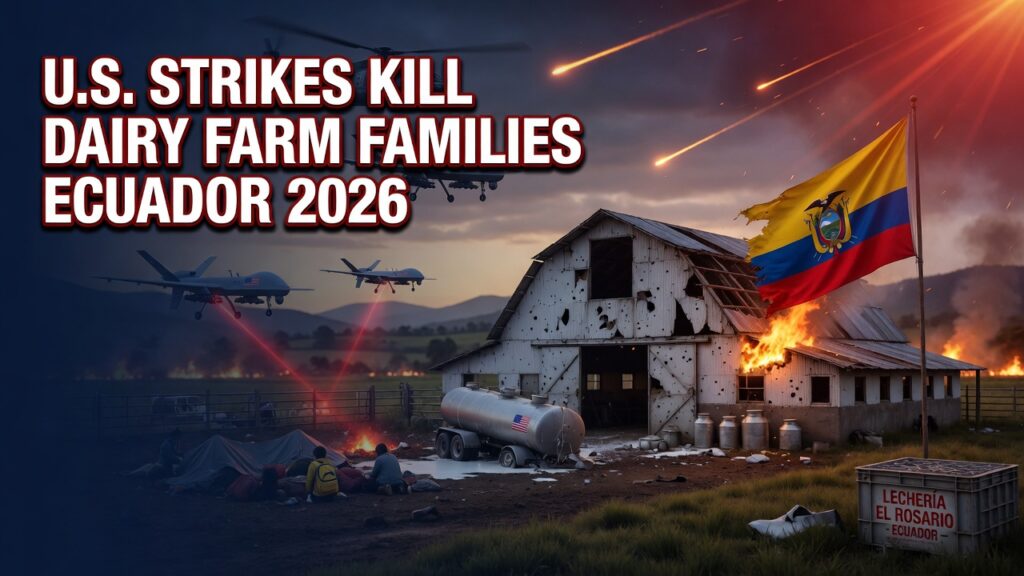
As U.S. military operations in Ecuador expand rapidly, a trail of bombed farms, dead fishermen, and unanswered questions is emerging — and the American public deserves a straight answer.
The war on drugs just crossed a dangerous new line. On March 3, 2026, U.S. and Ecuadorian military forces launched joint operations against what the Pentagon designated as “narco-terrorist organizations” operating inside Ecuador — marking the first time U.S. military forces have engaged in active land operations in South America in this capacity. Defense Secretary Pete Hegseth celebrated the strikes publicly, declaring, “We are bombing Narco Terrorists on land as well,” and promising more to come.
By late May 2026, the death toll from the associated maritime bombing campaign had surpassed 200 people. More than 50 strikes had been carried out against vessels in the eastern Pacific and Caribbean. Some of those killed were confirmed drug smugglers. Others, according to emerging reports from Ecuadorian fishermen, journalists, and independent investigators, were not. The question that every taxpayer, every civic-minded American, and every believer in accountable government should now be asking is simple: who authorized this, who is overseeing it, and who is responsible when it goes wrong?
Support Independent Local Journalism
TheTownHall.News is a non-profit reader-supported journalism. Just $5 helps us hire local reporters, investigate important issues, and hold public officials accountable across Alameda County. If you believe our community deserves strong, independent journalism, please consider donating $5 today to support our work.A “Drug Camp” That Was Actually a Dairy Farm
The story that broke the operation open came not from a whistleblower, but from a New York Times investigation published on March 24, 2026. Reporters traveled to the remote Ecuadorian village of San Martín, where U.S. and Ecuadorian forces had proudly declared the destruction of a “drug trafficker’s training camp.” What they found instead was a cattle and dairy farm — workers, livestock pens, and the ruins of an agricultural operation that local residents and farm employees said had no connection to narcotics.
The U.S. military and the Ecuadorian government have not offered a full retraction or a credible public accounting of the intelligence failure that led to that strike. No senior official has faced consequences.
If a U.S. military strike destroys a family’s dairy farm based on faulty intelligence, and no one is held responsible, what does that say about the standards governing these operations?
This is not a partisan question. It is a basic accountability question — the kind that limited-government conservatives and civil libertarians alike have historically demanded answers to, regardless of which administration is in power.

What Do the Numbers Actually Tell Us?
200+. That is the confirmed death toll from U.S. maritime strikes in the eastern Pacific and Caribbean as of May 31, 2026, according to reporting by the New York Times. The question no administration wants to answer: how many of those 200 were guilty of anything at all?
SOUTHCOM has confirmed more than 50 individual strikes against suspected narco-trafficking vessels. The U.S. military has framed each as a precision operation against designated terrorist networks. But precision requires accurate intelligence — and the dairy farm bombing is a documented, on-the-record example of that intelligence being wrong.
Supporters of the campaign point to real results: drug shipment routes disrupted, cartel infrastructure degraded, and a clear signal sent to criminal organizations operating in the Western Hemisphere. Those outcomes matter. The question is whether the methods being used to achieve them are proportionate, lawful, and subject to the kind of oversight that the American people — and the rule of law — demand.
Are Innocent Fishermen Paying the Price for Washington’s Drug War?
In April and May 2026, Ecuadorian fishing crews began coming forward with accounts that should have dominated headlines. Fishermen described their vessels being attacked at sea by what they identified as U.S. military assets. Some crews were detained. Others described scenes of chaos and terror, with no warning given and no opportunity to identify themselves as civilians.
The Guardian published detailed survivor testimony in April 2026, quoting one fisherman directly: “We were terrified they were going to kill us.” NPR and Brown Public Radio confirmed additional accounts in late May. Ecuador’s government released a survivor from one of the maritime strikes — a man held after his vessel was targeted as a suspected “drug sub.”
Support Independent Local Journalism
TheTownHall.News is a non-profit reader-supported journalism. Just $5 helps us hire local reporters, investigate important issues, and hold public officials accountable across Alameda County. If you believe our community deserves strong, independent journalism, please consider donating $5 today to support our work.When fishermen fear U.S. military drones more than drug cartels, something in the chain of command has broken down.
These are not anti-American claims. These are documented testimonies from ordinary working people caught in the crossfire of a military operation conducted with their tax dollars — Ecuador’s and America’s alike. Personal responsibility is a core civic value. But it cuts both ways: those who wield military power bear a personal and institutional responsibility for the consequences of its use.
What Do Supporters of This Policy Actually Believe?
To be fair, the case for aggressive action in Ecuador is not without merit. Ecuador has experienced a catastrophic collapse in public security over the past several years. Drug cartel violence has transformed cities like Guayaquil into some of the most dangerous urban environments in the Western Hemisphere. Assassinations of presidential candidates, prison massacres, and open gang warfare have overwhelmed local law enforcement and judiciary systems.
Supporters of the U.S.–Ecuador operations argue that conventional law enforcement has failed, that cartel networks operating across Colombia, Bolivia, and Peru use Ecuador as a critical transit hub, and that only a robust military response can meaningfully disrupt supply chains before drugs reach American streets. Defense Secretary Hegseth and SOUTHCOM have both framed the operations as decisive action where diplomacy and policing have stalled.
These are legitimate arguments. No serious observer of Latin American security denies the severity of the cartel threat or the failure of prior anti-drug strategies to produce durable results.
But the existence of a real problem does not grant unlimited authority to address it however officials choose, free from scrutiny. Law and order — one of the foundational civic values that underpins a functioning republic — requires that those enforcing the law be subject to it. An operation that destroys a dairy farm, kills fishermen at sea, and generates a body count of 200+ people, all without a public accounting, is not law and order. It is the exercise of unchecked power. And that is a principle worth defending no matter who is in the Oval Office.
“The question isn’t whether narco-terrorism is a real threat — it is. The question is whether bombing dairy farms and killing fishermen, with no public oversight, is the answer a free people should accept.”
Is This the Accountability Moment We’ve Been Waiting For?
The Manta port fire on June 6, 2026 — in which an accidental welding spark destroyed at least 35 fishing and speedboats, injuring two people — was quickly swept into the viral current of the broader Ecuador narrative. Social media posts falsely attributed the blaze to a U.S. military strike. Fact-checkers confirmed the fire was accidental, most likely ignited during routine maintenance on a docked vessel.
The misattribution matters, because it muddies the water around what is real and documented. When misinformation spreads about an accidental port fire, it actually makes it easier for officials to dismiss legitimate concerns about the actual strikes. Accurate information is the foundation of civic accountability — and every citizen who values free speech and honest public discourse should insist on the distinction.
The real story doesn’t need embellishment. It is documented, verified, and damning enough on its own terms.
If the American government conducted 50+ military strikes that killed 200+ people in a foreign country, and the only detailed public accounting came from foreign journalists and survivor testimonies — would you call that transparency?
Key Questions
- Who authorized the specific targeting criteria used in the U.S.–Ecuador maritime strikes, and has Congress been fully briefed?
- What independent investigation, if any, is being conducted into the bombing of the dairy farm in San Martín, and will affected families receive acknowledgment or compensation?
- At what point does a military campaign with a 200+ death toll and confirmed civilian targeting errors require formal congressional oversight and a public accounting?
What Comes Next — And What You Can Do
The operations in Ecuador are not a closed chapter. SOUTHCOM and the Trump administration have signaled that joint operations will continue and likely expand. The Intercept reported in early March that U.S. officials confirmed this would not be a one-time raid — and since then, events have borne that out.
The real question isn’t whether narco-terrorism in Latin America demands a serious response. It does. The real question is whether the American people — who fund these operations, whose government conducts them, and whose values are being projected across the hemisphere — are going to demand the transparency and accountability that any legitimate use of military force requires.
The closing question every reader should carry forward is this: If 200 people were killed in your name, with your tax dollars, under your flag — wouldn’t you want to know why?
Call to Action
Still have questions about U.S. military operations in Latin America? Stay informed — subscribe for daily fact-checked coverage of the stories that matter.
Think others need to hear this? Share the article and start the conversation.
Want to make your voice count? Contact your congressional representative and ask them directly: has Congress been fully briefed on the scope and rules of engagement governing U.S. military operations in Ecuador? Find your representative at house.gov.