Gaza Funeral Strike: Verified Facts on the Nuseirat Attack
As graphic footage from central Gaza spreads across social media, one question keeps resurfacing: what actually happened at the Nuseirat funeral, and who is verifying either side’s version of events?
A funeral turned into a massacre in seconds. That is how survivors describe the moment an Israeli drone struck a crowd of mourners in central Gaza.
The strike happened on July 17, 2026, outside the Ahmad Yassin Mosque in the Nuseirat refugee camp, more than nine months into a ceasefire that was supposed to have ended exactly this kind of violence. The footage circulating online is graphic, the casualty count is disputed by a matter of degree, and the underlying facts deserve a clear-eyed look before anyone shares another headline.
Where Did the Nuseirat Funeral Strike Actually Happen?
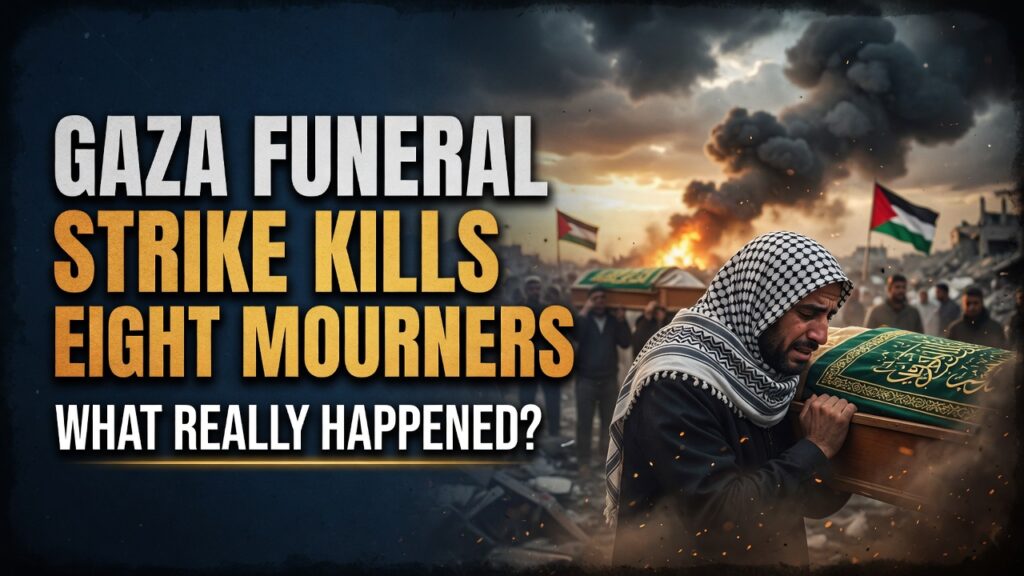
The strike hit a crowd gathered in the Al-Balata market area of the Nuseirat refugee camp in central Gaza. Mourners had assembled outside the Ahmad Yassin Mosque to bury a Palestinian man killed by an earlier Israeli strike that same morning. According to Al-Awda Hospital and Gaza’s civil defense agency, the drone strike hit the procession directly as people were leaving the mosque to begin the burial march.
Al-Awda Hospital reported receiving eight bodies and treating roughly 20 wounded. A handful of outlets cited a figure of seven dead rather than eight, but the hospital-confirmed count of eight killed and 20 wounded is the number that has held up consistently across independent reporting, including Al Jazeera’s coverage sourced to Gaza’s civil defense agency.
Eight mourners buried a neighbor and never made it to the grave. That single sentence captures why this strike, among the dozens reported in Gaza this year, cut through the noise and went viral.
Support Independent Local Journalism
TheTownHall.News is a non-profit reader-supported journalism. Just $5 helps us hire local reporters, investigate important issues, and hold public officials accountable across Alameda County. If you believe our community deserves strong, independent journalism, please consider donating $5 today to support our work.Did Israel Confirm Carrying Out the Strike?
Yes. This is the detail that separates this incident from many unverified viral claims. Israel’s military confirmed carrying out the strike, according to reporting from AFP. That confirmation removes any ambiguity about whether an Israeli strike occurred — the open question is not whether it happened, but why.
What Justification Has Israel Given?
Israel has not released detailed public evidence to support any specific military justification for the Nuseirat strike, and no independent body has verified a claim that the gathering included militant operatives. That absence of substantiation matters. A strike on a funeral procession, without a publicly documented target, is the kind of incident international monitors are specifically designed to investigate — yet no formal investigation has been announced by either the United Nations or independent monitors as of this writing.
Is the Ceasefire Actually Holding?
A ceasefire agreement took effect roughly nine months ago, in October 2025. On paper, it was meant to end large-scale strikes on civilian areas. In practice, Israeli strikes have continued in Gaza on a regular basis since then, according to Al Jazeera’s ongoing coverage of the enclave.
The Nuseirat funeral strike was not an isolated event. It occurred during a 72-hour stretch in which more than 25 Palestinians were reported killed across markets, residential buildings, and displacement tents, according to Gaza’s Government Media Office. If a ceasefire allows dozens of civilian deaths in three days, is it still a ceasefire?
Is a truce that permits eight funeral-goers to be killed by a drone strike really a ceasefire at all?
What Do the Numbers Actually Tell Us?
- That’s the reported death toll across Gaza in the 72-hour window that included the Nuseirat strike, according to Gaza’s Government Media Office. The question that number raises isn’t rhetorical — it’s about accountability structures. Who is tracking ceasefire violations on a rolling basis, and why isn’t that tally reaching the American public with the same speed as viral video clips?
Key Questions This Story Raises:

- Why has no independent international body opened a formal investigation into a strike on a documented funeral procession?
- If Israel has evidence justifying the strike, why hasn’t it been made public nine months into a ceasefire built on transparency commitments?
- What mechanism, if any, actually enforces the Gaza ceasefire when incidents like this keep occurring?
What Does Israel’s Position Actually Rest On?
Supporters of Israel’s continued operations in Gaza argue that Hamas and allied militant factions have a documented history of embedding fighters and operations within civilian gatherings, including funerals, and that Israel has an obligation to strike verified threats regardless of the surrounding crowd. That is a serious argument, and it deserves a direct answer rather than dismissal.
The direct answer is straightforward: no evidence for that specific claim, in this specific case, has been made public. Serious accusations require serious documentation, and international law generally requires that documentation be produced, not merely asserted, especially when the strike lands on a mosque-adjacent funeral procession rather than a fortified position. Until Israel publishes its targeting rationale, the justification remains an assertion, not a verified fact — and that gap is exactly what the public is entitled to ask about.
Why Are So Many People Sharing This Story?
Video and photographs from the aftermath spread rapidly because they show something viewers instinctively understand: a funeral, a mosque, a crowd of grieving neighbors, then chaos. Virality is not the same thing as verification, though, and it’s worth separating the two. Several of the accounts amplifying this story are explicitly partisan advocacy outlets rather than wire services, and their casualty figures, while broadly consistent with hospital data, come wrapped in emotionally loaded language that a fact-based outlet should avoid repeating uncritically.
That does not make the underlying event any less real. Al-Awda Hospital’s numbers, Gaza’s civil defense reporting, and Israel’s own confirmation of the strike are independently corroborated facts. The debate is not over whether the strike happened — it’s over why, and whether anyone with actual enforcement power is going to demand an answer.
What Happens If No One Demands Accountability?
If incidents like Nuseirat go uninvestigated, the ceasefire itself becomes a word without a mechanism behind it. A truce nobody enforces is not peace — it’s a pause with no consequences. That has implications well beyond Gaza: it tests whether internationally brokered agreements carry any operational weight at all, or whether they exist mainly for press releases.
So What Should Readers Actually Take Away From This?
Strip away the emotionally charged framing on both sides, and the verified facts are these: a drone strike killed eight people and wounded roughly 20 during a funeral procession in Nuseirat on July 17, 2026. Israel confirmed the strike. Israel has not publicly documented a justification. No independent investigation has been opened nine months into a ceasefire meant to prevent exactly this kind of incident.
The real question isn’t whether this strike happened — it’s whether anyone with the power to investigate it actually will. Until that changes, expect more viral clips, more disputed death tolls, and no more clarity than we have today.
Still have questions about how this ceasefire is actually being enforced? Stay informed — subscribe for daily coverage. Think others need to see the verified facts instead of just the viral clip? Share this article. Want your voice to count? Contact your congressional representatives and ask what oversight, if any, the United States is exercising over a ceasefire it helped broker.