Krokstadelva Fire: Norway’s Largest Residential Blaze in Decades
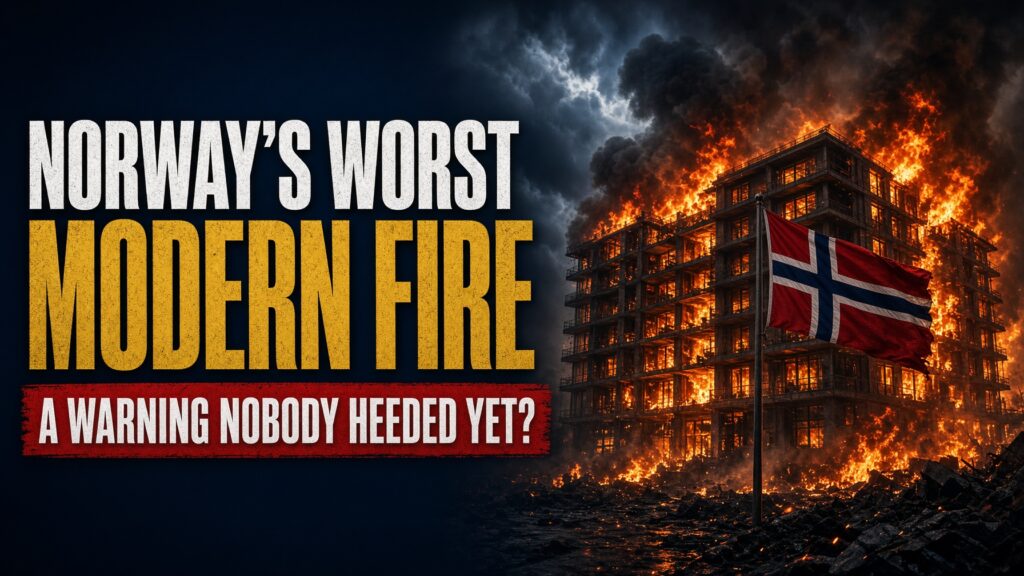
More than 100 homes are gone and hundreds of families are displaced after the largest residential fire in modern Norwegian history — and investigators still can’t say exactly why. One spark. One row house. Over 100 homes gone by nightfall. That is the blunt arithmetic of what happened on July 17, 2026, in Krokstadelva, a suburb of Drammen roughly 34 kilometers southwest of Oslo. A fire that started in a single townhouse tore through the Stenseth housing estate and into surrounding forest, and within hours it had become, by official Norwegian government accounting, the largest residential fire the country has recorded in modern times.
What Actually Happened in Krokstadelva?
The first emergency call came in at 3:35 p.m. local time on a Friday afternoon. Surveillance footage and witness accounts place the first visible smoke just two minutes earlier, and fire crews were on scene within four minutes of the initial report [Krokstadelva fire timeline, Norwegian emergency services]. That speed of response did not stop what came next. Dry vegetation, unusually hot weather, and high winds turned a single-structure fire into a neighborhood-scale disaster in a matter of hours. By nightfall, more than 100 homes were reported completely destroyed. Firefighting crews were pulled in from Drammen, Mjøndalen, Hokksund, Kongsberg, Asker, Bærum, Modum, and Oslo — a mutual-aid response spanning much of southeastern Norway [Drammen kommune, Norwegian fire services].
How Bad Is the Damage, Really?
The final tally, according to Norway’s Directorate for Civil Protection and Emergency Planning (DSB), stands at 116 homes rendered completely uninhabitable and more than 400 residents evacuated. More than 400 Norwegians went from a normal Friday afternoon to a shelter cot by nightfall — how many communities are one dry, windy week away from the same outcome? Initial damage estimates from Norwegian authorities put the cost above 1 billion kroner, or roughly $100 million [Norwegian emergency services estimate]. That figure covers destroyed homes and property but does not yet account for the longer tail of insurance claims, temporary housing, and rebuilding costs that will play out over months, not days.
Support Independent Local Journalism
TheTownHall.News is a non-profit reader-supported journalism. Just $5 helps us hire local reporters, investigate important issues, and hold public officials accountable across Alameda County. If you believe our community deserves strong, independent journalism, please consider donating $5 today to support our work.Who Fought the Fire, and What Did It Take?
This was not a routine structure fire response. Six helicopters and roughly 100 firefighters worked the scene, dropping more than 800,000 liters of water in the effort to contain both the residential blaze and the forest fire it spread into [Norwegian fire service operational reporting]. Norway’s Home Guard (Heimevernet) and Civil Defense (Sivilforsvaret) were also mobilized, alongside police and armed forces support — a scale of civilian-military cooperation rarely seen for a domestic fire. Ground crews used drones and infrared cameras to track hotspots that kept reigniting in the days that followed. Incident commanders warned repeatedly that residual heat made parts of the scene too dangerous even for forensic investigators to enter, delaying the most basic question anyone wanted answered: how did this start?
Why Does Nobody Know What Caused It Yet?
If it takes this long to even determine how a fire like this started, how confident should residents be that the next one can be prevented? That is not a rhetorical jab at Norwegian authorities — it is a fair question raised by their own public statements. Police task force leader Helene Sandquist told reporters investigators could not access the suspected ignition point for days because ground temperatures remained too high for forensic teams to safely examine the scene. On July 21, police confirmed they had questioned a man and formally classified him as a suspect — but officials were explicit that this designation exists to protect the individual’s legal rights during questioning, not because of evidence pointing to arson or any other crime. As of the most recent reporting, police say the fire appears to have been accidental, though a definitive cause has not been announced.
Is a fire this destructive really just bad luck, or a predictable outcome of how closely Norwegian rowhouses are built?
What Does This Say About How Norway Builds Its Neighborhoods?
Local reporting has repeatedly pointed to one structural vulnerability: the tightly spaced, shared-wall construction common to Norwegian rowhouse (rekkehus) communities. When one unit ignites, the physical design that makes these neighborhoods efficient to build also makes them efficient to burn through, especially once wind carries embers from roof to roof faster than crews can establish a containment line. That is not a uniquely Norwegian problem — dense, older housing stock across Europe and North America shares the same vulnerability. But it is a legitimate policy question for local officials now facing the job of rebuilding: do fire-code and spacing standards need a second look before 116 destroyed homes are simply replaced with the same layout that let a single spark become the country’s worst residential fire in a century? 116. That is the number of families whose homes were declared a total loss in a single afternoon — the question now is whether anyone rebuilds differently because of it.
What Do Officials Say Happens Next?
Drammen Fire Chief Torgeir Andersen and incident commander Espen Berge confirmed the fire was brought fully under control on July 21, four days after it began. Some residents were cleared to return home on a gradual, block-by-block basis as safety assessments were completed, though officials stressed those decisions remain conditional and some areas stayed closed. Recovery is now the operative word, not containment. Drammen Municipality has emphasized that reentry decisions will continue to be made based on ongoing safety assessments rather than a fixed timeline, and the criminal investigation into the fire’s origin remains open even after the flames were extinguished.

What Do Defenders of the Emergency Response Actually Believe?
It is worth engaging fairly with the view that Norwegian authorities handled an extraordinary event about as well as could be expected. Supporters of the response point out that firefighters arrived within four minutes of the first call, that no deaths or missing persons were reported despite over 400 evacuees, and that a multi-agency mobilization spanning eight municipalities plus military and civil defense units is not something most countries could organize on short notice. That argument has real merit. A fire of this scale with zero confirmed fatalities is, by any honest measure, a result rather than an accident. But a fast, well-coordinated response to a fire is a different achievement than preventing one, or than being able to explain within days — rather than weeks — how it started. Both things can be true: the emergency response may have been excellent, and the underlying questions about ignition speed, housing density, and forensic access may still deserve real answers. Key Questions This Story Raises:
- What specifically caused a single-structure fire to destroy 116 homes within hours, and when will investigators be able to say for certain?
- Should Norway revisit spacing and fire-code standards for rowhouse developments before rebuilding begins in Krokstadelva?
- How will the roughly $100 million in estimated damage be covered between private insurance and public disaster assistance, and how long will displaced families wait for resolution?
So is this fire simply a freak convergence of dry weather, high wind, and bad timing — or a warning about how modern Norwegian neighborhoods are built that officials will only take seriously after the next one? The honest answer, based on what’s public so far, is that nobody yet knows the cause, and that uncertainty is itself the story. The real question isn’t whether Krokstadelva can be rebuilt — it’s whether it gets rebuilt the same way that let one spark take out 116 homes in an afternoon. Still have questions about how this recovery unfolds? Stay informed — subscribe for daily coverage of accountability and public safety issues here and abroad. Think others need to see how fast this spread? Share this article. Want your voice to count? Contact Norwegian consular or municipal officials directly through Drammen kommune’s public channels to ask what fire-code review, if any, is planned before reconstruction begins.