Iran Peace Talks in Islamabad Collapse After 21 Hours — What Happens Next?
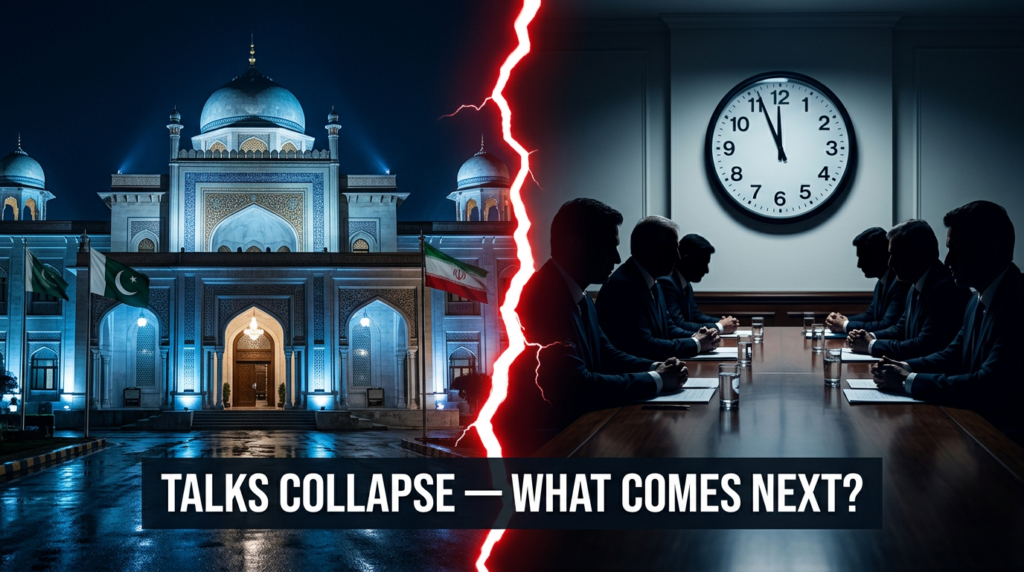
After 21 hours of high-stakes negotiations in Pakistan’s capital, the U.S.–Iran ceasefire framework fell apart. Here’s what the failure reveals about the limits of diplomacy with Tehran — and why American strength remains the world’s most credible deterrent.
When Iran’s Supreme National Security Council released its 10-point proposal to end the war and called for negotiations to begin in Islamabad, many observers dared to hope. Here, at last, was a diplomatic off-ramp — a chance to halt a conflict that had shuttered the Strait of Hormuz, rattled global energy markets, and pushed the Middle East to the brink of a wider conflagration.
That hope lasted less than two weeks.
Support Independent Local Journalism
TheTownHall.News is a non-profit reader-supported journalism. Just $5 helps us hire local reporters, investigate important issues, and hold public officials accountable across Alameda County. If you believe our community deserves strong, independent journalism, please consider donating $5 today to support our work.On April 12, 2026, U.S. Vice President JD Vance, special envoy Steve Witkoff, and senior advisor Jared Kushner walked out of Islamabad after 21 grueling hours of negotiations without an agreement. The ceasefire — brokered with Pakistan’s assistance and announced on April 8 — had bought time, but not peace. Now, with the truce set to expire around April 21–22 and a U.S. naval blockade of Iranian ports already in effect, the world watches to see whether diplomacy still has a role to play — or whether America’s hard line will be the deciding factor.
What Iran Actually Proposed — and Why the Demands Are Maximalist
Iran’s 10-point plan, released by its Supreme National Security Council, was framed as a comprehensive peace blueprint. On paper, it addressed the core concerns of the conflict: an immediate ceasefire, the reopening of the Strait of Hormuz, an end to regional hostilities, the lifting of sanctions, and a commitment by Tehran not to pursue nuclear weapons.
But buried within the proposal were demands that exposed Tehran’s true negotiating posture. Iran called for the full payment of war reparations — a demand U.S. officials flatly rejected. It demanded the cessation of war not just in Iran but also in Iraq, Lebanon, and Yemen, effectively tying Washington’s hands across the entire region. And it insisted on an immediate ceasefire on all fronts, with no phased process, no verification mechanism, and no enforceable concessions on its nuclear program beyond a vague non-pursuit pledge.
These are not the terms of a nation seeking peace. They are the opening bids of a regime that has spent decades probing the boundaries of Western resolve.

The Ceasefire That Wasn’t
To its credit, the Trump administration pursued diplomacy first. After Pakistan submitted a bridging proposal that salvaged talks before a critical U.S. deadline, Washington agreed to a two-week ceasefire on April 8, halting strikes against Iran in exchange for a temporary reopening of the Strait of Hormuz.
The problem? The Strait never fully reopened.
Iranian forces had planted mines throughout the waterway — and according to multiple reports, Iran had lost track of some of them. The U.S. Navy was forced to begin mine-clearing operations while only a trickle of vessel traffic moved through. To compound matters, Iran began charging transit tolls reportedly exceeding $1 million per ship — a de facto economic stranglehold dressed up as open navigation.
This is the pattern with Tehran: make a concession in principle, then ensure it costs nothing in practice.
Twenty-One Hours, Zero Progress
The Islamabad talks were the most significant diplomatic engagement between Washington and Tehran in years. Vice President Vance led the U.S. delegation, sitting across from Iranian Foreign Minister Abbas Araghchi and Parliament Speaker Mohammad Bagher Ghalibaf. By any measure, these were serious people with serious mandates.
Support Independent Local Journalism
TheTownHall.News is a non-profit reader-supported journalism. Just $5 helps us hire local reporters, investigate important issues, and hold public officials accountable across Alameda County. If you believe our community deserves strong, independent journalism, please consider donating $5 today to support our work.Yet after 21 hours, they produced nothing.
Iranian officials cited “significant gaps on major issues” and a failure by the U.S. to “win Iranian trust.” That framing deserves scrutiny. What Iran calls a trust deficit is, in plain terms, an expectation that the United States capitulate on reparations, sanctions, and regional influence before Tehran offers anything meaningful in return.
America does not owe Iran trust. Iran must earn it — through verifiable actions, not diplomatic theater.
For taxpayers who fund America’s military operations and bear the economic consequences of a disrupted Strait of Hormuz, this distinction matters enormously. Fiscal accountability starts with refusing to reward bad-faith negotiation with unilateral concessions.
The Real Economic Stakes: Strait of Hormuz and Global Markets
The closure of the Strait of Hormuz since February 28, 2026 — when Iran shut it following the outbreak of the war — has had immediate and serious consequences for global energy markets. The Strait is one of the world’s most critical oil transit chokepoints, with roughly 20–21% of global petroleum trade passing through it under normal conditions.
A prolonged closure doesn’t merely spike oil prices at the refinery level. It drives up costs across entire supply chains, hits American families hard at the pump, and disproportionately burdens working and middle-class households — the people least insulated from energy market shocks and least able to absorb sudden price volatility.
Fiscal accountability demands we acknowledge this plainly: the cost of Iran’s strategic obstruction is being paid by ordinary citizens worldwide, not by the Iranian regime or its proxy networks.
What Critics Get Wrong About Diplomacy with Tehran
Some voices in foreign policy circles have argued that America’s tough posture — including the naval blockade of Iranian ports ordered by President Trump on April 13 — is counterproductive and risks further escalation. The argument follows a familiar script: more engagement, more concessions, more goodwill gestures will bring Tehran to the table in good faith.
History says otherwise.
Iran closed the Strait, unleashed proxies across the region, demanded war reparations, and still walked away from 21 hours of direct talks without an agreement. The IRGC Navy warned that any military vessel approaching the Strait would meet a “severe response” — even as Tehran publicly claimed to seek peace. Gulf states including Kuwait, the UAE, Bahrain, Qatar, and Saudi Arabia intercepted dozens of Iranian drone and missile attacks on April 8 alone — the same day the ceasefire was formally announced.
Diplomacy functions when both parties have something to lose. Concession works when it is mutual and verified. Neither condition has been met here.
Israel, Lebanon, and the Ceasefire’s Fractured Edges
The ceasefire’s collapse was not limited to the negotiating table. Both the United States and Israel asserted from the outset that the ceasefire did not cover Lebanon. On April 8 — the same day the ceasefire was declared — Israel launched Operation Eternal Darkness, conducting 100 airstrikes in 10 minutes against Hezbollah assets in Lebanon.
Iran’s proxies responded in kind. Hezbollah claimed responsibility for rocket attacks on northern Israel on April 9 and 10, citing Israeli violations in Lebanon as justification for abandoning its own restraint.
For those who believe law and order must underpin any durable international agreement — that commitments must mean something — this pattern of proxy warfare, selective compliance, and preemptive carve-outs is deeply troubling. It underscores why verification, not goodwill, must be the foundation of any lasting deal with Tehran.
Key Takeaway
Iran entered these talks with maximalist demands, a Strait still laced with uncharted mines, and proxy forces still firing across multiple fronts. The Islamabad talks collapsed after 21 hours. A U.S. naval blockade is now in effect. The ceasefire expires around April 21–22, and no framework agreement is in place.
The lesson is not that diplomacy failed — it’s that diplomacy requires a willing partner. Iran has yet to prove it is one.
What Comes Next — and Why Every American Should Be Paying Attention
A second round of U.S.–Iran dialogue is reportedly being discussed. Analysts warn that if it also fails, the options narrow significantly and the risks multiply. Full escalation would carry enormous human, financial, and strategic costs that no responsible policymaker should welcome.
But the alternative — a deal that rewards Iran’s intransigence, legitimizes its proxy network, and leaves the Strait of Hormuz vulnerable to future coercion at will — is no solution at all. It is simply a delayed and more expensive crisis.
American strength, clear and non-negotiable red lines, and sustained multilateral pressure remain the most credible path toward a negotiated settlement that can actually hold. The Trump administration’s decision to walk away from a bad deal in Islamabad was not a failure of diplomacy. It was diplomacy functioning exactly as it must when one side refuses to negotiate in good faith.
Personal responsibility, civic accountability, and respect for law are not just domestic values. They are the principles that distinguish durable international agreements from diplomatic theater. The world needs more of the former — and a great deal less of the latter.
Stay Informed. Stay Engaged.
This story is developing rapidly. The ceasefire window is closing, a second round of talks may be imminent, and the global economic stakes could not be higher.
Share this article with someone who needs the full, unfiltered picture. Follow independent journalism that puts verified facts ahead of political convenience. And engage in the civic conversation — because what happens in the Strait of Hormuz affects the price you pay for everything from groceries to gasoline.
Informed citizens are the foundation of accountable government. Don’t let the noise drown out the signal.