Mount Lewotobi Eruption: Inside Indonesia’s Year of Nonstop Ash
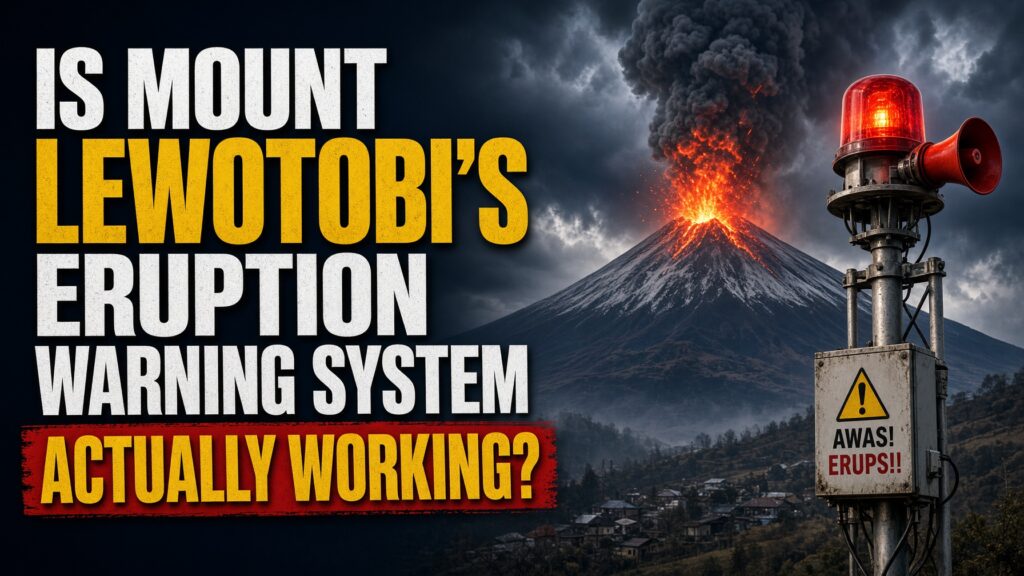
As Indonesia’s most active volcano fires its ninth eruption in a single week, residents, travelers, and disaster officials are asking the same question — is anyone actually staying ahead of Mount Lewotobi, or just reacting to it?
Nine eruptions in seven days is not a warning. It is a pattern already underway.
Mount Lewotobi Laki-laki, on Indonesia’s Flores Island, erupted again at 7:35 a.m. local time on Friday, August 28, 2026, sending an ash column roughly one kilometer above its peak. The eruption came less than 24 hours after a far stronger blast on Thursday, August 27, that sent ash 2,500 meters skyward. Together they mark the volcano’s ninth and eighth eruptions in a single week — and its 778th of the year so far, according to Indonesia’s MAGMA monitoring platform.
Support Independent Local Journalism
TheTownHall.News is a non-profit reader-supported journalism. Just $5 helps us hire local reporters, investigate important issues, and hold public officials accountable across Alameda County. If you believe our community deserves strong, independent journalism, please consider donating $5 today to support our work.What Actually Happened This Week?
Thursday’s eruption, at 8:30 a.m. local time, registered a seismograph amplitude of 47.3 millimeters — roughly three times the energy of Friday’s follow-up event. Ash drifted southwest and west over East Flores Regency. Friday’s eruption was smaller by comparison, lasting about six minutes with a lower amplitude of 14.8 millimeters, but it still sent thick gray ash toward the same populated corridor.
Indonesia’s Geological Agency has kept Mount Lewotobi Laki-laki at Level III, or “Siaga” (Alert) — the second-highest of the country’s four-tier volcano warning scale — since May 12, 2026. That followed months of relative quiet after activity moderated in early 2026. Officials say the return to elevated seismicity in May resembled the precursor signals seen before the volcano’s deadliest eruption in November 2024.
Why Does One Volcano Erupt This Often?
Mount Lewotobi sits directly on the Sunda Arc, the volcanic chain running from Sumatra through Flores where the Indo-Australian tectonic plate subducts beneath the Eurasian plate. That geology makes sustained, high-frequency eruptions the norm rather than the exception here. In 2026 alone, the volcano ranks as Indonesia’s second most active, trailing only Mount Semeru’s 1,704 recorded eruptions nationwide.
A single volcano has erupted 778 times this year — and most Americans have never heard its name. That is not a knock on the coverage. It is a reminder of how much of the world’s genuine, ongoing disaster risk unfolds far outside the headlines most outlets chase.

What Is the Real Danger Right Now?
Ash alone rarely kills. What officials are watching more closely is what happens after the ash falls. Indonesian authorities have issued specific lahar warnings — the volcanic mudflows that form when heavy rain mixes with loose ash deposits on Lewotobi’s steep slopes — for eight named river systems, including Dulipali, Padang Pasir, and Nobo. Those flows have historically posed as much danger to nearby villages as the eruptions themselves.
PVMBG, Indonesia’s volcanology agency, has maintained a 5-kilometer exclusion zone around the crater and is directing residents to avoid unverified information and follow official guidance from the local monitoring post. That instruction matters more than it sounds. During past eruptive phases at Lewotobi, rumor and panic have complicated evacuations as much as the ash itself.
Has This Volcano Killed Before?
Yes, and recently. In November 2024, a powerful eruption at Mount Lewotobi Laki-laki killed at least 10 people, including a nun who was reportedly overtaken by ash while fleeing her convent in Hokeng village. More than 10,000 people were affected, hundreds of homes were damaged or destroyed by fire, and the alert level was raised to Level IV — the highest tier — for the first time in years.
Is a five-kilometer exclusion zone enough when the last major eruption killed people who thought they had already fled far enough?
That 2024 disaster is the backdrop against which every current warning has to be read. PVMBG has been explicit that this year’s rising seismicity “resembled the precursors” to that deadly episode. Whether that comparison is prudent caution or genuine imminent risk is exactly the kind of judgment call disaster agencies are paid to get right — and one the public has no way to independently verify in real time.
Is the Warning System Actually Keeping Up?
778 eruptions. One volcano. The question worth asking is whether any warning system can realistically stay ahead of that pace, or whether residents are being asked to live with a permanent, rolling state of alert. To PVMBG’s credit, the agency has adjusted the alert level twice this year already — raised in May after a genuine spike in seismic and ground-deformation data, following a period when it had been lowered in early 2026 as activity cooled.
Support Independent Local Journalism
TheTownHall.News is a non-profit reader-supported journalism. Just $5 helps us hire local reporters, investigate important issues, and hold public officials accountable across Alameda County. If you believe our community deserves strong, independent journalism, please consider donating $5 today to support our work.That responsiveness is real. But a Level III alert that has now persisted for more than three months, through dozens of individual eruptions of wildly varying intensity, raises a fair question about whether a four-tier system built for discrete eruptive events is the right tool for a volcano that barely stops erupting at all.
What Do Defenders of the Current System Actually Believe?
Volcanologists and disaster officials make a reasonable case here, and it deserves a fair hearing rather than dismissal. They argue that Lewotobi’s alert levels are calibrated to instrumented, measurable precursors — seismic amplitude, ground inflation, gas emissions — not guesswork, and that raising or lowering the exclusion zone too frequently would itself erode public compliance over time.
There is real merit to that argument. A warning system that cries wolf on every minor ash puff risks the same failure as one that stays silent too long: residents stop listening. PVMBG’s decision to hold at Level III through a range of eruption sizes, rather than whipsawing the public with constant level changes, reflects a genuine tradeoff between precision and public trust. But that tradeoff still leaves an open question for the families living inside the exclusion zone: how do you plan a normal life around a threat that has no clear end date?
2,500 meters. That’s how high Thursday’s ash column climbed above the summit — the question local officials still can’t answer is which eruption, out of hundreds so far this year, will be the one that matters.
Key Questions This Story Raises:
- With 778 eruptions recorded in a single year, is Indonesia’s four-tier alert system still the right framework for a volcano in near-constant activity?
- Could the lahar risk from accumulated ash on Lewotobi’s slopes ultimately prove more dangerous to nearby villages than the eruptions that caused it?
- What obligation, if any, do international carriers and travel platforms have to proactively warn passengers before booking flights near an active exclusion zone?
What Happens Next for Flores Island?
For now, life around Mount Lewotobi continues inside the boundaries PVMBG has drawn. Fishing, farming, and daily commerce carry on outside the 5-kilometer zone, even as ash columns rise on an almost weekly basis. Airlines serving Flores and nearby Bali routes continue to monitor the Darwin Volcanic Ash Advisory Center’s bulletins, since past eruptions here have grounded dozens of flights in a single day when ash drifted into flight corridors.
The honest answer is that no one — not PVMBG, not the residents of East Flores, not the airlines rerouting around the ash — knows exactly when this eruptive phase ends. What is verifiable is the record so far: a volcano that has erupted nearly 800 times in eight months, a warning system stretched to interpret that pace in real time, and a death toll from 2024 that proves the stakes are not theoretical.
So is Mount Lewotobi’s warning system actually working, or is it simply the best available answer to a volcano that refuses to follow a predictable schedule? The honest answer may be both at once. The real question isn’t whether officials are watching — it’s whether watching closely enough is even possible when the mountain itself won’t stop.
Still have questions about how this story develops? Stay informed — subscribe for daily coverage of the international stories others overlook. Think your community needs to see how quickly a warning system gets tested in the real world? Share this article. Want to help directly? Consider a donation to a vetted disaster relief organization operating in East Nusa Tenggara, such as the Indonesian Red Cross (PMI), which coordinates directly with displaced families near active exclusion zones.