
Iran Boeing 737 Incident: Tire Failure Exposes Aging Fleet
Viral video showed a cabin ceiling collapsing mid-flight over Iran. As the clip races across social media, the real question isn’t about Boeing — it’s about who has been flying passengers on borrowed time for years.
A ceiling panel does not fall on its own. Something upstream already failed.
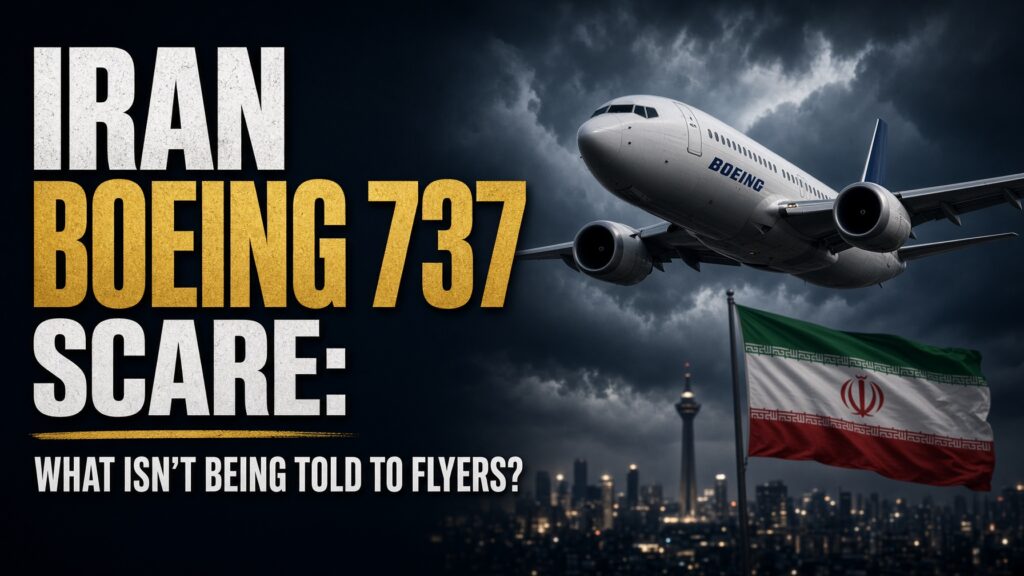
That’s what happened aboard a Sepehran Airlines Boeing 737 on September 15, 2026, when a tire reportedly came apart shortly after takeoff from Mashhad, Iran, triggering engine trouble and violent shaking that tore loose interior panels above passengers’ heads. The footage went viral within hours, and so did a wave of misleading captions claiming the plane itself had “broken apart” mid-air. It hadn’t. But the real story is arguably more alarming than the fake one.
Support Independent Local Journalism
TheTownHall.News is a non-profit reader-supported journalism. Just $5 helps us hire local reporters, investigate important issues, and hold public officials accountable across Alameda County. If you believe our community deserves strong, independent journalism, please consider donating $5 today to support our work.What Actually Happened Aboard the Flight?
Sepehran Airlines Flight bound for Kermanshah turned back to Mashhad minutes after departure when a wheel tire reportedly detached, according to CNN-News18 and multiple aviation outlets [wire-confirmed]. The resulting engine strain sent severe vibrations through the airframe, dislodging cabin ceiling panels and overhead bins onto passengers below. Video captured people praying, screaming, and ducking as debris fell into the aisle. The pilots landed the aircraft safely at Mashhad. No injuries were reported, and passengers were transferred to another plane to complete their trip [wire-confirmed].
Was This Really a Boeing Failure — Or Something Else?
Here’s where the viral framing breaks down. Nothing in confirmed reporting describes the fuselage itself splitting open or structural airframe failure — the damage was to interior cabin lining and overhead compartments, triggered by a tire and engine malfunction, not a manufacturing collapse of the plane’s body [aviation trade reporting]. Boeing’s name drives clicks, but this was an aging aircraft operated and maintained by an Iranian carrier under Iranian regulatory oversight, not a defect traced to Boeing’s factory floor. Conflating the two lets the actual responsible parties off the hook.
A tire blowout that shakes loose a ceiling panel is a maintenance and oversight failure, not a design flaw in an airplane built decades ago.
Why Are Passengers Still Flying on Decades-Old Jets?
Iran’s civil aviation fleet has operated for years under the weight of U.S. and international sanctions that restrict Iranian carriers’ access to new Boeing and Airbus aircraft and, critically, to genuine replacement parts [industry reporting]. The result, documented repeatedly by aviation analysts, is a fleet kept airborne through improvisation — used parts, extended service life, and maintenance workarounds that would not pass muster in most Western regulatory systems. Sepehran Airlines flies the largest Boeing 737 fleet in Iran, a dozen aircraft in total, according to airline records [company data].

Twelve. That’s the entire fleet keeping thousands of Iranian travelers airborne every week — the question no one in Tehran wants to answer is how many of those twelve are one worn tire away from the next viral video.
Who Is Accountable When the Regulator Answers to the Regime?
This is not Sepehran’s first brush with trouble at Mashhad. Newswire reporting describes this as the airline’s second recent incident at that airport alone [wire-confirmed]. In a functioning oversight system, a pattern like that triggers grounded aircraft, public investigations, and consequences for operators who cut corners. Iran’s Civil Aviation Organization has opened a formal investigation and briefly closed the runway for inspection [wire-confirmed] — a start, but a government aviation regulator answering to an authoritarian state has little independent incentive to publish findings that embarrass state-linked carriers.
Is it really an accident when a government has spent years choosing to keep unsafe planes flying rather than fixing the system underneath them?
How Did the Real Story Get This Distorted?
The clip attributed to “Brics News” framed the incident as proof of “unipolar aviation standards” failing against a rising multipolar order — a geopolitical spin with no basis in the underlying reporting. That framing did not originate with credible aviation journalism; it was layered on top of a real safety incident to serve an unrelated narrative. Outlets covering the story accurately — including aviation trade press and wire services — consistently described a tire and engine malfunction, not a structural aircraft failure or a referendum on Western manufacturing [aviation trade reporting].
If a video can travel the globe in hours while the actual cause takes days to confirm, who is actually responsible for the truth reaching people first?
What Do Defenders of the Sanctions Policy Actually Believe?
Supporters of continued sanctions pressure on Iran make a serious argument worth engaging directly: the sanctions exist to limit the regime’s access to resources, including aviation technology with potential dual-use applications, and loosening them for humanitarian carve-outs risks being exploited by the same government they’re meant to pressure. That’s a defensible national security position, not a cynical one.
Support Independent Local Journalism
TheTownHall.News is a non-profit reader-supported journalism. Just $5 helps us hire local reporters, investigate important issues, and hold public officials accountable across Alameda County. If you believe our community deserves strong, independent journalism, please consider donating $5 today to support our work.But it doesn’t answer the accountability question raised here. The sanctions regime constrains what parts Iran can legally buy — it does not force Tehran to keep flying aircraft past safe service limits instead of investing in safer alternatives or grounding fleets that can’t be properly maintained. Those are choices a government makes, not an inevitability sanctions dictate alone.
Why Does This Still Matter to Ordinary Travelers?
Nobody aboard that flight chose to be a test case for a sanctions-era maintenance shortfall. They boarded a scheduled domestic flight expecting the basic safety guarantee every passenger is owed anywhere in the world. When ceiling panels come down on people’s heads and the closest thing to accountability is a state-run investigation into a state-linked carrier, the promise of independent oversight starts to look thin. That gap between what passengers are owed and what a government-controlled system actually delivers is the real story here — not a Boeing engineering failure, but a regulatory failure with a regime’s fingerprints on it.
Passengers who boarded a routine domestic flight ended up filming a ceiling collapse — and the airline’s own government is the one investigating itself. International travelers connecting through the region deserve to know that oversight, not luck, kept that flight from ending far worse.
Key Questions This Story Raises:
- Why does Sepehran Airlines’ Boeing 737 fleet keep experiencing incidents at the same airport, and what has Iran’s aviation regulator done about the pattern?
- Is it accurate — or just convenient virality — to frame a maintenance failure on an aging Iranian-operated aircraft as a “Boeing” story?
- If sanctions restrict access to safety parts, does that excuse a government from prioritizing air safety over other spending, or does it just explain the excuse offered?
So is this really a story about Boeing, or about a system that has let an aging, sanctions-strained fleet keep flying passengers who have no real say in the matter? The plane landed safely this time. The real question isn’t whether Boeing built a bad airplane — it’s whether anyone with the power to ground an unsafe fleet is actually willing to do it before the next video goes viral.
Still have questions about what’s really happening in global aviation safety? Stay informed — subscribe for daily coverage of accountability stories that cut through viral misinformation. Think others need to see what actually happened on that flight? Share this article. Want your voice to count? Contact the International Civil Aviation Organization or your own country’s aviation regulator and ask what independent safety audits, if any, apply to sanctioned foreign carriers flying into international airspace.